 English
 Afrikaans
 Albanian
 Amharic
 Arabic
 Armenian
 Azerbaijani
 Basque
 Belarusian
 Bengali
 Bosnian
 Bulgarian
 Catalan
 Cebuano
 Chichewa
 Corsican
 Croatian
 Czech
Czech Danish
 Dutch
Dutch Esperanto
 Estonian
 Filipino
 Finnish
 French
 Frisian
 Galician
 Georgian
 German
 Greek
Greek Gujarati
 Haitian Creole
 Hausa
Hausa Hawaiian
 Hebrew
 Hindi
Hindi Hmong
Hmong Hungarian
 Icelandic
 Igbo
Igbo Indonesian
 Irish
Irish Italian
 Japanese
 Javanese
 Kannada
 Kazakh
 Khmer
Khmer Korean
 Kurdish (Kurmanji)
 Kyrgyz
 Lao
Lao Latin
Latin Latvian
 Lithuanian
 Luxembourgish
 Macedonian
 Malagasy
 Malay
Malay Malayalam
 Maltese
 Maori
Maori Marathi
 Mongolian
 Myanmar (Burmese)
 Nepali
 Norwegian
 Pashto
 Persian
 Polish
 Portuguese
 Punjabi
 Romanian
 Russian
 Samoan
 Scottish Gaelic
 Serbian
 Sesotho
 Shona
Shona Sindhi
 Sinhala
 Slovak
 Slovenian
 Somali
 Spanish
 Sudanese
 Swahili
 Swedish
 Tajik
Tajik Tamil
Tamil Telugu
 Thai
Thai Turkish
 Ukrainian
 Urdu
Urdu Uzbek
Uzbek Vietnamese
 Welsh
Welsh Xhosa
Xhosa Yiddish
 Yoruba
 Zulu
Zulu
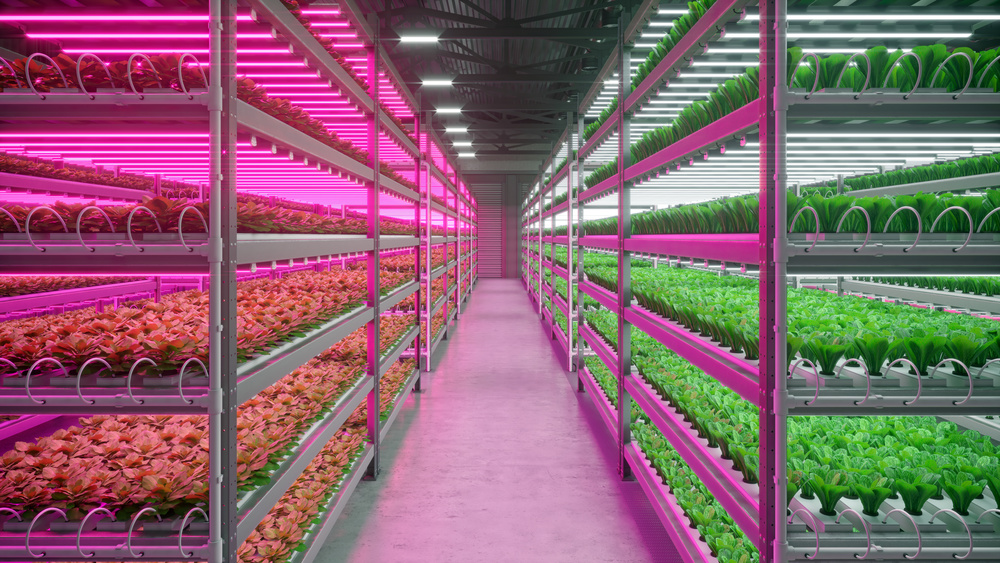



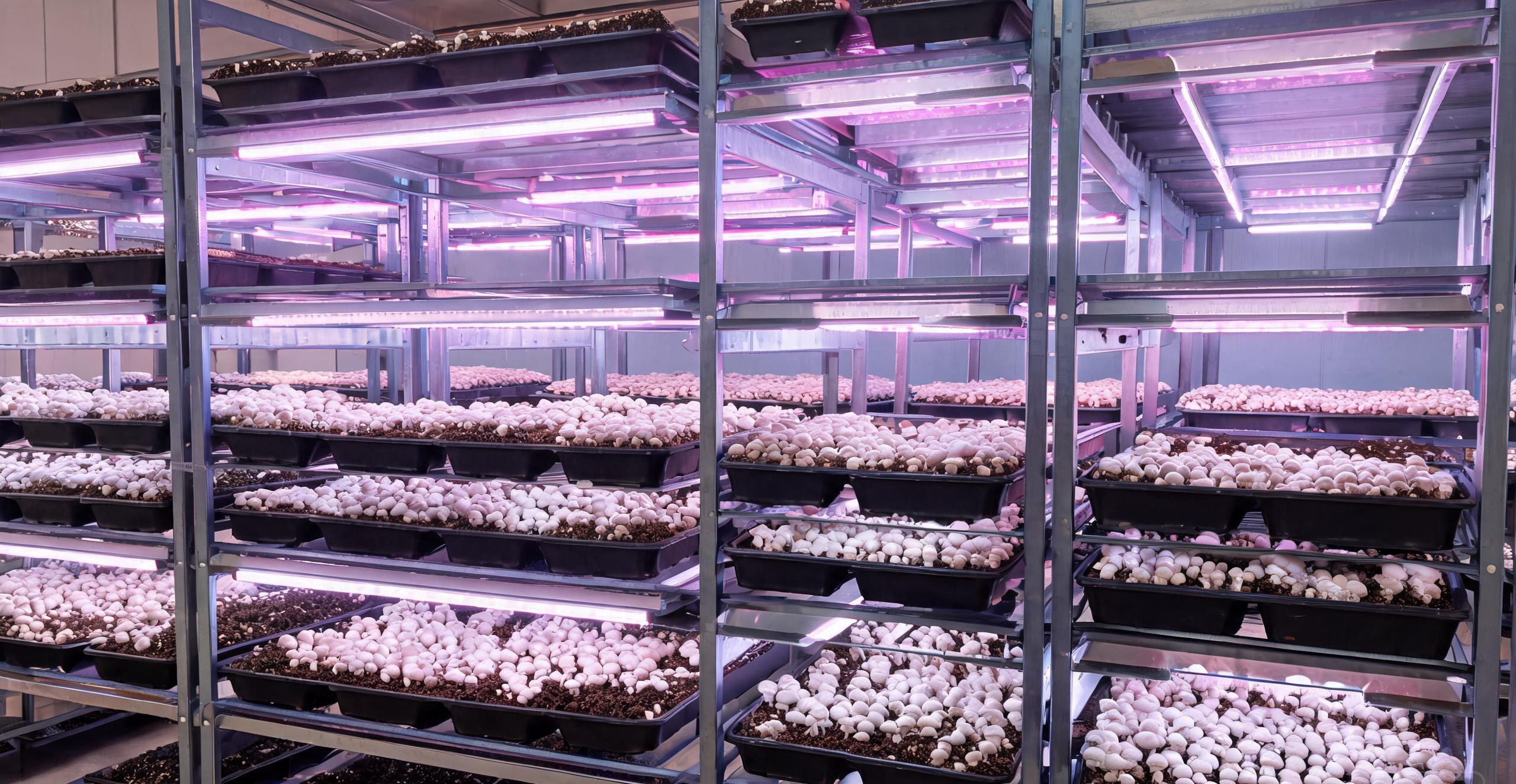
Mushrooms don’t photosynthesize — light is a developmental signal, not an energy source. Getting that signal wrong costs yield and quality. This project shows how blue-rich LED spectrum control synchronized pinning across an oyster mushroom farm’s growing rooms and cut lighting energy by 45%.
Application Background
An oyster mushroom farm operating twelve indoor growing rooms was scheduling its crops around an unreliable light regime. The rooms ran on fluorescent tubes installed for “some light during fruiting,” with no spectrum or timing strategy:
- Uneven pinning — fruiting bodies initiated at different times across the room, forcing multiple harvest passes per rack and adding labor to every cycle
- Crooked stipes and small caps appeared wherever light came from one direction only, downgrading clusters out of the premium packaging grade
- Fluorescent heat warmed the substrate near fixtures, pushing microclimate temperatures above the optimum band and forcing extra ventilation
- Energy was being wasted on intensity levels the crop never needed — mushrooms require far less light than photosynthetic crops
Engineering Challenge
Fungal photobiology dictates a completely different lighting design from plant horticulture:
- In oyster mushrooms, blue light (~450nm) is the dominant developmental signal — it triggers pin initiation and steers stipe elongation and cap development, while red spectrum contributes comparatively little
- Required intensity is low — on the order of 20–50 µmol/m²/s — so the design goal is spectral precision and uniformity, not raw PPF
- Directional coverage from both rack faces prevents the one-sided growth that single-row overhead lighting causes
- Stage timing matters: spawn run wants darkness, pinning wants the blue signal applied consistently, and holding the spectrum stable through fruiting keeps development synchronized — the lighting plan needed dimming and scheduling, not a fixed burn
- High-humidity rooms (RH > 85%) demand moisture-protected luminaires rated for the growing environment
Solution & Key Components
Queendom supplied dimmable, blue-weighted LED grow tubes in a two-channel layout per rack:
| Parameter | Value | Design Note |
|---|---|---|
| Spectrum | Blue-weighted, peak ~450 nm | Matches the pinning and morphology signal |
| Intensity at substrate | 20–50 µmol/m²/s, dimmable | Mushrooms need signal, not energy |
| Uniformity target | > 80% across rack faces | Two-sided layout eliminates one-sided growth |
| Photoperiod control | Scheduled per growth stage | Dark spawn run → blue-on pinning → fruiting hold |
| Thermal footprint | Negligible at operating dim levels | No substrate warm-up near fixtures |
| Environment rating | Moisture-protected tube body | Survives RH > 85% growing rooms |
Integration notes for growers: tubes mount vertically at rack ends and along both aisle faces, and the dimming schedule runs from the same controller that manages room climate — spawn-run darkness needs no lighting action, then the blue channel ramps to the pinning setpoint and holds through fruiting.
Results
With pinning synchronized by a consistent blue signal from both rack faces, each rack now clears in a single harvest pass, and the premium packaging grade share rose with the drop in crooked clusters. Substrate temperature also settled into the optimal band once fluorescent heat left the equation, reducing ventilation load.
Recommended Products
Frequently Asked Questions
How much light do mushrooms actually need?
Very little. Photosynthetic crops measure light in hundreds of µmol/m²/s; mushrooms develop well at 20–50. Over-lighting wastes energy without improving the crop — the value sits in spectrum quality, uniformity, and timing, not intensity.
Is one spectrum right for every mushroom species?
No. Oyster mushrooms respond strongly to blue light for pinning and morphology. Other commercially grown species have different — and sometimes much weaker — light responses, and a few specialty varieties want specific spectral cues. Mixed-species farms do best with adjustable spectrum fixtures and a per-room schedule.
Why does the LEDs’ low heat matter in a mushroom room?
Fruiting substrate has a narrow optimal temperature band. Fluorescent fixtures radiate heat that warms nearby substrate, pushing it out of band and forcing extra ventilation to compensate. LED tubes at mushroom dim levels add negligible heat, so the climate system controls temperature without fighting the lighting.