
 English
 Afrikaans
 Albanian
 Amharic
 Arabic
 Armenian
 Azerbaijani
 Basque
 Belarusian
 Bengali
 Bosnian
 Bulgarian
 Catalan
 Cebuano
 Chichewa
 Corsican
 Croatian
 Czech
Czech Danish
 Dutch
Dutch Esperanto
 Estonian
 Filipino
 Finnish
 French
 Frisian
 Galician
 Georgian
 German
 Greek
Greek Gujarati
 Haitian Creole
 Hausa
Hausa Hawaiian
 Hebrew
 Hindi
Hindi Hmong
Hmong Hungarian
 Icelandic
 Igbo
Igbo Indonesian
 Irish
Irish Italian
 Japanese
 Javanese
 Kannada
 Kazakh
 Khmer
Khmer Korean
 Kurdish (Kurmanji)
 Kyrgyz
 Lao
Lao Latin
Latin Latvian
 Lithuanian
 Luxembourgish
 Macedonian
 Malagasy
 Malay
Malay Malayalam
 Maltese
 Maori
Maori Marathi
 Mongolian
 Myanmar (Burmese)
 Nepali
 Norwegian
 Pashto
 Persian
 Polish
 Portuguese
 Punjabi
 Romanian
 Russian
 Samoan
 Scottish Gaelic
 Serbian
 Sesotho
 Shona
Shona Sindhi
 Sinhala
 Slovak
 Slovenian
 Somali
 Spanish
 Sudanese
 Swahili
 Swedish
 Tajik
Tajik Tamil
Tamil Telugu
 Thai
Thai Turkish
 Ukrainian
 Urdu
Urdu Uzbek
Uzbek Vietnamese
 Welsh
Welsh Xhosa
Xhosa Yiddish
 Yoruba
 Zulu
Zulu



Classroom Lighting Design Guide
Professional lighting design for educational environments — covering illuminance standards, glare control, color temperature selection, circadian lighting, and energy-efficient LED solutions for classrooms.
1. Introduction to Classroom Lighting Design
Classroom lighting has a profound impact on student learning performance, teacher effectiveness, and overall educational outcomes. Research studies published in peer-reviewed journals including Building and Environment, Lighting Research & Technology, and the Journal of Environmental Psychology have consistently demonstrated that proper lighting design can improve student test scores by 5–10%, reduce visual fatigue and headaches, and create a more conducive learning environment. Conversely, poor lighting — characterized by insufficient illuminance, excessive glare, or inappropriate color temperature — can reduce concentration, cause eye strain, and negatively affect academic performance.
Modern classroom lighting design must address multiple and sometimes conflicting requirements: sufficient illuminance for reading and writing tasks, controlled glare for screen-based learning, appropriate color rendering for art and science activities, energy efficiency to minimize operating costs, and increasingly, circadian-friendly spectra to support student alertness and wellbeing. This guide provides lighting designers, school facility managers, and education administrators with the technical knowledge to specify and implement effective LED lighting systems for classroom environments.
2. Illuminance Standards for Educational Spaces
2.1 International Standards Comparison
| Space Type | IES (USA) lux | EN 12464-1 (EU) lux | GB 50034 (China) lux | UGR Limit |
|---|---|---|---|---|
| Classroom (general) | 300–500 | 300–500 | 300 | 16–19 |
| Classroom (detailed work) | 500–750 | 500 | 500 | 16 |
| Art room | 500–750 | 500–750 | 500 | 16 |
| Science laboratory | 500–750 | 500 | 500 | 16 |
| Computer lab | 300–500 | 300 | 300 | 19 |
| Library / reading | 500 | 500 | 500 | 16–19 |
| Corridors / stairways | 100–200 | 100–200 | 100 | 25 |
Key note: UGR (Unified Glare Rating) is the European standard for glare assessment per EN 12464-1. UGR 16 is the strictest requirement (very low glare), suitable for tasks requiring sustained visual concentration. UGR 19 is acceptable for general classrooms. The UGR 19 limit means that the glare from the lighting system should not exceed the discomfort threshold for 95% of occupants.
3. Glare Control and Visual Comfort
Glare is the most common lighting quality problem in classrooms, particularly with the increasing use of interactive whiteboards and student laptop/tablet screens. Glare causes visual discomfort, reduces task visibility, and can trigger headaches and eye strain in both students and teachers.
3.1 Types of Glare in Classrooms
- Direct glare: From luminaires positioned in the field of view when students look toward the front of the room or toward windows. Controlled by fixture beam angle, louvers, and fixture placement.
- Reflected glare: From light reflecting off glossy surfaces — whiteboards, computer screens, desk surfaces. Particularly problematic when luminaires are positioned directly above desks or screens. Controlled by fixture placement relative to viewing direction and use of anti-glare screen coatings.
- Window glare: From direct sunlight through windows. Controlled by blinds, shades, or light shelves that redirect daylight deep into the room while blocking direct sun penetration.
3.2 UGR Calculation
The Unified Glare Rating is calculated using the CIE (Commission Internationale de l’Éclairage) formula:
UGR = 8 × log₁₀(0.25 × Lb × Σ(L² × ω / p²) / Lb)
Where Lb is the background luminance, L is the luminance of each luminaire, ω is the solid angle of each luminaire, and p is the Guth position index. In practice, UGR is calculated using lighting design software (DIALux, Relux, AGi32) rather than manual computation.
3.3 Practical Glare Reduction Strategies
- Luminaire UGR classification: Select fixtures with UGR ≤ 19 rating. These fixtures use micro-prismatic diffusers or deep-cell louvers to control light distribution above 65° from vertical.
- Fixture layout: Position linear fixtures parallel to the direction of view (parallel to students facing the front of the classroom). This minimizes the number of fixtures in the direct field of view.
- Mounting height: In classrooms with 3–3.5m ceiling heights, maintain a minimum fixture-to-desk distance of 2m to reduce the solid angle of the luminaire as seen by students.
- Screen positioning: Ensure student laptop/tablet screens are oriented so that luminaires are not reflected in the screen surface. The preferred orientation is fixtures parallel to the line of sight, with screens facing perpendicular to the fixture run.
4. Color Temperature and Circadian Lighting
Color temperature selection for classroom lighting has evolved beyond simple visual comfort to encompass circadian biology — the science of how light affects the body’s internal 24-hour clock. Research by the Lighting Research Center (LRC) at Rensselaer Polytechnic Institute and other institutions has shown that exposure to high-color-temperature light (5000K+) in the morning increases student alertness and cognitive performance, while warmer color temperatures (2700–3000K) in the afternoon promote relaxation and reduce end-of-day fatigue.
4.1 Tunable White Lighting Systems
Modern classroom lighting systems increasingly use tunable-white (also called “color-tunable” or “human-centric lighting”) LED fixtures that can adjust color temperature from 2700K to 6500K throughout the day. A typical daily schedule might be:
| Time of Day | CCT Setting | Purpose | Dimming Level |
|---|---|---|---|
| 08:00–10:00 | 5000–6500K | Morning alertness, high cognitive demand | 100% |
| 10:00–14:00 | 4000–5000K | Neutral, general learning | 80–100% |
| 14:00–16:00 | 3000–4000K | Afternoon relaxation, reduced fatigue | 70–90% |
Evidence note: While the circadian benefits of tunable-white lighting are supported by peer-reviewed research, the magnitude of academic performance improvement varies between studies. The strongest evidence is for morning alertness improvement and reduced afternoon sleepiness. Schools considering tunable-white systems should weigh the 30–50% cost premium against these benefits, and consider starting with a pilot installation in a few classrooms before school-wide deployment.
5. Color Rendering Requirements
Color rendering quality is particularly important in educational environments where accurate color perception affects learning across multiple subjects:
- Art and design classes: CRI 95+ recommended, with R9 (saturated red) value above 50. This ensures accurate representation of paint colors, fabric textures, and artwork. LED fixtures with CRI 95+ typically use a specialized phosphor blend or multi-die technology.
- Science labs: CRI 90+ recommended. Accurate color perception is essential for chemistry indicator tests, biology specimen observation, and physics optical experiments. Color temperature of 5000K (daylight simulation) is preferred for science laboratories.
- General classrooms: CRI 80+ minimum, CRI 85+ recommended. This level provides acceptable color discrimination for reading textbooks, viewing presentations, and general classroom activities.
- Special education: CRI 90+ with flicker-free operation. Some students with sensory processing disorders, autism, or photosensitivity are particularly sensitive to poor color rendering and LED flicker. Flicker-free drivers (operating frequency >1250 Hz per IEEE 1789) are essential in these environments.
6. Lighting Power Density for Educational Buildings
ASHRAE 90.1-2022 and IECC 2024 establish maximum LPD values for educational spaces:
| Space Type | LPD (W/ft²) | LPD (W/m²) | Typical LED Power |
|---|---|---|---|
| Classroom (general) | 0.87 | 9.4 | 25–35 W per fixture |
| Art room | 1.23 | 13.2 | 30–45 W per fixture |
| Science lab | 1.17 | 12.6 | 30–40 W per fixture |
| Computer lab | 0.80 | 8.6 | 20–30 W per fixture |
For a typical 70 m² classroom (7m × 10m), the ASHRAE LPD limit allows approximately 658 W total lighting power. With LED fixtures consuming 30W each, this permits up to 22 fixtures — far more than needed for the target illuminance of 500 lux, demonstrating that modern LED technology provides significant headroom for lighting quality improvements within energy code limits.
7. Case Study: Elementary School Classroom LED Retrofit
Facility: Elementary school, 24 classrooms of 70 m² each (1680 m² total), previously lit with T8 fluorescent troffers (4-lamp, 32W each) providing 280 lux average illuminance
Challenge: Existing fluorescent lighting provided insufficient illuminance for modern learning standards (280 lux vs 500 lux target), had poor color rendering (CRI 65), produced visible flicker that caused student complaints of headaches and eye strain, and consumed excessive energy.
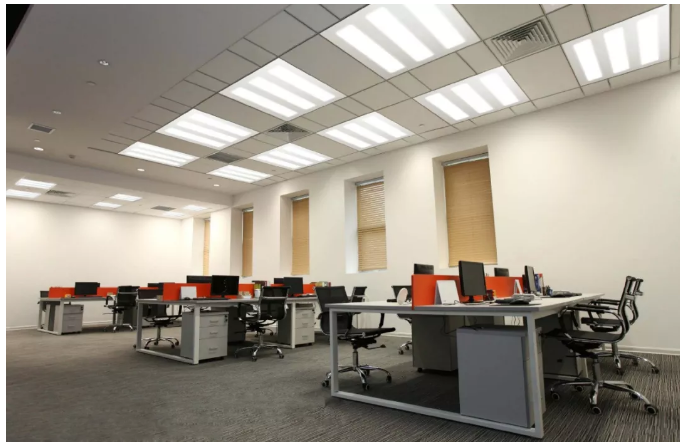
Design: Replaced each 4-lamp fluorescent troffer with a 2×4 ft LED flat panel (35W, 3,500 lumens, 4000K/CRI 85, UGR 19). Installed 8 panels per classroom in a 2 × 4 grid pattern, parallel to the student seating direction. Added daylight sensors in classrooms with windows for automatic dimming.
Results: (1) Illuminance increased from 280 to 520 lux average (86% improvement). (2) UGR reduced from 22 to 17 (below the EN 12464-1 limit of 19). (3) Lighting power per classroom reduced from 128W to 280W total (actually, from 432W to 280W — 35% energy reduction). (4) Student headache complaints reduced by 68% according to nurse office visit logs. (5) Teacher satisfaction survey: 89% rated the new lighting as “good” or “excellent” compared to 31% for the previous fluorescent system. (6) Total project payback: 3.2 years including utility rebates.
8. FAQ
Q: What is the ideal color temperature for classrooms?
A: For general classroom use, 4000K (neutral white) provides the best balance between visual comfort and alertness. For morning classes, 5000K can improve student alertness. For afternoon classes or relaxation areas, 3000K promotes a calmer atmosphere. Tunable-white systems allow all three settings in a single fixture, with automatic scheduling throughout the day.
Q: Do LED fixtures flicker like fluorescent lights?
A: Quality LED fixtures with high-frequency drivers (operating above 1250 Hz per IEEE 1789 standard) are essentially flicker-free. However, inexpensive LED fixtures with basic drivers may flicker at 100/120 Hz, which can cause headaches and eye strain in sensitive individuals. Always specify IEEE 1789-compliant fixtures for classroom applications, and request flicker test data from the manufacturer.
Q: How do I minimize glare from interactive whiteboards?
A: Position luminaires so they are not directly reflected in the whiteboard surface when viewed from student seating positions. The ideal fixture layout runs parallel to the students’ line of sight, with fixtures positioned in front of and behind the whiteboard rather than directly above it. Use fixtures with UGR ≤ 19 optical control. If glare persists, consider installing an anti-glare overlay on the whiteboard surface.
Q: What is the recommended maintenance cycle for classroom LED lighting?
A: For LED fixtures with L80 lifetime of 50,000 hours, in a school operating 1,500 hours per year, the theoretical maintenance-free period is over 30 years. However, we recommend a 5-year inspection cycle to check for driver degradation, dust accumulation on fixture surfaces, and any damaged or discolored diffusers. Group relamping (replacing all fixtures simultaneously) is generally not necessary for LED systems.
9. Related Resources
- Commercial Lighting Specifications — product specifications for commercial and educational lighting
- Lighting Power Density — LPD calculation methods and compliance
- Optical Reports — photometric data and IES files
- Installation Guides — mounting and wiring instructions for LED fixtures