





The problem as it presented itself
The brief was a specification, not a failure: the customer needed an illuminance figure guaranteed at the task plane, and the existing installation delivered a compliant average with unusable uniformity. The average number had been measured from a single point at the centre of the room, which is the first thing to check in any lighting complaint.
The diagnosis came from a measurement grid rather than a specification sheet. Taking readings on a grid across the working area showed the problem was geometric, not photometric: the fixture spacing was too wide for the mounting height, so the centre of the room was over-lit while the areas where work actually happened fell below target.
- Measure on a grid, not at a point. A single centre reading hides exactly the problem that matters.
- Check spacing-to-mounting-height before changing fixtures. Most uniformity complaints are layout problems.
- Separate the average from the task plane. Illuminance at floor level says little about illuminance at the work surface.
The fix was a layout change rather than a product change: closer spacing and a different mounting height brought the whole working plane into range. No luminaire was replaced. This is why the geometric check comes before the product check.
Industrial facilities — especially chemical plants, oil refineries, power stations, and large manufacturing complexes — operate under strict safety regulations (OSHA 1910.37, NFPA 101, IEC 60598-2-22) that mandate reliable emergency illumination during power failures, fire alarms, or critical process shutdowns. Conventional emergency lighting systems using incandescent or fluorescent battery-backup units suffer from short battery life (2–3 years), slow activation (1–3 seconds), low luminous efficacy (20–40 lm/W), and poor visibility in smoke-filled environments.
Queendom LED Solution
Queendom delivers Emergency Sensor LED Panel Lights combining high-efficiency general illumination with integrated motion sensing, battery backup, and smart self-testing capabilities. A single fixture replaces separate normal and emergency luminaires, reducing installation complexity, ceiling clutter, and total project cost.
Key Advantages:
- Dual-Technology Motion Sensing: Microwave + PIR, 360° coverage
- LiFePO₄ Battery: 10-year lifespan, 2,000+ cycles
- Instant Activation (< 0.3s): Full emergency output in milliseconds
- Smoke-Penetrating 4000K-5000K CCT: 25% better color recognition
- Smart Self-Test: Monthly auto-test, BMS relay reporting
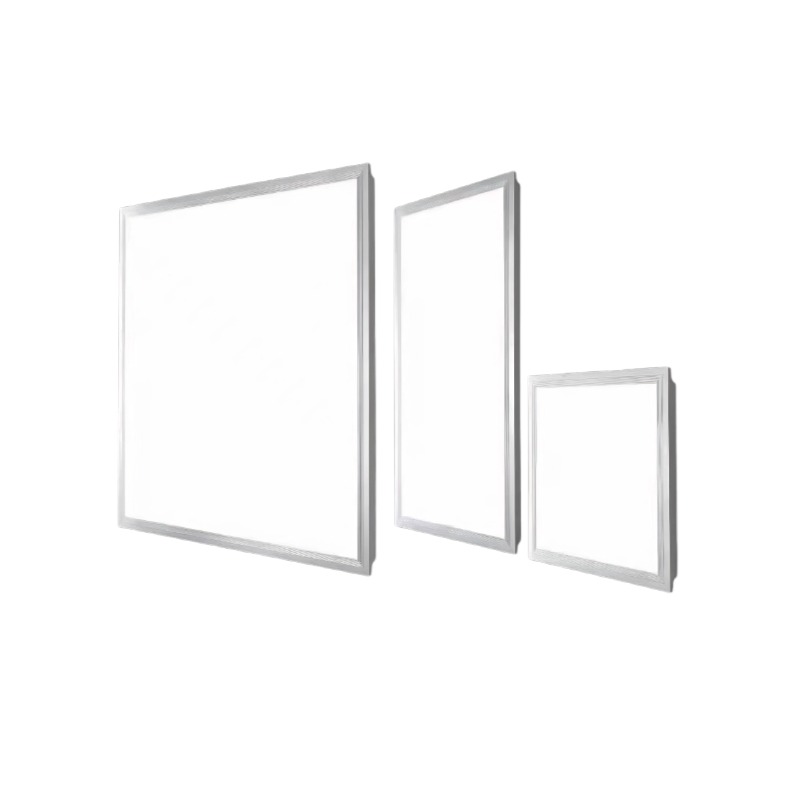
LED Panel Light with Emergency Sensor — 36W-72W, LiFePO₄ Battery
Product Specifications
| Parameter | Specification | Advantage |
|---|---|---|
| Normal Mode Power | 36 W – 72 W | High-efficiency (≥ 120 lm/W) |
| Emergency Power | 3 W – 6 W (battery) | ≥ 3 hours autonomous |
| Battery Type | LiFePO₄ | 2,000+ cycles, 8-10 year life |
| Motion Sensor | Microwave / PIR dual-tech | 360° coverage, 8 m range |
| Lumen (Normal) | 4,320 – 8,640 lm | UGR < 19, comfortable |
| Lumen (Emergency) | 360 – 720 lm | Meets OSHA egress |
| Color Temp | 4,000 K / 5,000 K | High visibility in smoke |
| IP Rating | IP54 / IP65 option | Dust & moisture resistant |
| Self-Test | Monthly + annual auto | Eliminates manual inspection |
| Dimming | 0–10V / DALI-2 | Daylight harvesting |
| Mounting | Surface / recessed / suspended | T-bar, concrete, cable-tray |
Application Scenarios
Scenario 1 — Chemical Plant Corridor
48W panel (5,760 lm, 4000K) with microwave sensor, surface-mounted at 3.5m. Normal: DALI-2 dimming. Emergency: LiFePO₄ battery activates in 0.3s, 480 lm for 3 hours. Annual energy saving 55%.
Scenario 2 — Data Center Cold Aisle
36W panel (4,320 lm, 5000K) with PIR sensor, recessed in 600mm T-bar. Normal: occupancy-activated. Emergency: 360 lm battery during UPS transition. 60% reduction in lighting HVAC load.
Scenario 3 — Underground Parking
72W panel (8,640 lm, 4000K) with microwave sensor, suspended at 4m. Normal: motion-triggered 100%, drops to 20% after 60s. Emergency: 720 lm for 3 hours. 72% energy saving vs. HPS.
Certifications & Compliance
CE / RoHS / REACH — Full EU compliance, mercury-free battery
UL 924 / cUL — Emergency lighting listed for North America
IEC 60598-2-22 — Emergency lighting international safety standard
NFPA 101 — Life Safety Code egress compliance
OSHA 1910.37 — Exit route minimum illumination
ISO 9001 / ISO 14001 — Quality & environmental management
Related Links
Solution: Industrial Lighting Solutions | Smart Lighting Solutions
Product: Industrial Lighting Products | Commercial Lighting | Lights & Lighting
Case Studies: UFO High Bay Factory Lighting | Waterproof LED Tubes
Upgrade your facility’s emergency lighting.
10-year battery life. Smart self-testing. Instant activation.
Contact Us