




The problem as it presented itself
The customer arrived with a working prototype and a production problem: the LEDs that passed the bench test were not the ones that survived the line. Nothing in the data was out of spec — the failures were spread across batches rather than concentrated in one lot, which ruled out a supplier problem and pointed at the process instead.
Three measurements separated the causes. First, forward voltage at a fixed low current across a sample of each batch, which showed whether the die set was consistent. Second, case temperature under the real drive condition, which showed whether the thermal path matched the assumption in the design. Third, the reflow profile logged on the line, which showed whether the assembly process stayed inside the qualified window.
The first two came back clean. The profile log showed the peak temperature sitting close enough to the limit that normal line-to-line variation pushed parts past it. This is the most common way a qualified component becomes an unqualified assembly, and it is invisible on the datasheet.
- Measure the process, not just the part. A component that meets its specification can still be assembled outside its qualification.
- Log the profile, do not assume it. Reflow profiles drift as boards and fixtures change.
- Look at failure distribution first. Failures spread across batches point at the process; failures concentrated in one batch point at the supply.
Once the profile was corrected and re-qualified, the field return rate dropped to the level the component datasheet predicts. The component never changed — only the process around it.
High power LED street lighting application
Driven by various emerging application fields, the scale of the LED market has been rapidly improved Recently,. Its application fields have evolved from simple electrical indications and LED-based displays to LCD green light sources, landscape lighting, Interior lighting, automotive lighting and other fields. As LED has the characteristics of long life, pollution-free and low power consumption, in the future, LED will gradually replace fluorescent lamps and incandescent lamps for the next generation of green lighting sources.
In this chapter, we explain the application of LED) in various territories, including the application of LED in the field of urban lighting, the application of LED display, the application of LED in home lighting, automotive lighting, and various special LED light sources.. The application of LED is very wide. It can not only provide bright lighting, but also save energy, which is the development direction of future lighting.
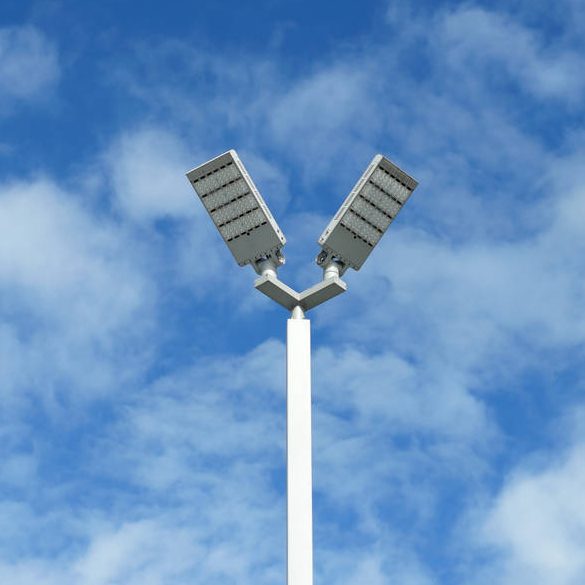
- The application of high-power LED in street lighting
Due to the rapid development of high-power LEDs Recently, the current luminous efficiency can reach 80-100 ImW. Therefore, a large number of high-power LEDs are used as green energy advertising equipment, green energy landscape lighting, park lighting, community lighting and lighting between buildings. It not only saves energy, but also environmental protection, and can save investment. This section introduces the wind-solar complementary power LED designed and manufactured by Wuxi Zhongke Green Energy Technology Co., Ltd., which can be used for urban street lighting.
1.1 City street lighting
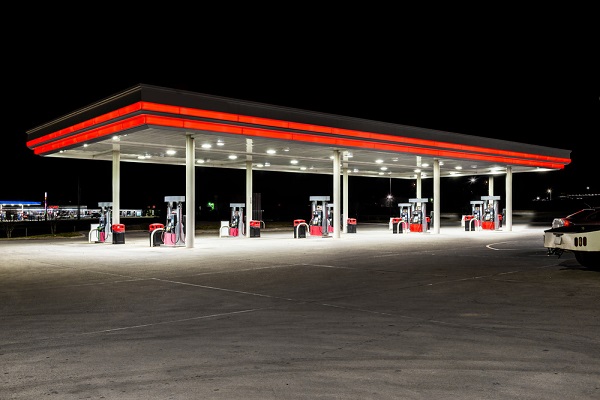
City street lights are common lighting tools in daily life, which bring light to night life (as shown in Figure 6.1). Beautiful street lights can also decorate the city at night. However, street lamps consume a lot of power, and because of the long low-voltage transmission lines of street lamps, not only the street lamps themselves consume power, but also the power consumption of the transmission lines and the wires themselves. At present, the energy-saving work of street lamps has been included in the important work of governments at all levels and street lamp management departments.
1.2 Solar lighting
Recently, a large number of new technologies and products of book energy have appeared in the urban Weilu lighting industry. Among them, Dayang energy urban street lights do not need electricity: therefore, they have the advantage of not having to install cables. However, when solar energy is used to light high-pressure or low-sodium lamps, because it is an inductive negative line, if the voltage is increased by the electric energy converted by solar energy, many circuits must be converted: this also consumes energy.
If you use solar energy to light up the LED street lights, although the sun can light up after charging the battery, there is no guarantee that the LED will continue to light if there is no sunlight for five or six consecutive days. Therefore, wind power generation is used for external use, and there is no sunlight. In the case of, it refers to the supplementary energy of wind power, which can still light up
1.3 Wind-solar complementary power LED intelligent street light
The LED intelligent street lamp uses solar energy and wind energy as driving energy, and its working principle.

If you encounter continuous rainy days, you can work normally for more than 4 days (up to 7 days)
- The height of the street lamp is 6~12m, which can be used for main and secondary roads, as well as for park and community lighting.
- According to needs, it can be set to automatically switch street lights, and also can be set to full power all night, half power late at night, 4 to 8 hours timing lights off and other power options.
- The charging circuit can be set with overload protection to provide constant current for lighting the LED.
After the company’s field test and trial, when the wind speed is high (above level 4), the wind turbine generates a large amount of electricity (more than 70%), and the charging speed is fast (the battery can be fully charged in 4 to 10 hours for 3 days use). This complements each other with solar panels and can meet usage requirements.
According to the actual measurement, the illuminance of 35W power LED is the same as 70W high pressure sodium lamp, but the LED emits white light, so the visual effect is obviously better than the yellow light emitted by sodium lamp. Table 6.1 compares the economic costs and technical indicators of conventional street lamps and wind-solar complementary power LED street lamps.
From the above data, the price and performance of high-power LED street lights are still very competitive. With the advancement of technology, the luminous efficiency of high-power LED street lamps will continue to increase. Therefore, under the same power conditions, the street lights will be brighter, and the price will continue to fall. If the heat dissipation and other aspects are well designed, the life of this street lamp is guaranteed, so the use of LED as street lamp lighting will continue to spread. LED street lights lit by solar energy as a power source will find practical applications in the future.
Street Lighting LED Solutions
Our high-power LED street lights deliver 130-150 lm/W efficacy for urban and highway illumination. These high-power LED arrays replace traditional HID lamps with superior color rendering and uniform light distribution.
High-Power LED Benefits
Compared to sodium vapor lamps, our high-power LEDs offer instant start, dimming capability, and 50,000+ hour lifespan. The 4000K-5000K color temperature enhances road safety while reducing light pollution.
Energy Efficiency & Cost Savings
Municipalities save 60-70% on electricity costs by switching to LED street lighting. Our LED fixtures require minimal maintenance, reducing total cost of ownership by over 50%.
Smart Street Lighting Products
Explore our smart lighting solutions with IoT connectivity. Our LED products support remote monitoring, adaptive dimming, and integration with smart city platforms.
Smart Control Systems
DMX, DALI, and wireless control for intelligent street lighting networks.
Lumen Depreciation Curves
LED lumen maintenance data supporting 50,000-hour lifetime claims.
Municipal Compliance
Dark sky compliant, DLC-listed, and ENEC-certified street lighting.
Part of ← LEDs Case Studies
Related pages
- Infrared LEDs for Perimeter CCTV Illumination
- Narrowband UVB LEDs for Phototherapy Equipment
- Ceramic 3535 LEDs for Automotive Signaling
- SWIR LEDs for Semiconductor Wafer Inspection
- SWIR LEDs for Plastic Recycling Sorting
- UVC LED Water Treatment & Disinfection
…and 20 more in LEDs Case Studies.