

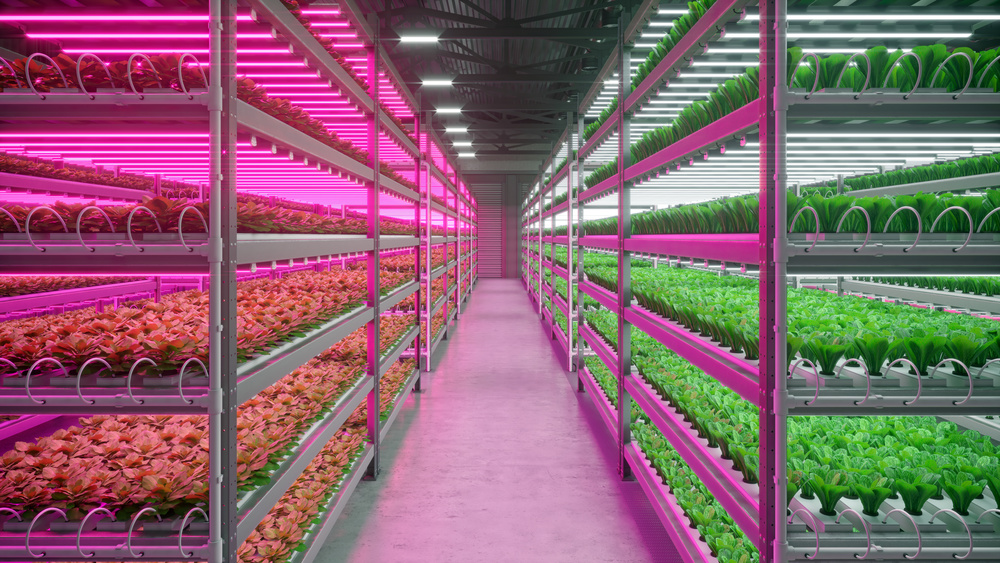



Horticultural (Greenhouse) Lighting Design Guide
Professional lighting design for greenhouses, vertical farms and controlled-environment agriculture – covering DLI targets, PPFD mapping, spectrum selection, photoperiod planning and horticultural LED selection.
Horticultural lighting is not a brighter version of general lighting. The design target is not illuminance on a work plane measured in lux; it is the quantity of photosynthetically active radiation delivered to the canopy over a day, measured as daily light integral (DLI) in mol·m-2·d-1. A greenhouse that meets every lux recommendation can still under-deliver yield if the spectrum is mis-shaped, the photoperiod is wrong, or uniformity across the canopy is poor. This guide sets out the design chain used for commercial installations: crop target, DLI budget, PPFD requirement, fixture geometry, spectrum, and control schedule.
1. The Design Chain: From Crop Target to Fixture Count
Every horticultural design follows the same conversion chain. Fixing the sequence prevents the most expensive error, which is choosing fixtures before knowing the target.
- Crop and growth stage – defines the DLI target and the photoperiod limit (many crops need a dark period; some are day-neutral)
- DLI target (mol·m-2·d-1) – the seasonal requirement, not an annual average
- Photoperiod (h/day) – sets the achievable PPFD: PPFD (µmol·m-2·s-1) = DLI / (photoperiod in seconds × 10-6)
- Supplemental fraction – how much of the DLI the sun already supplies, hour by hour
- Fixture PPFD and geometry – output, beam angle, mounting height, and spacing
- Uniformity check – verify the lowest point of the canopy, not the average
- Control schedule – dimming, sunrise/sunset ramps, and DLI-based feedback
2. DLI Targets and PPFD Requirements
DLI is the single most useful design target because it integrates intensity and duration. The table below lists typical commercial targets; local climate, cultivar and market grade shift these figures, so treat them as a starting envelope and confirm against the grower’s own records.
| Crop / Group | Typical DLI (mol/m²/d) | Photoperiod (h) | Notes |
|---|---|---|---|
| Leafy greens (lettuce, basil) | 12 – 17 | 14 – 18 | Low light requirement; bolting risk at long photoperiod |
| Tomato, pepper (fruiting) | 20 – 30 | 14 – 18 | Requires supplemental light in winter at high latitude |
| Cucumber | 20 – 28 | 14 – 16 | High canopy density; uniformity is critical |
| Strawberry | 15 – 22 | 12 – 16 | Day-length sensitive; photoperiod control affects flowering |
| Microgreens | 6 – 12 | 12 – 16 | Very short cycle; intensity matters more than duration |
| Cannabis-type flowering (reference) | 25 – 40 | 12 | Highest band; verify with local regulation |
3. Converting DLI to Installed PPFD
The conversion is arithmetic, but two corrections are routinely omitted and both matter. First, only the photons that reach the canopy count – wall losses and shading by structure are real. Second, LEDs lose output with age and with elevated ambient temperature near the canopy, so the design figure must be the maintained PPFD, not the initial laboratory value.
| Step | Formula | Worked example |
|---|---|---|
| Required average PPFD | PPFD = DLI × 106 / (photoperiod_h × 3600) | DLI 20, 16 h → 20×106/(16×3600) = 347 µmol/m²/s |
| Add maintenance factor | PPFDdesign = PPFD / (1 − light loss) | 10% loss → 347/0.9 = 386 µmol/m²/s initial |
| Net canopy area | Area = bench area, excluding aisles and structure | 1,000 m² bench → design on 1,000 m², not on 1,200 m² floor |
| Total flux required | Φtotal = PPFD × Area | 386 × 1,000 = 386,000 µmol/s |
| Fixture count | N = Φtotal / Φfixture | 1,000 µmol/s fixture → 386 fixtures |
4. Spectrum Selection
Photosynthesis responds to the 400-700 nm waveband, with peaks in the blue and red regions. That does not mean a design should emit only blue and red. A narrow red-blue spectrum delivers good photosynthesis per watt but suppresses the morphological responses that keep a crop compact, thick-leaved and marketable.
| Waveband | Primary role | Design note |
|---|---|---|
| Blue, 400-500 nm | Photosynthesis; stomatal opening; compact habit | Too little blue produces elongated, weak stems |
| Green, 500-600 nm | Canopy penetration; visual assessment | Reaches lower leaves shaded from red/blue; useful in dense canopies |
| Red, 600-700 nm | Peak photosynthetic efficiency | The workhorse band; efficiency per photon is highest here |
| Far-red, 700-750 nm | Phytochrome signalling; internode extension | Small dose affects architecture; not a photosynthesis substitute |
| UV-A, 315-400 nm | Secondary metabolite induction | Optional; dose carefully and follow local rules |
5. Uniformity and Layout
Greenhouse and vertical-farm failures are usually uniformity failures. A high average PPFD with a deep shadow band across the canopy produces uneven ripening, uneven grade and unpredictable harvest windows. Uniformity is set by luminaire spacing relative to mounting height, and by the beam distribution chosen.
- Compute the ratio of luminaire spacing to mounting height above canopy; as a starting point, tighter spacing at low height gives better uniformity than wide spacing at high height
- Use asymmetric or wide distributions over wide benches; narrow optics concentrate light and create hot spots
- Verify at the lowest acceptable canopy height, because uniformity degrades as the canopy grows toward the fixtures
- Check the perimeter separately – the edge row is always the weakest and is often the one the buyer photographs
- Account for shading by gutters, trusses and irrigation lines before finalising spacing
6. Photoperiod, Control and DLI Feedback
Modern installations control to a DLI target rather than to a fixed dimming level. An irradiance sensor above the canopy reports instantaneous PPFD; the controller integrates it over the day and dims the fixtures so the crop receives the target DLI regardless of how much sun arrived. This saves energy in bright weather and protects the crop in dull weather.
- Sunrise and sunset ramps avoid a step change in light that can shock the crop
- Interlacing or zone dimming reduces peak electrical demand and spreads heat load across the photoperiod
- Alarm thresholds should watch the daily DLI deficit, not only instantaneous PPFD
- Log the DLI delivered per zone per day – it is the only record that lets a grower diagnose a yield change
7. Case Study: Lettuce Greenhouse, Supplemental Lighting
A 1,200 m² glasshouse growing lettuce in a temperate climate had an adequate summer crop but failed its winter grade because head weight fell and bolting became unpredictable. Measurements showed the winter DLI was 7–9 mol/m²/d against a target of 14.
| Stage | Action | Measured result |
|---|---|---|
| Baseline | Natural light only, winter | DLI 7-9 mol/m²/d; variable head weight |
| Design | Supplemental fixtures sized for 190 µmol/m²/s maintained over 16 h | Target 14 mol/m²/d combined |
| Layout | Uniform spacing over benches; perimeter row doubled | Uniformity improved; edge rows removed from grading complaints |
| Control | DLI feedback dimming with sunrise/sunset ramp | Energy use followed the weather instead of a fixed schedule |
| Result | First full winter season | Consistent grade; bolting window predictable; energy below the fixed-schedule baseline |
8. Common Design Mistakes
- Designing to lux instead of to DLI – the two are not interchangeable for plants
- Using the initial (laboratory) PPFD and ignoring light loss over life and at elevated canopy temperature
- Treating the whole floor area as the design area when only the bench area receives useful light
- Choosing narrow optics because they look efficient on paper, then discovering hot spots and poor uniformity
- Setting a photoperiod without checking the crop’s dark-period requirement
- Omitting far-red entirely, or adding a large far-red dose and expecting a photosynthesis gain
9. FAQ
Can I compare a horticultural fixture by lumens per watt?
No. Lumens are weighted to the human eye and discard most of the red and all of the far-red region. Compare on micromoles per joule of input power (µmol/J) across the 400-700 nm band, and check whether the quoted figure is initial or maintained.
How much does weather variability change the design?
Enough that a fixed schedule is usually the wrong choice at high latitude. A DLI-feedback controller is generally justified where the seasonal spread of natural light exceeds roughly a factor of two.
Is a higher PPFD always better?
No. Above the crop’s light-saturation region, additional photons convert to heat, and the electrical cost rises without a yield return. Excess intensity can also cause photo-damage and leaf bleaching in sensitive species.