

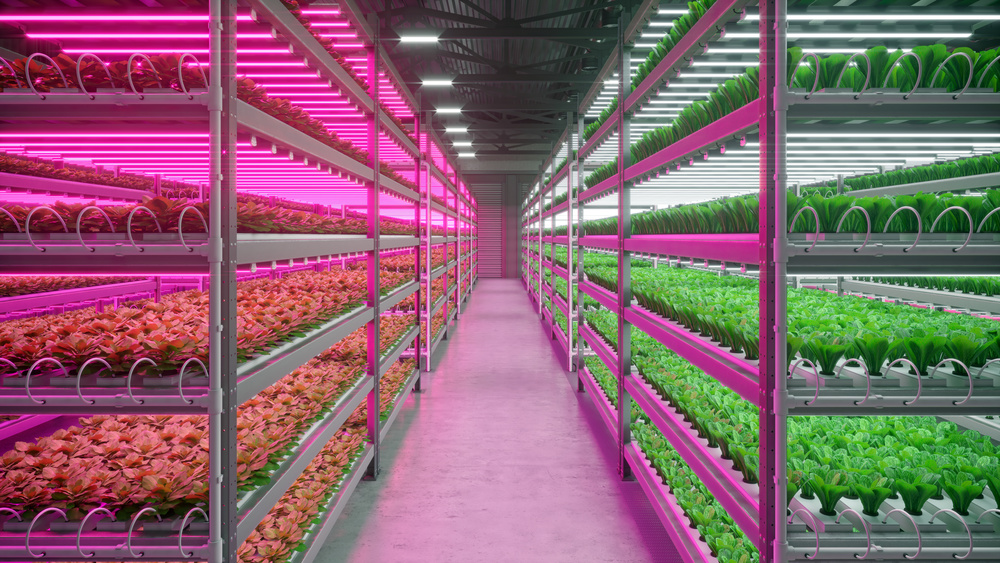



Horticultural lighting is decided on the crop, not on the luminaire. A spectrum that works for one species can be wrong for another, and the dose has to be right as well as the spectrum. The pages here cover the spectrum decisions, the dose modelling behind them, and the terms used to describe both.
1. What is in this section
- Far-Red 730/780 nm Spectrum
Why far-red is part of the spectrum rather than an optional extra, and how to select the channel. - Greenhouse DLI Economics
Modelling daily light integral and photoperiod together, and working back to installed wattage. - Horticultural Lighting Glossary
Photon quantities, spectrum terms, DLI and photoperiod, and the terminology mistakes that change a design.
2. Where to start
Start from the requirement rather than from a product. Each page here opens with the condition that makes the problem what it is — the crop and the dose, the cleanroom class, or the schedule the output has to follow — and only then moves to parameters and selection. Read the first section before comparing products; it usually rules out more than a datasheet would.
3. Why this class is separate
Horticultural lighting is decided on the crop, not on the luminaire. A spectrum that works for one species can be wrong for another, and the dose has to be right as well as the spectrum. The pages here cover the spectrum decisions, the dose modelling behind them, and the terms used to describe both.
4. What these pages do and do not settle
They settle the reasoning and the method, so that a figure taken from them can be checked against the page that carries it. They do not commit to a part number or close a design: the range changes with availability, and the current figures sit on the product pages. For a specific parameter, go to the specification pages; for a background argument, these are the pages to read in full.