


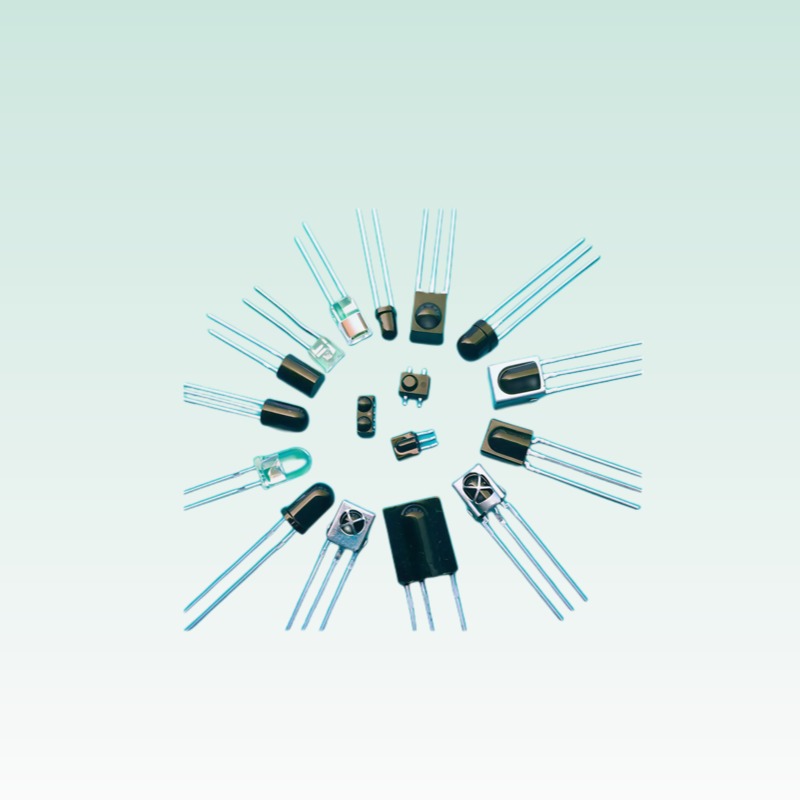







Infrared emitters are used for two quite different reasons, and the two are covered separately here. Near-infrared imaging depends on the spectral response of the sensor and on how the reflectance of the target behaves at that wavelength. Infrared illumination is usually chosen for the illuminance it delivers on the surface, with the eye response out of the picture entirely.
Both are radiometric. Like the UV parts, an infrared emitter is specified by radiant power and by wavelength, and neither of those converts into lumens. The wavelength selection page below treats the imaging case, where the choice of wavelength is a sensor decision as much as an emitter decision.
1. What is in this section
- SWIR Wavelength Selection
Short-wave infrared, roughly 900 nm and above. Wavelength selection against sensor response and target reflectance, including the moisture and temperature trade-offs that make one wavelength preferable to another. - IR Illumination Design
Illuminance design for surveillance cameras, biometrics and machine vision, with the power, beam angle and ambient light levels that determine whether the image is usable.
2. Where to start
If your application is an imaging system with a sensor, start with wavelength selection — the emitter follows from what the sensor can see. If the application is illumination for a camera that already exists, start with the illumination page, where the first question is how much light the scene needs, not which emitter to use.
3. Two things that are commonly misunderstood
- The emitter is not the whole system. A wavelength that suits the sensor still has to be paired with optics, a filter and a drive level. The wavelength choice narrows the options; it does not finish the design.
- Ambient light changes the requirement. The illumination needed depends on how much light the scene already has. A specification written without an ambient reference cannot be checked.
4. Why this class is separate
Infrared sits beside the visible classes rather than inside them for the same reason ultraviolet does: there is no photometric quantity to work with. An infrared emitter is quoted in radiant power at a stated wavelength, and the useful question is not how bright it looks but how much energy lands on the target and how the sensor responds to it.
The two applications also fail differently, which is why they are separate pages. An imaging design is wavelength-led: the detector has a response curve, the target has a reflectance curve, and the emitter has to match both, so the choice is constrained by the sensor. An illumination design is power-led: the emitter is chosen for the energy it delivers at the working distance, with the camera fixed. In the first case the wavelength is the design; in the second it is a secondary constraint.