




Growers ask a very different set of questions from general lighting buyers, and the answers change with every crop and every building. These are the questions our horticultural applications group handles most often when a project moves from an enquiry to a quotation, with the numbers that let a grower check a proposal before accepting it.
1. PPFD, PPF and DLI
Q1. What is the difference between PPF, PPFD and DLI?
PPF is what the fixture emits, in micromoles per second, and it does not depend on where you measure. PPFD is what arrives at a surface, in micromoles per second per square metre, and it depends on distance and beam shape. DLI is PPFD integrated over the photoperiod, in moles per square metre per day, and it is the quantity the crop actually responds to.
Q2. Why is my measured PPFD lower than the datasheet figure?
Almost always because of height. Datasheet PPFD is normally quoted at a reference distance, often 30 cm or 60 cm below the fixture, and the figure falls with the square of the distance in the far field. Always record the measurement height and compare like with like.
Q3. Can I use a lux meter and convert?
Not reliably. A lux meter weights the spectrum for human vision, which peaks in the green region where plants are least responsive and underweights the deep red where most of the useful energy sits. A rough conversion exists for a specific white spectrum and nothing else. Use a quantum sensor with a corrected response.
Q4. What DLI does my crop need?
It varies widely. Leafy greens commonly sit in the 12 to 17 mole range, tomatoes and other fruiting crops in the 20 to 30 mole range, and some ornamentals tolerate more. The crop target table in the PPFD to DLI calculator gives the bands our horticultural group uses in proposals, and the right approach is to start from the target and work backwards to the fixture count.
2. Spectrum questions
Q5. Is full spectrum better than red and blue?
“Full spectrum” is a marketing description, not a specification. What matters for the crop is the photon flux in each physiological band and the ratios between them. A broad white spectrum with adequate red content can perform well, and a narrow red-blue spectrum with the wrong ratio performs badly, regardless of how the label reads.
Q6. Does far-red help or hurt?
Both, depending on the target. Far-red photons can contribute to photosynthesis through the Emerson enhancement effect and they drive the phytochrome system that controls stem extension and flowering. The effect on morphology can be undesirable in a crop where compact plants are the goal, so far-red is a tool with a direction rather than an unconditional improvement.
Q7. What is the phytochrome photostationary state and why does it matter?
It is the equilibrium fraction of the active Pfr form of phytochrome under a given spectrum, expressed as a number between 0 and 1. It compresses the morphogenic effect of a spectrum into one figure, which makes it possible to compare two very different spectra on the trait that most affects plant shape.
Q8. Why do my plants stretch under my new lights?
Stretching is usually a low blue fraction or an excess of far-red, or both, and it can also be a temperature effect at the canopy. Check the spectrum ratios first, then the day and night temperature difference, which drives internode extension independently of light.
3. Fixture count and layout
| Question | Short answer | Detail |
|---|---|---|
| How many fixtures do I need? | Delivered moles drive the count | Divide the required total photons per day by the photons each fixture delivers over the photoperiod, then round up and add margin for uniformity losses. |
| Should I use fewer fixtures at higher power or more at lower power? | More at lower power, usually | More fixtures at lower output improve uniformity and reduce the peak junction temperature, which protects the maintenance curve. |
| What uniformity should I target? | Within 10 percent of the mean | Poor uniformity wastes photons on oversupplied areas and under-serves the rest of the canopy, and the energy bill is set by the average, not the minimum. |
| How high should the fixtures hang? | As low as the crop and the thermal limit allow | Lower mounting raises the delivered PPFD for the same fixture and reduces the spill onto walls and floors. |
| Do I need intercanopy lights? | For tall crops, yes | Top lighting alone leaves the lower canopy under-lit in tomatoes and similar crops; intercanopy fixtures raise the effective uniformity. |
| Should I use a white wall or reflective film? | Yes, where the structure permits | Reflective surfaces raise the effective delivered moles without additional fixtures, and they cost far less per mole than another light. |
4. Efficiency and operating cost
| Layout parameter | Typical target | Why it matters |
|---|---|---|
| Photoperiod window | 12 to 20 hours | Set by crop physiology; a longer day is not automatically better. |
| Dark period, short-day species | At least 12 continuous hours | Interrupted darkness delays or prevents flowering. |
| Canopy PPFD uniformity | Within 10 percent of mean | The energy bill is set by the average, but yield is limited by the minimum. |
| Mounting distance, top lighting | 30 to 90 cm above canopy | Shorter distance raises PPFD but concentrates the heat at the leaf. |
| Reflective wall coverage | As complete as practical | Cheapest available photon recovery; usually pays back in weeks. |
| Intercanopy spacing, tall crops | Every 1.0 to 1.5 m of height | Reaches the lower canopy that top lighting cannot. |
| Question | Short answer | Detail |
|---|---|---|
| What photon efficacy should I expect? | Above 110 micromol per joule | The reference line in the chart above marks 110. Legacy HPS fixtures sit near 70 to 90 and current LED architectures exceed it comfortably. |
| How do I compare two fixtures fairly? | Cost per delivered mole | Multiply the input power by the electricity tariff and divide by the photon efficacy. The result, cost per mole, is the figure that decides payback. |
| Does dimming save energy? | Yes, roughly proportionally | Most constant-current drivers scale light output with the dimming signal, so a 40 percent dim command removes roughly 40 percent of the power. |
| Does the spectrum affect running cost? | Indirectly, through efficacy | A spectrum weighted toward the red peak delivers more useful photons per watt than one weighted for visual appearance. |
| What maintenance should I budget for? | Cleaning, not replacement | Dust and condensation on optical surfaces reduce delivered PPFD over a season. Plan a cleaning interval, and plan for reflector replacement over the fixture lifetime. |
| Is there a rebate for horticultural lighting? | Some jurisdictions, yes | DLC horticultural qualification is the usual eligibility gate in North America, so ask for the listing before choosing a fixture. |
5. Installation environment
| Environment | What to specify | Failure mode if omitted |
|---|---|---|
| Greenhouse, condensing humidity | Corrosion specification plus IP rating, sealed driver | Corroded fasteners and degraded seals within a season |
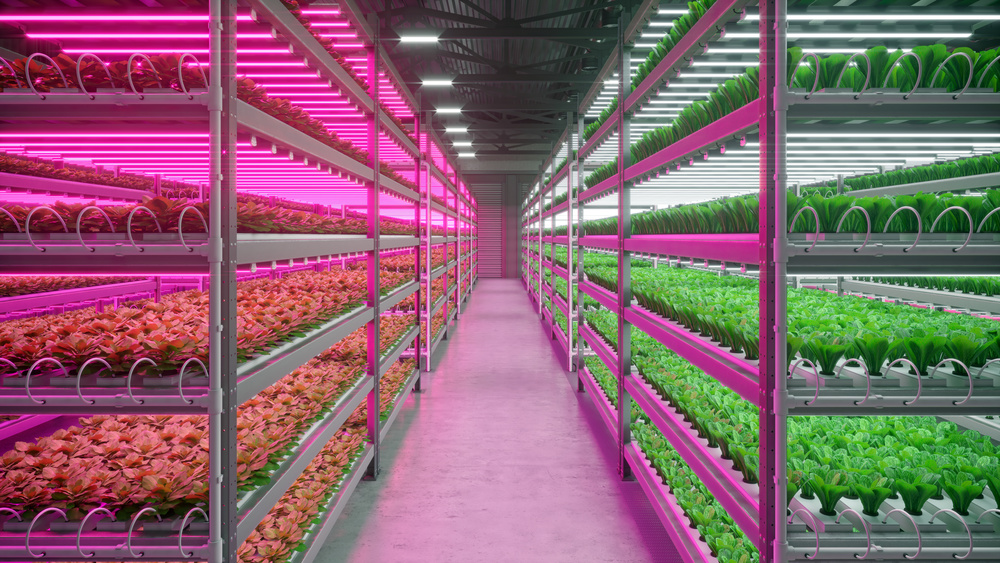
| Vertical farm, multilayer rack | Narrow distribution, low profile, intercanopy option | Poor uniformity between layers and light spill onto the aisle |
| High-temperature climate | Derated drive current and a driver rated for the ambient | Reduced photon output as the LED warms, and shortened driver life |
| Cold climate, unheated structure | Driver rated for the low-temperature start | Failure to start, or reduced output at the beginning of the photoperiod |
| Dusty environment | Sealed optical surfaces and a cleaning interval | Delivered PPFD falls over the season even though the fixture is working |
| Chemically aggressive ambient | Stainless housing and chemically resistant seals | Housing degradation and a shortened service interval |
Q9. What IP rating do I need in a greenhouse?
An IP rating covers water ingress from jets and sprays and says less about condensing humidity. A greenhouse needs both an appropriate IP rating and a corrosion specification for the housing, because the failure mode in that environment is usually corroded fasteners and degraded seals rather than direct water entry.
Q10. Will the humidity shorten the LED life?
Indirectly, through the driver and the connections more than through the die itself. The LED die is sealed within the package; the exposed path is the driver electronics and the terminal blocks. Specify the driver for the ambient and use sealed connectors.
Q11. How much heat do the lights add to the greenhouse?
All of the input power ends up as heat in the space, either directly or through the photons being absorbed and re-emitted. A 600 W fixture is a 600 W heater in the thermal balance, and a lighting upgrade that reduces power also reduces the heating credit, which changes the winter energy bill in the opposite direction to the lighting saving.
Q12. Can I use the same fixtures for a vertical farm?
Usually not without re-specification. A vertical farm has a much shorter mounting distance, so the beam distribution and the uniformity requirement differ, and the rack structure changes the thermal environment. Fixtures designed for overhead greenhouse mounting are normally too narrow in beam for a multilayer rack, and the reverse is also true.
6. Getting a quotation right
Q13. What information do you need to quote accurately?
Five things: the crop, the canopy area, the ceiling or rack height, the photoperiod window you can accept, and whether the installation is sole source or supplemental to daylight. With those five inputs our group can return a fixture count, a delivered daily light integral with a uniformity estimate and an energy figure in kilowatt hours per day.
Q14. Can you supply photometric files for a uniformity simulation?
Yes. We can supply an IES photometric file for any candidate fixture so that the layout can be simulated before purchase. Running the simulation at the proposal stage costs nothing and prevents the most expensive class of error in a commercial grow build, which is discovering a uniformity problem after the rails are installed.
Q15. Do the figures you quote include the driver losses?
The photon efficacy figures we publish are measured at the luminaire input under IES LM-79 conditions, so driver losses are included. Where a driver is supplied separately, we quote the driver efficiency separately so that the two can be combined correctly.
7. Part numbers in this FAQ
The top-lighting horticultural family runs from Z-01 to Z-08, covering white, red-blue and far-red hybrid options. Linear grow tubes for multilayer racks are in Z-09 to Z-13, and the high-bay plant grow fixtures with a published uniformity figure are in Z-14 to Z-18. Because these fixtures use the same 3535 and 5050 package families as the general LED catalogue, the thermal and reliability vocabulary in the LED FAQ applies here as well.
8. Related resources and next steps
For the units used in these answers, see the horticultural lighting glossary. For the arithmetic from PPFD to delivered daily light integral and fixture count, see the PPFD to DLI calculator. Send a project with the five inputs above and our horticultural applications group will return a plan.
Crop Planning Questions
| Crop | Target DLI (mature) | Photoperiod | Note |
|---|---|---|---|
| Lettuce and baby leaf | 14-17 | 16 h | Tipburn risk when EC runs high |
| Basil | 12-20 | 16 h | Flavor drops at low DLI |
| Tomato | 20-30 | 16-18 h | Pairs well with CO2 enrichment |
| Cucumber | 15-25 | 16-18 h | High transpiration load |
| Strawberry | 17-24 | 14-16 h | Runner control via photoperiod |
| Microgreens | 6-12 | 14-16 h | Short cycle tolerates low ambient |
Q16. What DLI should I target for lettuce?
14 to 17 mol/m2/d for mature heads. Below 12, weight and texture suffer; above 20 without CO2 enrichment, tipburn becomes the limiting disorder rather than light.
Q17. Is it better to raise intensity or extend photoperiod?
Plants read the integral. Extending photoperiod at lower intensity is cheaper per photon and gentler on crops that dislike high instantaneous PPFD, provided the cultivar tolerates long days.
Q18. How do I verify DLI on my own site?
Log PPFD with a quantum sensor at canopy height across one clear and one overcast day in each season, integrate the readings, and use the winter value as your sizing case.
Spectrum Questions
Spectrum questions usually reduce to which photoreceptor you are trying to address:
| Photoreceptor | Sensitive band | Plant response |
|---|---|---|
| Phytochrome | 660 / 730 nm | Germination, stem extension, flowering switches |
| Cryptochrome | 350-500 nm | Circadian entrainment, anthocyanin synthesis |
| Phototropin | 350-500 nm | Phototropism, stomatal opening |
| UVR8 | 280-315 nm | UV stress responses, flavonoid production |
Q19. Does the red-to-blue ratio matter?
Less than marketing suggests. Lettuce biomass tracks total photons across a wide ratio range; blue matters for compactness and flavor, and blue-only or red-only regimes cause morphological problems.
Q20. What does an end-of-day far-red pulse do?
A short far-red dose after sunset shifts phytochrome to its far-red form and accelerates stem extension and leaf expansion in many species, useful for finishing young plants faster.
Q21. Is green light wasted?
No. Green penetrates deeper into canopies and drives cryptochrome responses; modern recipes keep 10 to 20 percent green rather than the old purple-only extremes.
Related products and applications
- Horticultural lighting (Z-01 to Z-18)
- Calculator: PPFD to DLI calculator
- Glossary: Horticultural lighting glossary
- Lighting knowledge: Lighting knowledge resources