




Horticultural lighting has a vocabulary problem that general lighting does not. A warehouse is specified in lux and watts; a grow room is specified in micromoles, and the conversion between the two is not a fixed factor. This glossary defines the quantities that appear in QUEENDOM horticultural datasheets and in the lighting plans our applications group reviews, in the order a design conversation usually meets them. Where a term has a standard behind it, the standard is named so that a specification can cite it directly.
1. Photon quantities
The photon vocabulary exists because the human eye and a plant leaf do not weight the spectrum the same way. A light that looks bright to a person can deliver almost no usable photons to a leaf, and a deep red source that looks dim can be the most productive light in a grow room. Every quantity below is a photon count rather than a visual impression.
| Term | Symbol | Unit | Definition |
|---|---|---|---|
| Photosynthetic photon flux | PPF | umol/s | Total photons in the 400 to 700 nm band emitted by a fixture per second. |
| Photosynthetic photon flux density | PPFD | umol/m2/s | PPF arriving at a surface, divided by its area. This is what a quantum sensor reads. |
| Daily light integral | DLI | mol/m2/d | PPFD integrated over the photoperiod. The quantity plants actually respond to over a day. |
| Photon efficacy | umol/J | PPF produced per watt of input power. The horticultural replacement for lumens per watt. | |
| Extended PAR | ePAR | umol/s | Photons in 400 to 750 nm, adding far-red to the classic PAR band. |
| Photon flux maintenance | Q90 / Q70 | hours | The hours at which PPF falls to 90 or 70 percent of initial. The horticultural counterpart of L90 and L70. |
| Yield photon flux | YPF | umol/s | Photons weighted by the relative quantum efficiency of photosynthesis rather than counted equally. |
| Ultraviolet photon flux | UV-PF | umol/s | Photon count in the UV band, used where UV response is a design goal rather than a hazard to be minimised. |
| Photosynthetic photon efficacy | PPE | umol/J | The same quantity as photon efficacy, spelled out to avoid confusion with the abbreviation PE. |
| Photon cost | currency/mol | Electricity cost divided by delivered moles; the number that decides between two fixture bids in a commercial build. |
2. The spectrum terms
Horticultural buyers increasingly ask not for a colour temperature but for a ratio between spectral regions. Four ratios carry most of the decisions, and a fifth term, the photostationary state, compresses all of them into a single number that predicts morphology.
| Term | Definition | Practical effect |
|---|---|---|
| R:B ratio | Ratio of red (600 to 700 nm) to blue (400 to 500 nm) photon flux. | Higher red favours elongation and biomass; more blue compacts the plant. |
| Phytochromes Pr / Pfr | Two interconvertible forms of a photoreceptor; red light converts Pr to Pfr, far-red converts it back. | Controls germination, flowering time and shade avoidance. |
| Phytochrome photostationary state | PSS, the equilibrium fraction of Pfr under a given spectrum. | A single number that summarises the morphogenic effect of a spectrum. |
| Emerson enhancement | The yield gain when red and far-red are delivered together rather than separately. | Justifies adding a far-red channel to an otherwise red-blue fixture. |
| Cryptochrome response | Blue-sensitive photoreceptor controlling stem extension and stomatal opening. | The reason a pure red fixture produces stretched, weak plants. |
| Photoperiod | Hours of light per day, as distinct from the total photons delivered. | Short-day and long-day species need the window as well as the dose. |
| Far-red end-of-day treatment | A brief far-red exposure after the main photoperiod to drive Pfr back to Pr. | Used to control extension growth without changing the daily photon total. |
| R:FR ratio | Ratio of red to far-red photon flux, the classic shade-avoidance signal. | A low ratio mimics canopy shade and triggers elongation. |
| Green fraction | The share of photon flux between 500 and 600 nm. | Penetrates the canopy more deeply than red or blue; matters in dense canopies. |
| UV-A fraction | The share of photon flux between 315 and 400 nm. | Can increase secondary metabolite content in some species; also a materials ageing risk. |
3. DLI and photoperiod are two ways to say the same dose
The two curves below both deliver the same daily photon total, and choosing between them is a physiological decision rather than a photometric one. The relationship itself is a straight multiplication: DLI in moles per square metre per day equals PPFD in micromoles per second per square metre, multiplied by hours of light, multiplied by 3600, divided by one million. Everything else in this section is about the constraints that limit which direction along a curve a grower may move.
Both curves deliver a target DLI, but they are not interchangeable in practice. A long photoperiod at low PPFD costs the same electricity per mole but changes plant morphology, and it may violate the dark period a short-day species needs. In a commercial greenhouse the ceiling height and the rack spacing usually fix the achievable PPFD, which leaves the photoperiod as the free variable; in a multilayer vertical farm the opposite is true and the photoperiod is fixed by the operating schedule while the PPFD is set by the layer spacing. A lighting plan that does not state which variable is free is not yet a plan.
Uniformity matters as much as the average. A canopy that receives twice the target DLI in the centre and half at the edges consumes the full energy bill while the marginal rows underperform, so a quotation that gives only a centre-point PPFD does not allow the delivered DLI to be calculated at all. Ask for the uniformity figure and the height at which it was measured before comparing two fixtures on photon cost per mole.
4. Optical and measurement terms
Measurement vocabulary is where two credible suppliers most often disagree, because the sensor, the correction and the measurement height are all variables and none of them is visible in a single number printed on a datasheet.
| Term | Definition | Notes |
|---|---|---|
| Quantum sensor | Instrument with a spectral response shaped to the 400 to 700 nm band. | Reads PPFD directly; a lux meter will not substitute |
| Spherical vs cosine correction | Correction applied so the sensor reads correctly at oblique incidence and under diffuse light. | Poor cosine response is the main source of field disagreement between two meters |
| IES LM-79 | Approved method for the electrical and photometric measurement of a complete luminaire. | The basis of every published PPF figure from a reputable maker |
| Dark period | Uninterrupted darkness required by some species for flowering or for respiration. | Light pollution from a neighbouring bay can defeat it |
| Photon uniformity | Variation in PPFD across the canopy, usually quoted as max/min or as a percentage of mean. | A lower uniformity wastes photons on oversupplied corners |
| Canopy vs sensor plane | The height at which PPFD is specified. Measurements at fixture height are far higher than at canopy height. | Always state the height with the figure |
| Integrating sphere | A calibrated enclosure that captures total emitted flux independent of beam shape. | The reference method behind an LM-79 PPF figure |
| Goniophotometer | An instrument that measures intensity as a function of angle to produce a distribution file. | Source of the IES file used in a lighting plan |
| IES file | A digital photometric file describing the intensity distribution of a luminaire. | Required to run a uniformity simulation before purchase |
| Reflectance | The fraction of incident photons returned by a surface in the room. | A white tent film raises effective DLI without more fixtures |
| Intercanopy lighting | Fixtures placed within the canopy rather than above it to reach lower leaves. | Raises the effective uniformity in tall crops |
| Supplemental vs sole-source | Adding photons to daylight versus providing all photons artificially. | Determines whether DLI must be tracked against a weather record |
5. Terminology mistakes that change a design
| Written as | Often meant | Consequence |
|---|---|---|
| “600 watt equivalent” | Actually 600 W drawn from the wall, or a comparison to a legacy HPS fixture | Overstates photon delivery if the reference is a legacy lamp rather than the actual fixture |
| “PPFD 1000” | PPFD at an unstated height and unstated distribution | Numbers taken at the fixture face are not achievable at the canopy |
| “Full spectrum” | Any white phosphor LED with a small blue accent | Says nothing about the red and far-red content that drives the crop |
| “DLI 20” | Either a target or an achieved value | Target and delivered DLI diverge where uniformity is poor |
| “Replaces 1000 W HPS” | A claim about DLI at a specific coverage area | Valid only at the same coverage area and photoperiod |
| “Horticultural white” | Any high-CRI white emitter | CRI is a human-vision metric and says nothing about photon efficacy |
| “Waterproof for humidity” | An IP rating tested against water jets, not against condensing humidity | Greenhouse condensation requires a corrosion and ingress specification, not just an IP number |
| “No maintenance required” | Q90 above the warranty period at a stated case temperature | Glass and reflector cleaning still affects delivered PPFD over a season |
6. The QUEENDOM horticultural range in these terms
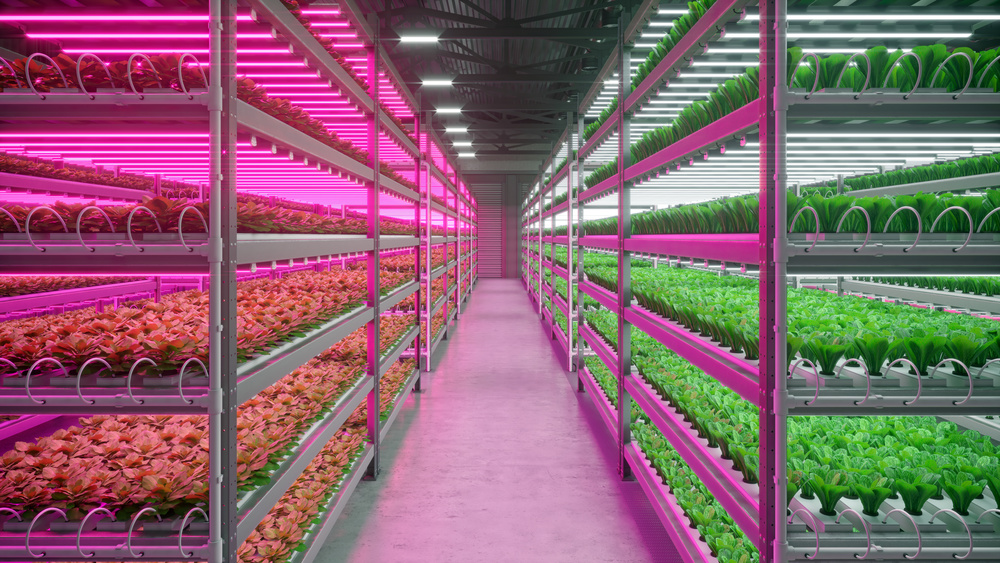
The Z-01 to Z-04 family covers top-lighting white and far-red hybrids for greenhouses and vertical farms, with photon efficacy published in micromoles per joule rather than lumens per watt. The linear grow tubes in Z-09 through Z-12 are specified as PPF per tube for rack-mounted multilayer benches, and the high-bay plant grow fixtures in Z-14 through Z-18 are specified with a photon uniformity figure and a stated canopy height.
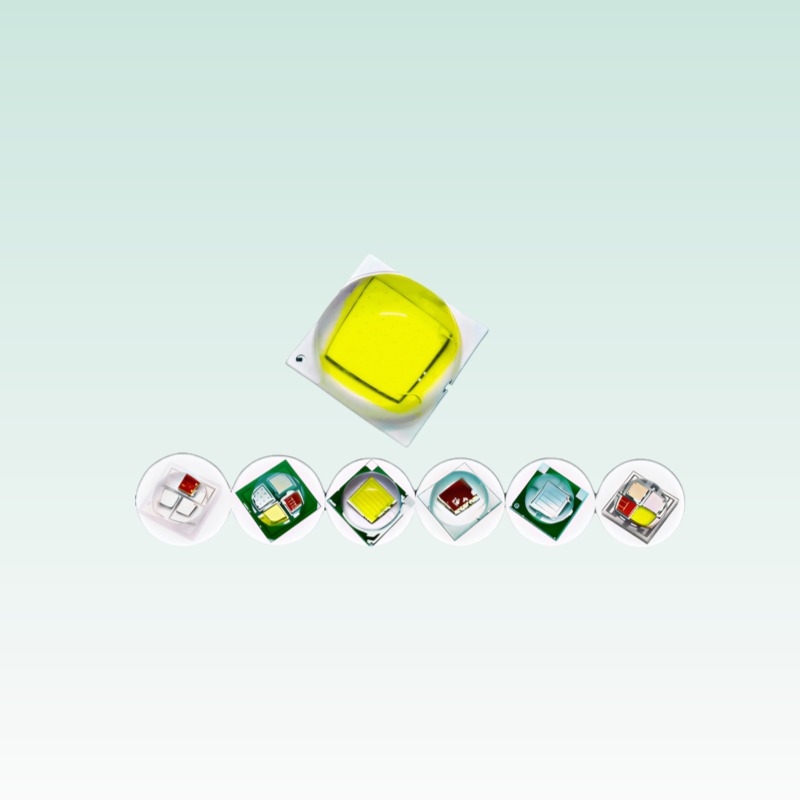
Because all of these are variants of the same 3535 and 5050 package families used across the LED catalogue, the thermal and binning vocabulary from the LED package glossary applies here as well. A horticultural fixture that over-drives its packages to hit a photon efficacy headline will lose that advantage within a season, because the junction temperature that sets the maintenance curve is set by the same thermal resistance the general LED datasheet quotes.
7. Using the glossary with the calculator
The PPFD to DLI calculator converts a measured or designed PPFD and a chosen photoperiod into a daily light integral, and compares the result with published crop targets. Use this page for the units and the calculator for the arithmetic. The two are written to be read together, and the crop target bands in the calculator use the same target values quoted in the tables above.
Where a project adds supplemental light to a greenhouse, the calculator output should be read as the total target, not as the fixture contribution, because daylight already supplies a substantial share of the daily integral for most of the year in temperate latitudes.
8. Contact and lighting plan review
Send the crop, the canopy area, the photoperiod window you can accept and the ceiling height, and our horticultural applications group will return a fixture count, a delivered DLI with uniformity estimate and an energy figure in kilowatt hours per day. Where a spectrum is contested, we can supply the measured spectral power distribution and the phytochrome photostationary state for the candidate fixtures so the decision rests on measurement rather than on a colour rendering description.
Where a project is in the design stage, we can also return a photometric IES file for the proposed fixture so that a uniformity simulation can be run before any purchase commitment is made. This costs nothing at the proposal stage and prevents the most expensive class of error in a commercial grow build, which is discovering a uniformity problem after the rails are installed.
Photometry Units in Horticulture
Horticultural metrics are photometric units re-based on plant vision rather than human vision. The curve is the schematic relative action spectrum of photosynthesis: broad through blue and green, peaking in red, collapsing in the far infrared. It explains why photon counting replaced lux in grow-light specification.
| Metric | Symbol | Unit | What it measures |
|---|---|---|---|
| Photon flux | PPF | umol/s | Photons emitted by the source, 400-700 nm |
| Photon flux density | PPFD | umol/m2/s | Photons arriving per square metre each second |
| Daily light integral | DLI | mol/m2/d | PPFD accumulated over the photoperiod |
| Extended PAR | ePAR | umol/m2/s | 400-750 nm, including far-red 700-750 |
| Photon efficacy | – | umol/J | PPF per watt of wall-plug power |
Light Source Efficacy and Spectrum Terms
Source choice still sets the economics: efficacy determines the electricity line and spectrum determines the crop response. Modern LED fixtures lead on both counts and remain the only source whose spectrum can be re-shaped per crop stage.
| Source | Typical efficacy | Spectrum character |
|---|---|---|
| LED fixture | 2.4-3.6 umol/J | Tunable white, red and far-red combinations |
| HPS lamp | 1.4-1.9 umol/J | Yellow-orange heavy, high radiant heat |
| Ceramic metal halide | 1.5-2.0 umol/J | Broad, strong blue-green |
| T5 fluorescent | 0.9-1.3 umol/J | Broad but weak per surface |
| Bicolor red-blue module | 1.2-1.8 umol/J | Narrow red-blue, little green |
When comparing quotes, convert everything to delivered PPFD at canopy with the layout you actually plan to run. A 0.3 umol/J wall-plug difference compounds into roughly 15 percent of electricity over a season.
Related products and applications
- Horticultural lighting (Z-01 to Z-18)
- Calculator: PPFD to DLI calculator
- Equipment glossary: LED package and reliability glossary
- Lighting knowledge: Lighting knowledge resources
- Horticultural white and far-red emitters: high-power LED packages