
 English
 Afrikaans
 Albanian
 Amharic
 Arabic
 Armenian
 Azerbaijani
 Basque
 Belarusian
 Bengali
 Bosnian
 Bulgarian
 Catalan
 Cebuano
 Chichewa
 Corsican
 Croatian
 Czech
Czech Danish
 Dutch
Dutch Esperanto
 Estonian
 Filipino
 Finnish
 French
 Frisian
 Galician
 Georgian
 German
 Greek
Greek Gujarati
 Haitian Creole
 Hausa
Hausa Hawaiian
 Hebrew
 Hindi
Hindi Hmong
Hmong Hungarian
 Icelandic
 Igbo
Igbo Indonesian
 Irish
Irish Italian
 Japanese
 Javanese
 Kannada
 Kazakh
 Khmer
Khmer Korean
 Kurdish (Kurmanji)
 Kyrgyz
 Lao
Lao Latin
Latin Latvian
 Lithuanian
 Luxembourgish
 Macedonian
 Malagasy
 Malay
Malay Malayalam
 Maltese
 Maori
Maori Marathi
 Mongolian
 Myanmar (Burmese)
 Nepali
 Norwegian
 Pashto
 Persian
 Polish
 Portuguese
 Punjabi
 Romanian
 Russian
 Samoan
 Scottish Gaelic
 Serbian
 Sesotho
 Shona
Shona Sindhi
 Sinhala
 Slovak
 Slovenian
 Somali
 Spanish
 Sudanese
 Swahili
 Swedish
 Tajik
Tajik Tamil
Tamil Telugu
 Thai
Thai Turkish
 Ukrainian
 Urdu
Urdu Uzbek
Uzbek Vietnamese
 Welsh
Welsh Xhosa
Xhosa Yiddish
 Yoruba
 Zulu
Zulu









Short-wave infrared (SWIR) LEDs are no longer a niche component. From food-sorting lines that inspect 120 tonnes per hour to semiconductor wafer inspection tools that detect sub-micron defects, SWIR LED chips are becoming a core light source in industrial machine vision. For buyers who source LED components, understanding what SWIR LEDs can and cannot do is essential — the wrong wavelength choice can cost you thousands in rejected optics and rework.
In this guide, we explain how SWIR LEDs work, which wavelengths matter for which application, and the specifications you should demand from a supplier before you commit to volume procurement.
What exactly is a SWIR LED?
SWIR stands for short-wave infrared, and in the LED industry it refers to infrared light-emitting diodes that emit in the 970–1700 nm range (some suppliers define SWIR more broadly as 900–2500 nm, which overlaps with other infrared bands). The human eye cannot see this light — it sits beyond the visible spectrum, between near-infrared (NIR, roughly 700–1000 nm) and mid-wave infrared (MWIR).
Unlike visible LEDs that use gallium nitride (GaN) or indium gallium aluminium phosphide (InGaAlP), SWIR LEDs are typically built on indium gallium arsenide (InGaAs) or gallium arsenide (GaAs) substrates. The choice of epitaxial material directly determines the emission wavelength. This is why you cannot simply “tune” a visible LED into the SWIR range — the semiconductor bandgap is fixed at the wafer stage.
Key wavelengths and their typical uses:
- 1050–1200 nm: alignment, ranging, and NIR-SWIR boundary imaging
- 1300 nm: silicon wafer and glass inspection, moisture detection in thin films
- 1450 nm: water absorption band — moisture and liquid level sensing
- 1550 nm: fibre-optic communication, distance sensing, certain medical diagnostics
- 1650 nm: plastic identification (PET vs PVC), food and agricultural sorting
How do SWIR LEDs work?
Like all LEDs, a SWIR LED converts electrical energy into light through electroluminescence. When forward voltage is applied, electrons and holes recombine in the active region of the epitaxial structure, releasing photons. The critical difference is that in SWIR materials, the bandgap is small enough that the emitted photons carry low energy — which is exactly why their wavelength is longer than visible light.
This low bandgap creates three practical engineering challenges that buyers should understand:
- Efficiency drops with wavelength. The longer the wavelength, the lower the wall-plug efficiency SWIR LEDs can realistically achieve. A good 1050 nm emitter may reach 30–40% wall-plug efficiency, while a 1650 nm device is typically far lower. Expect SWIR LEDs to require more drive current and produce more heat per useful watt than visible LEDs.
- Thermal management is unforgiving. Because efficiency is lower, waste heat is higher. Without a low-thermal-resistance package — ceramic substrates, appropriate die attach, and proper heatsinking — junction temperature rises quickly, and output power drops sharply with temperature. Suppliers should provide thermal resistance (Rth) data and derating curves.
- Wavelength shifts under temperature and current. Maximum emission wavelength drifts with junction temperature and drive current. In spectroscopy and sorting applications, wavelength stability matters. Ask for wavelength stability data over the full operating temperature range.
Why SWIR? The applications that pay for it
SWIR imaging reveals what visible light and standard NIR cameras cannot. Because many materials have unique spectral “fingerprints” in the SWIR band, SWIR light sources enable machine vision systems to classify materials by composition rather than by color alone.
Food and agricultural sorting
Moisture content, sugar levels, bruises, and foreign material (stones, plastic fragments) show strong contrast in the 1100–1700 nm range. SWIR-LED-based sorters inspect fruits, vegetables, grains, and nuts at production line speed, removing defects that are invisible in RGB images.
Plastic recycling
Different polymers absorb and reflect SWIR light differently. At around 1650 nm, PET can be distinguished from PVC and other plastics, enabling automated recycling lines to separate material streams that look identical to the human eye.
Semiconductor and electronics inspection
Silicon is transparent to SWIR light above about 1100 nm. That property allows inspectors to see through silicon wafers and packaged devices, checking die placement, bond integrity, and hidden cracks without destructive testing.
Medical and biometric sensing
Water absorption bands in the SWIR region make SWIR illumination useful for hydration measurement, certain diagnostic instruments, and medical device light sources where precise spectral output is required.
Laser and system integration support
For many industrial systems, SWIR LEDs provide a lower-cost, eye-safer alternative to lasers in continuous-duty illumination applications, while lasers remain preferred where coherence or extreme power density is required.
SWIR LED vs IR LED vs NIR LED: what to specify
Buyers frequently confuse NIR, IR, and SWIR. The practical distinction:
- NIR LEDs (700–1000 nm): widely used in proximity sensors, security cameras, and optical communications. Low cost, mature technology.
- IR LEDs (broadly 850–1100 nm): common in illuminators and distance sensing. Often the cheapest “infrared” option.
- SWIR LEDs (970–1700 nm): for machine vision and spectroscopy applications that need to see material composition. Higher cost, lower efficiency, but irreplaceable where the application requires it.
Do not let a supplier substitute an NIR LED for a SWIR requirement. The emission band, detector sensitivity, and optical system are all designed around a specific wavelength. A “one-size-fits-all IR LED” will fail in sorting and inspection applications that depend on SWIR spectral contrast.
Key specifications to request from a SWIR LED supplier
When you evaluate SWIR LED chips or modules, request datasheets that state these parameters explicitly:
Peak wavelength and spectral width (FWHM)
Know the center wavelength and how wide the emission band is. A wide spectral spread degrades contrast in spectral-sorting applications.
Radiant power and efficiency
Ask for radiant flux (mW or W) at your operating current, together with wall-plug efficiency. Compare devices at the same drive conditions, not at marketing headline numbers.
Thermal resistance and derating behavior
Rth, junction-to-case values, and derating curves tell you how much heatsinking you will need in your final product design.
Wavelength stability
Request data on wavelength shift across temperature and current. Tight wavelength bins are essential for optical system design.
Reliability and lifetime
Ask for L70 or L90 lifetime projections, failure mode analysis, and any qualification data (e.g., temperature cycling, humidity bias tests) relevant to your operating environment.
Packaging and integration: ceramic, SMD, and COB options
SWIR LEDs are available in a range of package formats, and the packaging choice is an engineering decision, not a preference:
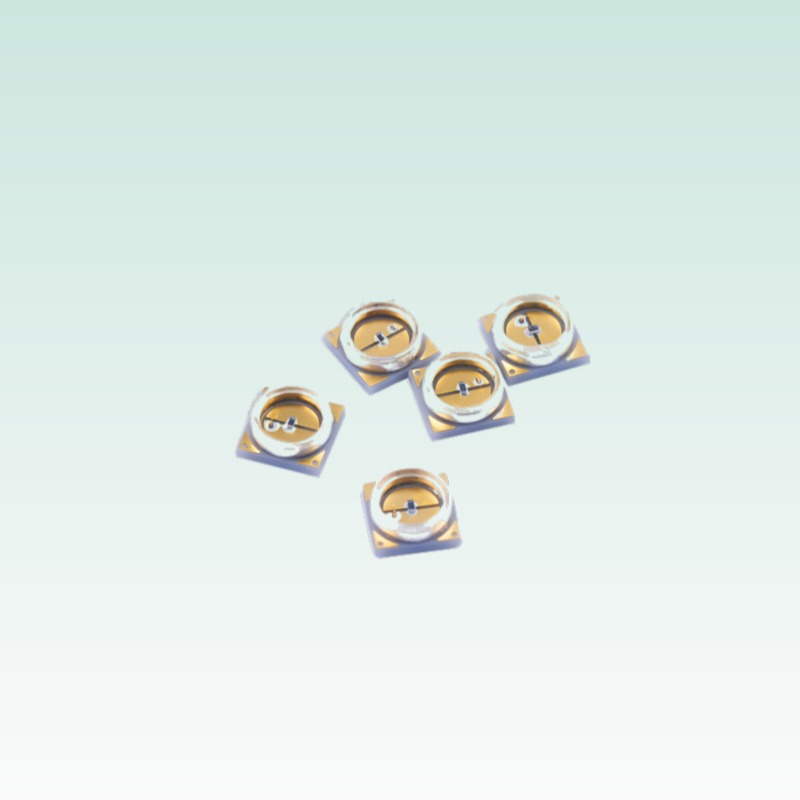
- Ceramic packages — the standard for high-power SWIR emitters. Ceramic substrates offer low thermal resistance, good coefficient-of-thermal-expansion (CTE) matching with the die, and stable performance at high drive currents. If your application needs sustained radiant power (sorting lines, continuous inspection), ceramic packaging is the reliable baseline.
- SMD-style packages — cost-effective for moderate power and board-level integration, but thermal path and power ceilings are lower. Suitable for sensing and alignment applications that do not require high radiant flux.
- COB and array modules — multiple dies on one substrate for higher total power and uniform illumination of a target area. Useful when the application needs broad-area SWIR illumination rather than a single beam.
When you evaluate packages, focus on the thermal path: junction-to-case thermal resistance (Rth j-c), maximum junction temperature, and the derating curve at your operating current. A well-designed ceramic package may run 10–20°C cooler at the junction than an equivalent SMD package at the same die — and that temperature difference translates directly into higher radiant output and longer life in your finished system.
Cost and total-cost-of-ownership reality check
SWIR LEDs are more expensive than NIR or visible LEDs per watt, and buyers should model total system cost, not unit price:
- Optics — SWIR-grade lenses and filters cost more than standard optics; verify the optical system is designed for your wavelength so transmission losses do not eat your radiant power budget;
- Detector matching — the camera or sensor (often InGaAs detectors in machine vision) is typically the most expensive component in the chain; the LED choice affects detector gain settings and integration time;
- Thermal design — heatsinking, airflow, and enclosure design cost scales with waste heat; efficiency differences between suppliers compound over the product life;
- Yield and reliability — a system that meets spec on first integration saves weeks of engineering time. Paying more for verified, tightly binned devices is usually the lower-cost decision.
Model the cost per acceptable part inspected (or per sorted tonne processed), and you will see why buyers of SWIR components treat supplier quality data as a first-class specification.
FAQss from professional buyers
Q1: Can I use one SWIR LED for multiple applications?
Rarely. Each application has a specific wavelength window and spectral contrast requirement. Design your optical system around the exact wavelength your inspection target requires.
Q2: Do SWIR LEDs need special drivers?
Not fundamentally — standard constant-current LED drivers work — but the low forward voltage of long-wavelength devices and their thermal sensitivity mean your driver and thermal design must be sized for SWIR-specific I-V characteristics.
Q3: Are SWIR LEDs eye-safe?
SWIR emission is invisible, which is itself a hazard: the blink reflex does not protect the eye. Evaluate photobiological safety per IEC 62471 for your application. Invisible light sources deserve caution, not complacency.
Q4: What is the typical lead time for custom wavelength SWIR LEDs?
Standard catalog wavelengths ship quickly. Custom epitaxial wavelengths require wafer runs and can take weeks to months. Confirm lead times and minimum quantities early in your design cycle.
Q5: How should I test incoming SWIR LEDs?
Do not rely only on a datasheet. Verify peak wavelength, radiant power, and forward voltage on a sample basis with calibrated equipment, and require batch-level test reports from your supplier.
Conclusion
SWIR LEDs are a specialist component for specialist applications, and that is precisely where they create value: food sorting, plastic recycling, semiconductor inspection, and precision instrumentation. Selecting the right wavelength, package, and supplier qualification data is the difference between a system that works on the first integration and one that burns engineering hours in rework.
At Queendom LED, we support professional buyers with SWIR LED chips and modules across the 970–1700 nm range, complete with spectral, thermal, and reliability documentation. Contact our engineering team to discuss your application wavelength and integration requirements.
Related Products
Further reading: SWIR LED Chips (970-1700nm) · How to Choose a SWIR LED Supplier
