



What Is an LED Chip and How Does It Work? | Queendom LED
What Is an LED Chip and How Does It Work?
An LED chip is the core light-emitting component inside every LED product. Whether you are designing a commercial lighting fixture, a grow light system, or an automotive headlamp, the LED chip determines your final performance: brightness, color accuracy, energy efficiency, and lifespan.
In this guide, we explain how an LED chip works, what materials engineers use, and why chip architecture matters for industrial buyers and lighting designers.
1. What Is an LED Chip?
An LED chip (also called an LED die) is a tiny semiconductor device that converts electrical energy directly into light. It sits inside the LED package — the component you solder or mount onto your PCB.
Think of the chip as the “engine” and the package as the “chassis.” The engine produces power; the chassis manages heat, optics, and electrical connections.
Key characteristics:
| Feature | Description |
|---|
| Material | Gallium Nitride (GaN), Gallium Arsenide (GaAs), or Gallium Phosphide (GaP) |
|---|---|
| Size | 0.2 mm × 0.2 mm to 2 mm × 2 mm |
| Voltage | 2V–3.5V (blue/white), 1.8V–2.2V (red/IR) |
| Current | 20 mA (small signal) to 3,500 mA (high-power COB) |
| Output | Single-color emission at a specific wavelength |
2. How Does an LED Chip Work? (The Science)
LED chips operate on a principle called electroluminescence. Here is the step-by-step process:
Step 1: Electron Injection
When you apply forward voltage across the LED chip, electrons flow from the N-type semiconductor layer into the P-type layer.
Step 2: Electron-Hole Recombination
At the junction between the N and P layers (the PN junction), electrons meet “holes” — spaces where electrons are missing. When an electron fills a hole, the electron drops from a higher energy state to a lower one.
Step 3: Photon Emission
That energy drop releases a photon — a particle of light. The wavelength (color) of the photon depends on the bandgap energy of the semiconductor material:
| Material | Bandgap | Emission Color | Typical Wavelength |
|---|
| GaN (Gallium Nitride) | 3.4 eV | Blue / UV / White | 450–470 nm |
|---|---|---|---|
| InGaN | 2.7–3.4 eV | Green / Blue / White | 380–550 nm |
| AlGaInP | 1.9–2.3 eV | Red / Orange / Yellow | 570–650 nm |
| GaAs | 1.4 eV | Infrared (IR) | 850–940 nm |
| GaP | 2.3 eV | Green / Yellow | 555–590 nm |
Step 4: Light Extraction
The photon must escape the chip material. Engineers use transparent substrates, surface roughening, and reflective layers to maximize how much light actually exits the chip.
Quantum efficiency — the ratio of photons out to electrons in — is the key metric. High-quality LED chips achieve 70–90% internal quantum efficiency.
3. Types of LED Chips
LED chips come in different form factors for different applications. Here are the most common types:
SMD LED Chips (Surface-Mount Device)
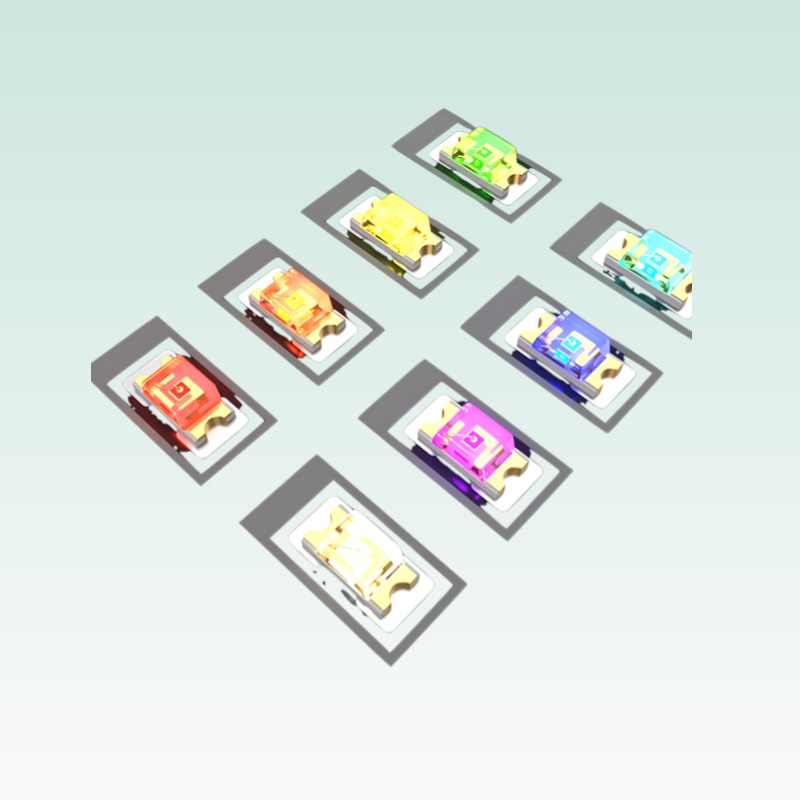
SMD LEDs are the most widely used format in modern lighting. They mount directly onto PCBs using automated pick-and-place machines.
| Model | Size (mm) | Power | Typical Application |
|---|
| **2835** | 2.8 × 3.5 | 0.2W–0.5W | LED tubes, panels, strips |
|---|---|---|---|
| **3528** | 3.5 × 2.8 | 0.06W | LED strips, indicators |
| **5050** | 5.0 × 5.0 | 0.2W | RGB strips, decorative lighting |
| **5630** | 5.6 × 3.0 | 0.5W | High-lumen panels, downlights |
| **3014** | 3.0 × 1.4 | 0.1W | Slim fixtures, backlighting |
Why SMD dominates: Low cost, high automation compatibility, good thermal management, and excellent luminous efficacy (130–180 lm/W).
High-Power LED Chips
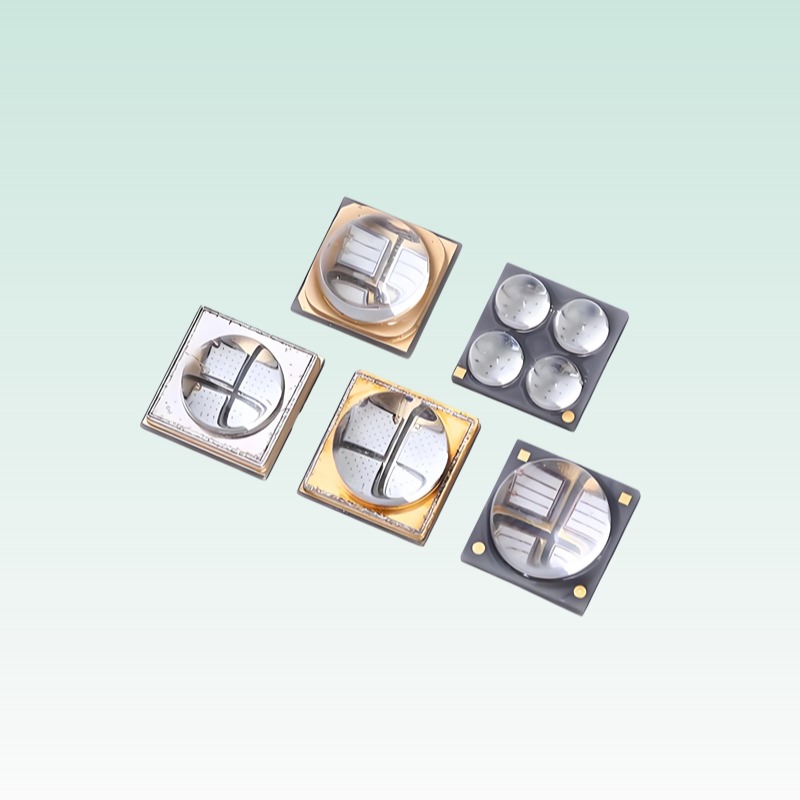
High-power LED chips handle 1W, 3W, 5W, or more per chip. They use larger dies, ceramic or metal substrates, and advanced heat-sinking.
| Power | Die Size | Current | Application |
|---|
| 1W | 1 mm² | 350 mA | Spotlights, MR16 bulbs |
|---|---|---|---|
| 3W | 1.5 mm² | 700 mA | Downlights, track lighting |
| 5W | 2 mm² | 1,400 mA | Floodlights, high-bay fixtures |
| 10W+ | 3+ mm² | 3,000 mA | Stadium lighting, grow lights |
High-power chips require careful thermal management. Without adequate heat sinking, junction temperature rises above 125°C, causing rapid lumen depreciation and color shift.
COB LED Chips (Chip-on-Board)
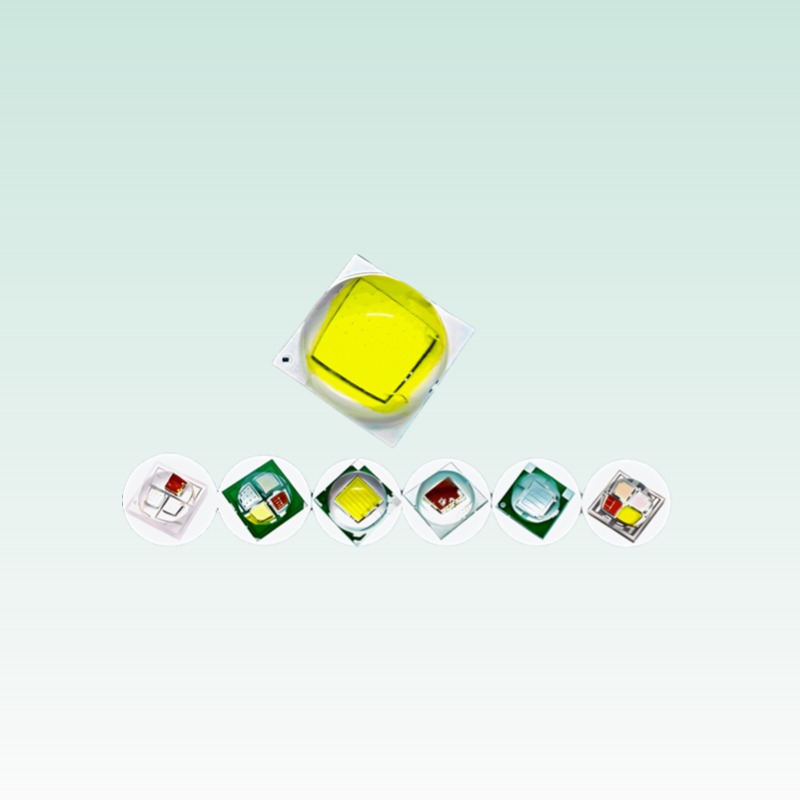
COB technology bonds multiple small LED dies directly onto a substrate, then encapsulates them with phosphor.
Advantages:
Applications: Street lights, high-bay lights, downlights, and projector lamps.
UV and IR LED Chips
UV LED chips (280–405 nm) use specialized AlGaN materials. They serve curing, sterilization, and fluorescence applications. IR LED chips (730–940 nm) use GaAs substrates for remote controls, security cameras, and night-vision systems.
Learn more about our UV LED products | Explore high-power LED options
4. What Determines LED Chip Quality?
Not all LED chips are equal. Professional buyers should evaluate these metrics:
4.1 Luminous Efficacy (lm/W)
Luminous efficacy measures how efficiently the chip converts watts to visible lumens. Premium chips reach 200+ lm/W in laboratory conditions; commercially available chips typically achieve 130–180 lm/W at 25°C junction temperature.
4.2 Color Rendering Index (CRI)
CRI measures how accurately the LED reproduces colors compared to natural light. High-CRI chips (Ra > 90) are essential for retail, medical, and photography lighting.
4.3 Color Consistency (Binning)
LED chips vary slightly in color due to manufacturing tolerances. Manufacturers sort chips into “bins” by color coordinates (CIE x, y) and forward voltage. Tight binning (3-step MacAdam ellipse) ensures consistent color across a lighting installation.
4.4 Thermal Resistance (Rth)
Lower thermal resistance means heat flows more easily from the chip junction to the heat sink. Typical values:
| Package Type | Thermal Resistance (Rth) |
|---|
| Standard 2835 | 50–80 K/W |
|---|---|
| High-power ceramic | 3–8 K/W |
| COB module | 0.5–2 K/W |
4.5 Forward Voltage (Vf) Tolerance
Consistent Vf is critical for parallel circuit designs. Tight Vf binning (±0.1V) prevents current hogging and thermal runaway.
5. Common Applications by LED Chip Type
| Application | Recommended Chip Type | Why |
|---|
| LED tube light | SMD 2835 | High efficacy, even light distribution |
|---|---|---|
| Downlight / panel | SMD 2835 / 5630 or COB | Good lumens per watt, slim profile |
| Street light | COB or high-power array | High lumen density, long-distance throw |
| Grow light | High-power or COB + custom spectrum | PPFD requirements, targeted wavelengths |
| Automotive | High-power ceramic | Shock resistance, wide temperature range |
| UV curing | UV LED (365–405 nm) | Precise wavelength, instant on/off |
| Security IR | IR LED (850–940 nm) | Invisible illumination, long range |
6. FAQ: LED Chip Questions
Q1: Can I replace one LED chip brand with another?
Only if the replacement matches Vf, dimensions, and optical characteristics. Swapping chips without verifying compatibility can cause flickering, color shift, or driver failure.
Q2: How long do LED chips last?
Quality LED chips last 50,000+ hours (L70 rating). However, poor thermal management or overdriving can reduce lifespan to under 10,000 hours.
Q3: Why do white LED chips look different from warm white?
White LEDs use blue chips + yellow phosphor. Warm white adds more red phosphor, shifting the color temperature from 6500K (cool) to 3000K (warm).
Q4: What is the difference between LED chip and LED package?
The chip is the bare semiconductor die. The package includes the chip, bonding wires, encapsulant, lens, and leads — everything needed to mount and power the chip.
Conclusion
Understanding how an LED chip works helps you make better procurement and design decisions. The chip material determines the color; the architecture determines the power handling; and the manufacturing quality determines the lifespan and consistency.
At Queendom LED, we supply a full range of LED chips — from SMD 2835/5050 for commercial lighting to high-power COB modules for industrial applications and UV/IR chips for specialized use cases. All chips undergo strict binning and 100% aging testing before shipment.
Contact us for custom wavelength, power, or packaging requirements. We provide free samples and technical datasheets for qualified buyers.

 English
 Afrikaans
 Albanian
 Amharic
 Arabic
 Armenian
 Azerbaijani
 Basque
 Belarusian
 Bengali
 Bosnian
 Bulgarian
 Catalan
 Cebuano
 Chichewa
 Corsican
 Croatian
 Czech
Czech Danish
 Dutch
Dutch Esperanto
 Estonian
 Filipino
 Finnish
 French
 Frisian
 Galician
 Georgian
 German
 Greek
Greek Gujarati
 Haitian Creole
 Hausa
Hausa Hawaiian
 Hebrew
 Hindi
Hindi Hmong
Hmong Hungarian
 Icelandic
 Igbo
Igbo Indonesian
 Irish
Irish Italian
 Japanese
 Javanese
 Kannada
 Kazakh
 Khmer
Khmer Korean
 Kurdish (Kurmanji)
 Kyrgyz
 Lao
Lao Latin
Latin Latvian
 Lithuanian
 Luxembourgish
 Macedonian
 Malagasy
 Malay
Malay Malayalam
 Maltese
 Maori
Maori Marathi
 Mongolian
 Myanmar (Burmese)
 Nepali
 Norwegian
 Pashto
 Persian
 Polish
 Portuguese
 Punjabi
 Romanian
 Russian
 Samoan
 Scottish Gaelic
 Serbian
 Sesotho
 Shona
Shona Sindhi
 Sinhala
 Slovak
 Slovenian
 Somali
 Spanish
 Sudanese
 Swahili
 Swedish
 Tajik
Tajik Tamil
Tamil Telugu
 Thai
Thai Turkish
 Ukrainian
 Urdu
Urdu Uzbek
Uzbek Vietnamese
 Welsh
Welsh Xhosa
Xhosa Yiddish
 Yoruba
 Zulu
Zulu