
 English
 Afrikaans
 Albanian
 Amharic
 Arabic
 Armenian
 Azerbaijani
 Basque
 Belarusian
 Bengali
 Bosnian
 Bulgarian
 Catalan
 Cebuano
 Chichewa
 Corsican
 Croatian
 Czech
Czech Danish
 Dutch
Dutch Esperanto
 Estonian
 Filipino
 Finnish
 French
 Frisian
 Galician
 Georgian
 German
 Greek
Greek Gujarati
 Haitian Creole
 Hausa
Hausa Hawaiian
 Hebrew
 Hindi
Hindi Hmong
Hmong Hungarian
 Icelandic
 Igbo
Igbo Indonesian
 Irish
Irish Italian
 Japanese
 Javanese
 Kannada
 Kazakh
 Khmer
Khmer Korean
 Kurdish (Kurmanji)
 Kyrgyz
 Lao
Lao Latin
Latin Latvian
 Lithuanian
 Luxembourgish
 Macedonian
 Malagasy
 Malay
Malay Malayalam
 Maltese
 Maori
Maori Marathi
 Mongolian
 Myanmar (Burmese)
 Nepali
 Norwegian
 Pashto
 Persian
 Polish
 Portuguese
 Punjabi
 Romanian
 Russian
 Samoan
 Scottish Gaelic
 Serbian
 Sesotho
 Shona
Shona Sindhi
 Sinhala
 Slovak
 Slovenian
 Somali
 Spanish
 Sudanese
 Swahili
 Swedish
 Tajik
Tajik Tamil
Tamil Telugu
 Thai
Thai Turkish
 Ukrainian
 Urdu
Urdu Uzbek
Uzbek Vietnamese
 Welsh
Welsh Xhosa
Xhosa Yiddish
 Yoruba
 Zulu
Zulu

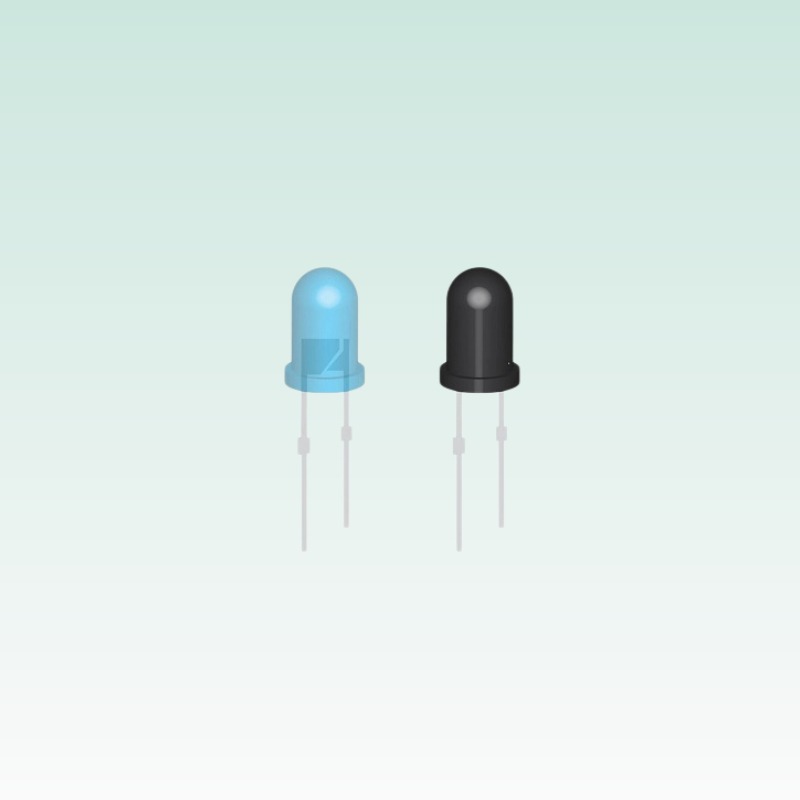








Infrared (IR) LEDs are the invisible workhorses of modern sensing technology. From your phone’s proximity sensor to factory safety light curtains, IR LEDs enable a vast range of detection, ranging, and communication applications. The two most common IR LED wavelengths — 850nm and 940nm — each have distinct properties that make them better suited for different use cases.
Why IR LEDs for Sensing?
Infrared light sits just beyond the visible spectrum (above 700nm). IR LEDs are ideal for sensing because:
- Invisibility to the human eye — the sensor can operate without visible distraction
- High radiant efficiency — modern IR LEDs convert electrical power to IR light very efficiently
- Fast switching — IR LEDs can be modulated at MHz frequencies, enabling sophisticated detection schemes
- Low cost — mass production has driven prices down dramatically
- Compact size — small packages fit into virtually any device
- Higher radiant power — 850nm LEDs typically deliver 20–30% more output power than equivalent 940nm LEDs
- Better silicon photodiode response — silicon detectors are more sensitive at 850nm than at 940nm (peak sensitivity around 800–900nm)
- Slight red glow — at high currents, 850nm LEDs produce a faint red glow that’s visible in dark environments
- Wider availability — more manufacturers, more package options, better pricing
- Maximum detection range is needed
- The faint red glow is acceptable or desirable (e.g., visible for setup/verification)
- Cost sensitivity is high
- Low-light environments where the glow isn’t a concern
- Completely invisible — no red glow whatsoever, even at high drive currents
- Less sensitivity to ambient light — sunlight and indoor lighting have less IR content at 940nm, reducing false triggers
- Lower power output — 20–30% less radiant power than equivalent 850nm LEDs
- Slightly higher cost — narrower market than 850nm
- The glow would be distracting or reveal the sensor’s position
- Outdoor or high-ambient-light operation
- Consumer electronics where aesthetics matter
- Security and surveillance applications
- Found in smartphones, smart speakers, and smart displays
- 850nm most common — the tiny sensor is usually hidden behind a bezel
- Used for screen auto-dimming and call proximity detection
- PIR (Passive Infrared) sensors detect body heat, but active IR sensors use IR LEDs for precise distance measurement
- Used in smart lighting, security cameras, and home automation
- 940nm preferred for indoor smart home use — no visible red dots
- IR LED arrays paired with multi-element photodiodes detect hand movements
- Used in smart TVs, kitchen appliances, and automotive infotainment
- 850nm preferred for better sensitivity and range
- The classic IR LED application — nearly every remote control uses a 940nm IR LED
- Modulated at 38kHz or similar frequency to avoid ambient light interference
- 940nm chosen because the glow isn’t visible to users
- IR LED arrays provide structured illumination for face recognition
- Works in complete darkness
- 940nm preferred — no visible glow when the lock activates
- Through-beam, retro-reflective, and diffuse-reflective types
- Used for object detection, counting, and positioning on assembly lines
- 850nm dominates for maximum range (up to 100m for through-beam)
- Arrays of IR LEDs and receivers create an invisible protective barrier
- Stop machinery when a person or object breaks the beam
- 850nm for maximum reliability and range
- Must meet strict safety standards (IEC 61496, ISO 13849)
- IR LEDs paired with photodetectors and coded discs measure rotation
- Used in motors, conveyor systems, and robotics
- 850nm or 940nm both common — chosen based on detector pair availability
- IR LEDs inside smoke chambers detect light scattered by smoke particles
- 940nm common — matches the peak scattering response for typical smoke particle sizes
- IR LEDs detect the presence or absence of liquid based on refraction
- Used in industrial tanks, medical equipment, and consumer appliances
- 940nm often preferred for better liquid penetration
The most common sensing architecture uses an IR LED paired with a photodiode or phototransistor. The LED emits IR light, and the detector measures how much light reflects back (proximity) or passes through (beam break / object counting).
850nm IR LEDs — High Sensitivity, Visible Glow
850nm is the most widely used IR wavelength for sensing applications. It sits closer to the visible spectrum than 940nm, which gives it both advantages and tradeoffs.
Key characteristics:
Best for applications where:
940nm IR LEDs — Truly Invisible, Less Interference
940nm LEDs emit deeper into the infrared spectrum, making them completely invisible to the human eye under all conditions.
Key characteristics:
Best for applications where:
Application Spotlight: Smart Home
The smart home market is one of the fastest-growing segments for IR LEDs.
1. Proximity and Ambient Light Sensors
2. Motion Sensors
3. Gesture Recognition
4. IR Remote Control
5. Smart Lock Face Recognition
Application Spotlight: Industrial Sensing
Industrial environments demand reliability, durability, and long range.
1. Photoelectric Sensors
2. Safety Light Curtains
3. Optical Encoders
4. Smoke Detectors
5. Liquid Level Sensors
How to Choose: 850nm or 940nm
| Factor | 850nm | 940nm |
|---|---|---|
| Output power | Higher (+20-30%) | Lower |
| Detector sensitivity | Higher | Lower |
| Visible glow | Faint red glow | Completely invisible |
| Ambient light interference | More (sunlight has 850nm content) | Less |
| Cost | Lower | Slightly higher |
| Maximum range | Better | Good |
| Best choice if you need… | Max range, low cost | No glow, outdoor use |
Design Tips for IR LED Sensing
1. Use modulation — Drive the IR LED with a modulated signal (e.g., 38kHz) and use a tuned receiver. This dramatically reduces false triggers from ambient light.
2. Optimize drive current — Pulse the LED at higher current for short bursts instead of running at DC. This increases peak output without exceeding thermal limits.
3. Add optical elements — Lenses or reflectors can collimate the IR beam, increasing range and reducing side lobes.
4. Consider angle — Wide-angle LEDs (120°+) are better for proximity; narrow-angle (15–30°) for long-range sensing.
5. Test in your environment — Always validate performance in the actual operating environment, accounting for surface reflectivity, temperature, and ambient light.
Queendom LED supplies a full range of 850nm and 940nm IR LEDs in through-hole, SMD, and high-power packages, with custom wavelengths and optical configurations available for industrial and smart home applications.
Published for educational purposes — Queendom LED Technical Resources
Further reading: Infrared LEDs for Night Vision · 730nm vs 850nm Wavelength Guide
