
 English
 Afrikaans
 Albanian
 Amharic
 Arabic
 Armenian
 Azerbaijani
 Basque
 Belarusian
 Bengali
 Bosnian
 Bulgarian
 Catalan
 Cebuano
 Chichewa
 Corsican
 Croatian
 Czech
Czech Danish
 Dutch
Dutch Esperanto
 Estonian
 Filipino
 Finnish
 French
 Frisian
 Galician
 Georgian
 German
 Greek
Greek Gujarati
 Haitian Creole
 Hausa
Hausa Hawaiian
 Hebrew
 Hindi
Hindi Hmong
Hmong Hungarian
 Icelandic
 Igbo
Igbo Indonesian
 Irish
Irish Italian
 Japanese
 Javanese
 Kannada
 Kazakh
 Khmer
Khmer Korean
 Kurdish (Kurmanji)
 Kyrgyz
 Lao
Lao Latin
Latin Latvian
 Lithuanian
 Luxembourgish
 Macedonian
 Malagasy
 Malay
Malay Malayalam
 Maltese
 Maori
Maori Marathi
 Mongolian
 Myanmar (Burmese)
 Nepali
 Norwegian
 Pashto
 Persian
 Polish
 Portuguese
 Punjabi
 Romanian
 Russian
 Samoan
 Scottish Gaelic
 Serbian
 Sesotho
 Shona
Shona Sindhi
 Sinhala
 Slovak
 Slovenian
 Somali
 Spanish
 Sudanese
 Swahili
 Swedish
 Tajik
Tajik Tamil
Tamil Telugu
 Thai
Thai Turkish
 Ukrainian
 Urdu
Urdu Uzbek
Uzbek Vietnamese
 Welsh
Welsh Xhosa
Xhosa Yiddish
 Yoruba
 Zulu
Zulu
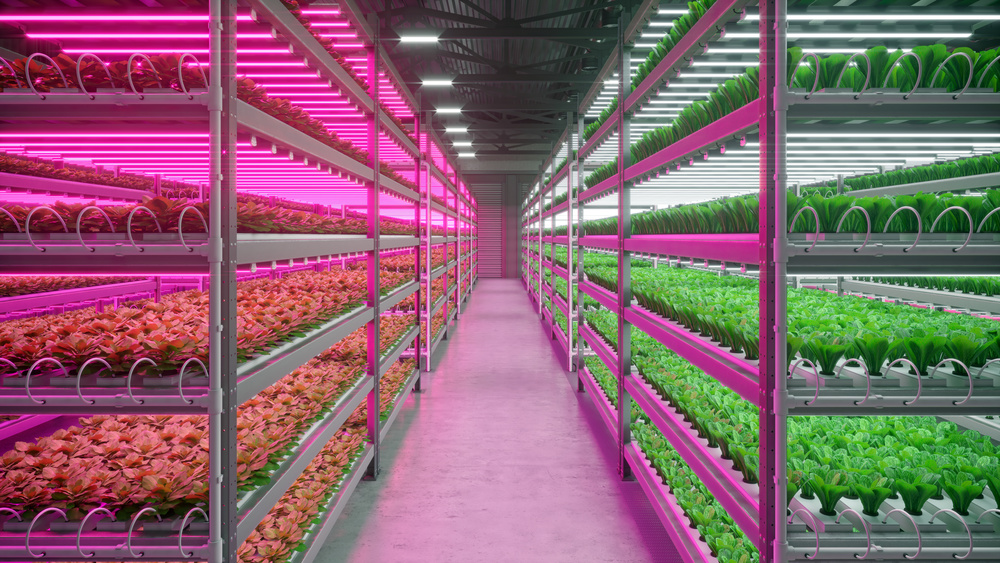



Wattage tells you how much electricity a grow light consumes. PPFD tells you what the plant actually receives — and it is the number that separates productive fixtures from expensive ornaments. This guide explains PPFD and its related metrics, and how to read grow light specifications like a horticultural engineer.
The Metric Chain: PPF → PPFD → DLI
- PPF (Photosynthetic Photon Flux): total PAR photons emitted by the fixture per second, measured in μmol/s. This is a property of the fixture alone — like luminous flux (lm) in general lighting.
- PPFD (Photosynthetic Photon Flux Density): photons landing on a given area of canopy per second, in μmol/m²/s. This is what the plant experiences — it depends on the fixture, mounting height, beam angle, and fixture spacing.
- DLI (Daily Light Integral): the cumulative daily dose, mol/m²/day — PPFD integrated over the photoperiod. Plants integrate light over the day; DLI is the yield-driving variable.
- Linear tubes (T8/T10/T12 grow tubes) — multitier racks, uniform close-canopy lighting for greens and propagation
- Flat panels — even coverage at fixed heights in vertical farms
- High-bay / top-lighting — single-layer greenhouses and tall-crop facilities supplementing sunlight
- Full-spectrum panels — flexible small-scale and research use
A fixture with impressive PPF can still deliver poor PPFD at canopy level if its optics spread light unevenly or the layout wastes photons on aisles.
Target PPFD by Crop and Stage
| Crop / stage | Target PPFD (μmol/m²/s) | Typical DLI target |
|---|---|---|
| Microgreens, sprouts | 100–200 | 6–10 |
| Leafy greens (lettuce, basil) | 200–350 | 12–17 |
| Culinary herbs | 200–400 | 12–18 |
| Propagation / seedlings | 150–300 | 8–13 |
| Fruiting crops (tomato, pepper) | 400–700 | 20–30 |
| Cannabis (where legal) | 600–1000+ | 30–45 |
| Rooftop / greenhouse supplement | Varies with sunlight | Gap to crop DLI target |
Exceeding crop-appropriate PPFD wastes energy and can cause photoinhibition; undersupply stretches growth and extends cycles. Matching PPFD to the crop is the core economic decision in a plant factory.
Reading Manufacturer Specifications Critically
1. Ask for PPFD maps, not a single number — a center-point PPFD reading hides edge falloff. A useful map shows values on a grid at a stated mounting height and coverage area
2. Check the measurement height — PPFD rises as the sensor moves closer; comparing a 30cm reading with a 60cm reading is meaningless
3. Compute uniformity — the ratio of minimum to average PPFD across the growing area; below ~0.7, edge plants lag noticeably
4. Verify PPF efficacy (μmol/J) — current-generation fixtures deliver 2.5–3.5 μmol/J; this drives your energy cost per kg of produce
5. Beware “full spectrum” without spectra data — ask for the relative spectral power distribution; red fraction and far-red presence shape morphology alongside PPFD
Sizing Example: Leafy Greens Layer
A 1.2m × 2.4m layer targeting 250 μmol/m²/s average for 16 hours: DLI = 250 × 3600 × 16 / 1,000,000 = 14.4 mol/m²/day — squarely in the productive range for lettuce. If the chosen linear fixture delivers an average 22 μmol/m²/s per meter of fixture at the working height, the layer needs roughly 12 meters of fixture length, arranged for uniformity rather than a single bright band. This is the calculation our T8 integrated LED grow tubes and L1–L3 linear grow lights are typically deployed in for multi-layer leafy-green production.
Fixture Formats and Their PPFD Roles
Our full-spectrum LED grow panel, flat panel grow light, and high-bay plant grow lights cover these formats, and the greenhouse tomato grow light case documents measured results in a fruiting-crop environment.
Control and Dimming
Dimming multiplies the value of correct PPFD design: propagation stages run at reduced output, and PPFD can track electricity tariffs. Specify fixtures with 0–10V or PWM dimming and, for research-grade environments, per-channel spectral control.
Queendom LED manufactures horticultural fixtures with published PPFD maps, spectral distributions, and μmol/J efficacy data, supporting plant factory and greenhouse projects from leafy greens through fruiting crops.
Published for educational purposes — Queendom LED Technical Resources
Further reading: Horticultural LED Lighting | PPFD, Spectrum & DLC FAQ · Greenhouse Tomato Grow Light Case
