

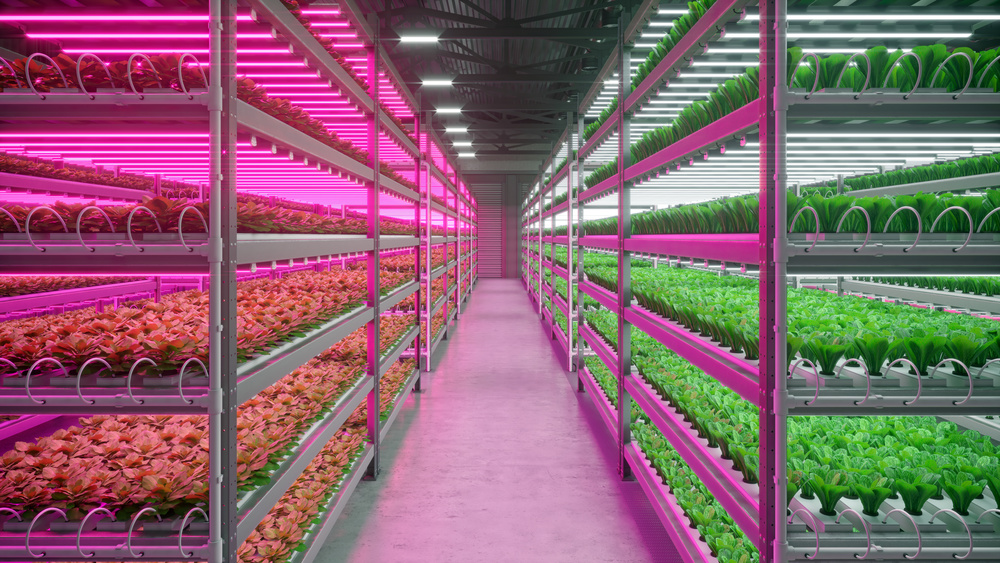



Different crop stages run on different photon budgets, and a fixture that only runs at 100% wastes energy and stresses plants. Seedlings tolerate roughly 100-250 umol/m2/s, vegetative leafy greens commonly run 250-400 umol/m2/s, and fruiting stages need more. The fix is not a brighter fixture. It is a controlled ramp of intensity over time: the grow light dimming curve.
Stage Targets Set the Shape of the Curve
An abrupt jump in PPFD can trigger photoinhibition, leaf bleaching and measurable stress responses, so every change in intensity should be a ramp, not a step. Set the target per stage first:
| Crop stage | PPFD target (umol/m2/s) | Photoperiod (h) | Transition practice |
|---|---|---|---|
| Seedling / propagation | 100-250 | 16-18 | 30-60 min ramp at lights-on |
| Vegetative leafy greens | 250-400 | 16-18 | Step the target up over 1-3 days |
| Fruiting, high light | 400-550 | 18 | Long ramp into the recipe, dim during rest hours |
Between stages, a propagation rack moves from the seedling recipe to the vegetative recipe by stepping the target PPFD up over hours or days rather than instantly. Inside a single day, the schedule repeats the same shape: a gradual rise at lights-on, higher PPFD during peak assimilation hours, reduced intensity during rest periods, and a smooth fade at lights-off that simulates sunrise and sunset. Rest-period dimming keeps the daily photon total on target while shifting output into the hours the crop uses best. Because the curve is stored in the controller, the schedule repeats identically every day, which matters for research protocols and for consistent crop timing.
Consider what a flat 100% run actually costs. A fixture sized for a fruiting stage at 500 umol/m2/s, held flat over a seedling tray that needs 150, delivers more than three times the target. The surplus becomes heat, bleach and wasted kilowatt-hours. Dimming closes that gap: the same fixture runs near 30% during propagation, then climbs as the canopy matures. The energy saving follows from the photon budget, not from a marketing claim.
0-10 V vs DALI: The Hardware Behind the Curve
LED grow lights with 0-10 V dimming handle the majority of greenhouse installs. DALI adds two-way digital communication, addressable groups and runtime logging, which is why large greenhouses and research facilities increasingly standardize on it. Group addresses let one controller hold separate curves for propagation, vegetative and fruiting zones, and runtime logs prove what the crop actually received. Confirm the curve is implemented in the driver or controller, not bolted onto the lamp.
Dimming has a second benefit beyond plant response. Running the fixture at reduced current lowers junction temperature, which slows lumen depreciation and driver capacitor aging and extends the L70 lifetime. Thermal load on the room also drops, cutting cooling demand in summer.
Specify It, Then Verify It
Three checks before purchase, two habits after.
Before purchase:
- Confirm the fixture dims smoothly across the whole range. Many drivers are clean at 100% but flicker or lose color consistency below 20% output.
- Ask for percent flicker data across the dimming range if the crop is sensitive or if cameras monitor the racks.
After installation:
- Log the schedule and the actual runtime, and clean the optics after each crop stage.
- Once per season, check that the delivered PPFD at 100% still matches the design value. A quantum sensor spot-check on a 9-point grid per zone is enough to catch drift. The curve cannot compensate for light lost to dirty optics or aged LEDs.
FAQ
What happens if PPFD jumps instantly between stages?
Expect photoinhibition and leaf bleaching on tender foliage. Step the target up over 1-3 days instead.
Does dimming shorten LED lifetime?
The opposite. Lower drive current reduces junction temperature, which slows L70 depreciation and driver capacitor aging.
Is 0-10 V enough for a small facility?
Yes, for a single room with fixed schedules. DALI earns its cost when you need addressable groups, runtime logs and reproducible recipes.
