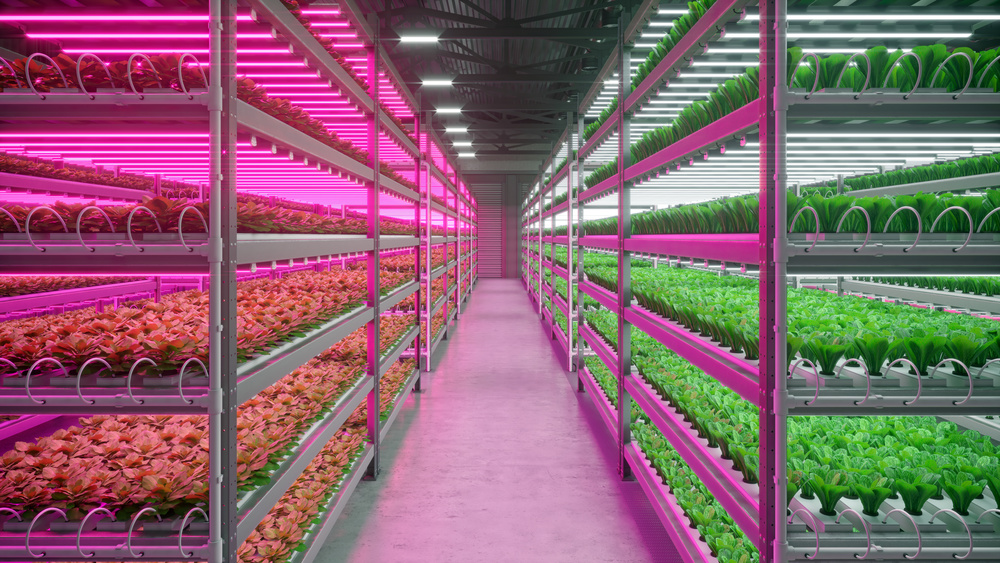



The Dutch government has launched a dedicated grant program supporting greenhouse operators that replace legacy lighting with high-efficiency LED horticultural systems. The scheme covers up to 40% of total investment costs for DLC QPL-qualified LED systems replacing aging high-pressure sodium installations. At a moment when energy prices and sustainability reporting both pressure the sector, this is one of the most generous public co-funding schemes in European horticulture. It also positions LED technology as central to the Dutch horticultural sustainability strategy.
What the grant covers
Eligible spending centers on certified LED systems that displace sodium installations, with priority allocation steered toward specific crop groups and system capabilities.
| Parameter | Detail |
|---|---|
| Co-funding rate | Up to 40% of total investment cost |
| Eligible systems | DLC QPL-qualified LED replacing high-pressure sodium |
| Priority crops | Tomato, cucumber, and ornamental producers |
| Priority scope | Full-spectrum LED with integrated SWIR monitoring for automated quality sorting |
Why SWIR monitoring earns priority funding
The inclusion of SWIR monitoring signals a policy shift: next-generation horticultural investment is not only about growing light efficiency but about post-harvest quality control. Short-wave infrared illumination enables non-contact foreign object detection and ripeness assessment on high-speed grading lines. For Dutch producers supplying high-value export markets, grading accuracy directly protects brand quality and reduces manual inspection labor. Vendors marketing SWIR grading modules into the Dutch market should expect procurement teams to ask for integration references from comparable grading lines. A grant that funds the sorting layer alongside the grow layer treats the greenhouse as one integrated production system, from lamp to packed box.
The energy math behind the subsidy
Lighting typically represents the single largest electricity load in Dutch high-tech greenhouses. The replacement math is direct: a 1 ha greenhouse running 200 umol/m2/s for a 16 h photoperiod draws roughly 18,800 kWh per day at a sodium-era 1.7 umol/J, versus about 11,900 kWh at 2.7 umol/J — a cut of nearly 37% on lighting energy alone. At €0.20/kWh that saving approaches €0.5 million per year per hectare (to be verified). Grid connection headroom improves too, since a retrofitted LED bay frees electrical capacity that growers can redirect to climate control or expansion. Because the program aligns with the Netherlands’ national carbon reduction commitments for protected agriculture, every certified LED retrofit delivers immediate emissions reductions while supporting year-round production competitiveness. For growers, the grant converts part of the capital barrier of LED transition into an operational decision with quantified energy returns.
What suppliers and growers should do now
For suppliers, the program rewards certification and full-spectrum capability. Products must hold a current DLC QPL listing, ship with complete spectral documentation, and increasingly demonstrate integration with quality sorting and monitoring systems. Exporters serving the Dutch market should align product strategies with the grant’s technical priorities before the next application cycle opens.
Documentation decides the outcome. Growers should assemble the current HPS load profile, the proposed LED light plan, and supplier spectral data before the application window opens; incomplete files are the usual reason applications stall (to be verified). Suppliers that pre-package grant-ready documentation bundles — efficacy test data, DLC QPL listing numbers, and integration drawings — shorten the path from quote to funded order.
Growers should move quickly. Funding allocation is expected to be competitive across the concentrated Dutch greenhouse sector, and program cycles close on fixed schedules (to be verified). Early applicants also benefit from the technical assistance attached to the grant, which helps growers model light plans and energy savings before committing to a final system design. A modeled light plan is also the document a funding officer will ask for first.
Key Takeaways
- Up to 40% co-funding is available for DLC QPL-qualified LED retrofits replacing high-pressure sodium in Dutch greenhouses.
- Priority funding targets tomato, cucumber, and ornamental projects that add SWIR-based automated quality sorting.
- Apply early: allocation is competitive and cycles close on fixed schedules; attached technical assistance models light plans and savings first.
Fact-check status: source list pending
