
 English
 Afrikaans
 Albanian
 Amharic
 Arabic
 Armenian
 Azerbaijani
 Basque
 Belarusian
 Bengali
 Bosnian
 Bulgarian
 Catalan
 Cebuano
 Chichewa
 Corsican
 Croatian
 Czech
Czech Danish
 Dutch
Dutch Esperanto
 Estonian
 Filipino
 Finnish
 French
 Frisian
 Galician
 Georgian
 German
 Greek
Greek Gujarati
 Haitian Creole
 Hausa
Hausa Hawaiian
 Hebrew
 Hindi
Hindi Hmong
Hmong Hungarian
 Icelandic
 Igbo
Igbo Indonesian
 Irish
Irish Italian
 Japanese
 Javanese
 Kannada
 Kazakh
 Khmer
Khmer Korean
 Kurdish (Kurmanji)
 Kyrgyz
 Lao
Lao Latin
Latin Latvian
 Lithuanian
 Luxembourgish
 Macedonian
 Malagasy
 Malay
Malay Malayalam
 Maltese
 Maori
Maori Marathi
 Mongolian
 Myanmar (Burmese)
 Nepali
 Norwegian
 Pashto
 Persian
 Polish
 Portuguese
 Punjabi
 Romanian
 Russian
 Samoan
 Scottish Gaelic
 Serbian
 Sesotho
 Shona
Shona Sindhi
 Sinhala
 Slovak
 Slovenian
 Somali
 Spanish
 Sudanese
 Swahili
 Swedish
 Tajik
Tajik Tamil
Tamil Telugu
 Thai
Thai Turkish
 Ukrainian
 Urdu
Urdu Uzbek
Uzbek Vietnamese
 Welsh
Welsh Xhosa
Xhosa Yiddish
 Yoruba
 Zulu
Zulu

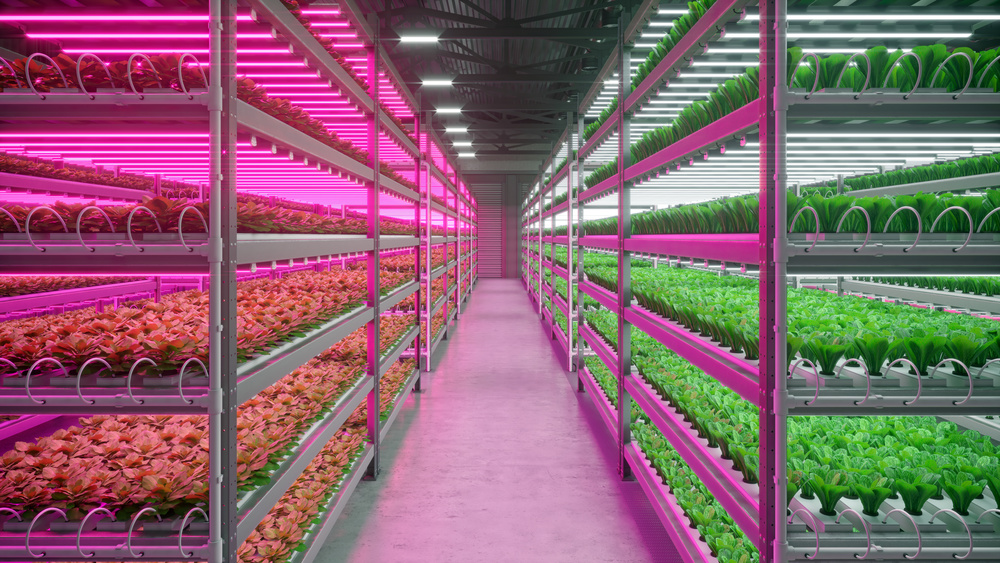



Beam angle is the main lever for balancing intensity and coverage from a UFO-style high bay grow light. A narrow optic concentrates photons and lifts center PPFD; a wide optic spreads the beam and raises uniformity at lower peak values. There is no universally correct angle, only the angle that matches mounting height, target DLI and row spacing.
What Beam Angle Actually Changes
Two effects follow from geometry. First, footprint: the lit pool diameter approximates 2 x height x tan(beam angle / 2). At 4 m above the canopy, a 60 degree optic covers about 4.6 m, a 90 degree optic about 8.0 m, and a 120 degree optic about 13.9 m. Second, intensity: the same fixture PPF squeezed into a smaller cone raises the center value. A 90 degree optic delivers roughly 1.7x the center PPFD of a 120 degree optic from the identical fixture, because the cone solid angle is 1.84 sr versus 3.14 sr.
Selection Table for Greenhouse Mounting Heights
| Optic | Footprint at 4 m | Best fit | Watch-out |
|---|---|---|---|
| 60 degrees | ~4.6 m | mounts above 5-6 m, high-PPFD rows | more units, tighter spacing |
| 90 degrees | ~8.0 m | standard truss mount, 3-5 m | verify edge dips between fixtures |
| 120 degrees | ~13.9 m | wide-span houses, low mount 2.5-3 m | aisle spill and wall waste |
| Asymmetric | rectangular pattern | single-sided benches and rail rows | rotation alignment during install |
For a truss-mounted fixture 3-5 m above the canopy, 90 degrees is the common starting point: enough concentration to reach useful PPFD with workable bench coverage. Wide-span layouts that would otherwise show edge shadowing between rows usually prefer 120 degrees or an asymmetric distribution aimed to overlap at the aisle.
Spacing and Uniformity Rules
Practical starting points: space 90 degree fixtures at roughly the mounting height, and space 120 degree fixtures at 1.2-1.4x the height. Whatever the layout, judge it on the PPFD map rather than the average alone. A high average with deep dips between fixtures wastes photons and produces uneven crops. Target a minimum-to-average uniformity of 0.7 or better across the productive area, and 0.8 for propagation trays, where seedlings cannot compensate for weak zones.
Beam angle also interacts with structure. A higher mount with a narrow beam can mimic the footprint of a lower mount with a wide beam, but it adds interception losses on trusses and wires. Wide-beam fixtures need careful aiming to avoid spilling light into aisles and onto walls, where it does nothing for the crop; narrow-beam fixtures need closer spacing and therefore more units for the same coverage.
How to Decide Before You Buy
Ask the supplier to run simulated PPFD maps at your real mounting heights, with the fixture’s actual IES file and your crop’s DLI target. Check three numbers on each map: average PPFD over the bench, minimum-to-average uniformity, and spill into aisles or onto walkways. For North American rebate projects, confirm the fixture appears on the DLC QPL at the efficacy tier your energy model assumes. The map comparison settles the choice faster than any datasheet.
FAQ
Can I mix beam angles in one house?
Yes. Perimeter rows often use wider or asymmetric optics to pull edge PPFD up to the center level without raising fixture count.
Does a higher mount with a narrow beam equal a lower mount with a wide beam?
Approximately for footprint, but structure interception and air losses differ, so simulate both options before committing.
How do I check uniformity on site?
Measure PPFD on a 1-1.5 m grid at canopy level with a quantum sensor and compare the min/avg ratio against the simulation.
