



The IP code gets all the attention in luminaire specifications, yet it never answers the question that matters most in an industrial hall: what happens when something hits the fixture? The IK code, defined in IEC 62262, classifies the impact energy an enclosure can withstand. IP protects against dust and water; IK protects against the fork-lift mast, the dropped wrench and the swinging load. The two codes answer different failure modes, and both belong on the same datasheet.
What the IK Scale Means
| IK Code | Impact Energy | Typical Equivalent Hazard |
|---|---|---|
| IK01 | 0.14 J | Accidental light contact |
| IK04 | 0.5 J | Dropped small parts |
| IK06 | 1 J | Dropped hand tool |
| IK07 | 2 J | Kicked or knocked fixture |
| IK08 | 5 J | Fork-lift mast contact, heavy tool impact |
| IK09 | 10 J | Vandalism-level impact |
| IK10 | 20 J | Heavy collisions in industrial and public settings |
The scale runs from IK01 at 0.14 joules up to IK10 at 20 joules. IK08 and IK10 are the levels most often specified for machinery halls, warehouses, car washes and public infrastructure. IK00 exists as a marking for enclosures with no impact protection at all.
How the Test Works
Certification laboratories strike the enclosure with calibrated impact masses — pendulum hammers, spring hammers and drop hammers — from defined heights and at defined impact points. Low-energy levels are tested with spring hammers, mid-range levels with pendulum hammers, and the top of the scale with drop weights; every method applies the same calibrated energy, so the code compares like with like. The product passes when the housing, the optical cover and the seals remain safe and functional after the strike: no cracks that expose live parts, no gaps that break the ingress protection, no mounting failure that lets the fixture drop.
A rating without a test certificate is a marketing claim, not a specification. Verify the IK marking on the delivered product against the certificate; a thick housing without verified testing is not an IK10 product, and photos of heavy construction prove nothing.
Why a High IP Rating Is Not Enough
Impact failure costs more than one lamp. A shattered optical cover above a production line means falling debris, a maintenance call, production downtime and potentially a safety incident — all from a collision the IP code was never designed to address. For LED luminaires there is a second cost: heat. Dents and deformed housings change the thermal path between the light engine and the ambient air, and a fixture that survives the strike can still age faster afterward — shortened driver life, earlier lumen depreciation, and a warranty conversation nobody planned for.
Construction details separate impact-rated luminaires from standard commercial fixtures: polycarbonate diffusers that absorb impact energy instead of shattering, reinforced housings, and sealed light engines that stay protected after the strike. Polycarbonate optics in particular protect both the light source and the people working below it.
Matching IK to the Site
Selection should follow the accident scenarios of the location:
- Machinery halls: swinging loads and tools create impact risk near moving equipment; IK08 is the practical baseline.
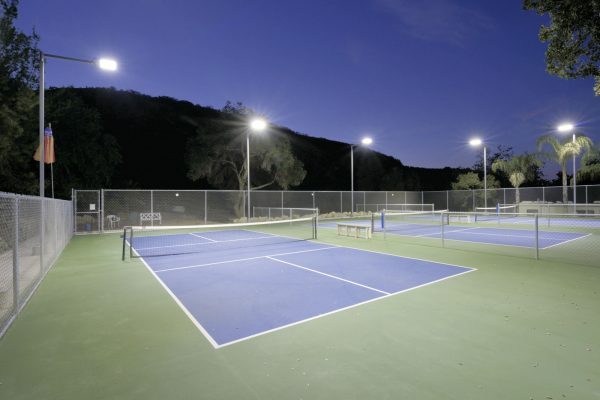
- Warehouses and sports halls: vehicles, trolleys and balls are routine hazards; IK08 covers moderate collisions, IK10 covers heavier ones.
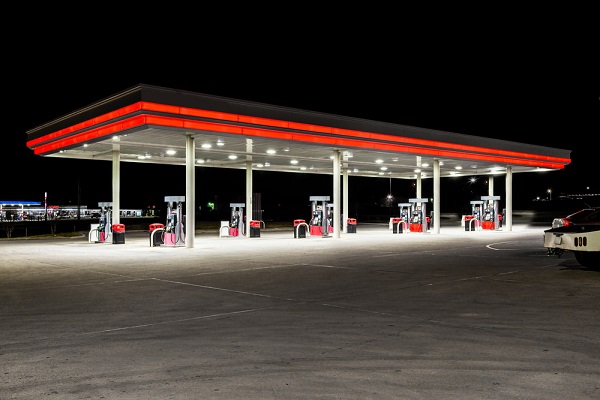
- Car washes: vehicles and pressure lances strike fixtures repeatedly; IK10 paired with a high IP level is the sensible combination.
- Public infrastructure: exposed fixtures face deliberate and accidental abuse; IK09 or IK10.
Write the IK level and the IP level together into the project specification. The two ratings use different test methods, address different failure modes, and both appear in the delivered product marking. Matching IK to the real collision scenarios of the site protects the lighting investment and the safety of the people beneath it.
Key Takeaways
- IK (IEC 62262) rates impact energy from 0.14 J (IK01) to 20 J (IK10); IP (IEC 60529) rates dust and water ingress. One number does not substitute for the other.
- IK08 (5 J) suits everyday industrial operation; IK10 (20 J) is for heavy collision zones such as car washes and public infrastructure.
- Confirm every rating with the test certificate and the product marking before acceptance.
