
 English
 Afrikaans
 Albanian
 Amharic
 Arabic
 Armenian
 Azerbaijani
 Basque
 Belarusian
 Bengali
 Bosnian
 Bulgarian
 Catalan
 Cebuano
 Chichewa
 Corsican
 Croatian
 Czech
Czech Danish
 Dutch
Dutch Esperanto
 Estonian
 Filipino
 Finnish
 French
 Frisian
 Galician
 Georgian
 German
 Greek
Greek Gujarati
 Haitian Creole
 Hausa
Hausa Hawaiian
 Hebrew
 Hindi
Hindi Hmong
Hmong Hungarian
 Icelandic
 Igbo
Igbo Indonesian
 Irish
Irish Italian
 Japanese
 Javanese
 Kannada
 Kazakh
 Khmer
Khmer Korean
 Kurdish (Kurmanji)
 Kyrgyz
 Lao
Lao Latin
Latin Latvian
 Lithuanian
 Luxembourgish
 Macedonian
 Malagasy
 Malay
Malay Malayalam
 Maltese
 Maori
Maori Marathi
 Mongolian
 Myanmar (Burmese)
 Nepali
 Norwegian
 Pashto
 Persian
 Polish
 Portuguese
 Punjabi
 Romanian
 Russian
 Samoan
 Scottish Gaelic
 Serbian
 Sesotho
 Shona
Shona Sindhi
 Sinhala
 Slovak
 Slovenian
 Somali
 Spanish
 Sudanese
 Swahili
 Swedish
 Tajik
Tajik Tamil
Tamil Telugu
 Thai
Thai Turkish
 Ukrainian
 Urdu
Urdu Uzbek
Uzbek Vietnamese
 Welsh
Welsh Xhosa
Xhosa Yiddish
 Yoruba
 Zulu
Zulu





By Queendom LED Technical Team | September 2026
Why Lifespan Claims Matter — and Why They Often Mislead
When a supplier tells you their LED lasts “50,000 hours” or even “100,000 hours,” what evidence backs that number? In the B2B LED market — where products are specified into multi-year installations across agricultural facilities, industrial plants, and cleanroom environments — an unverifiable lifespan claim is not a feature. It is a liability.
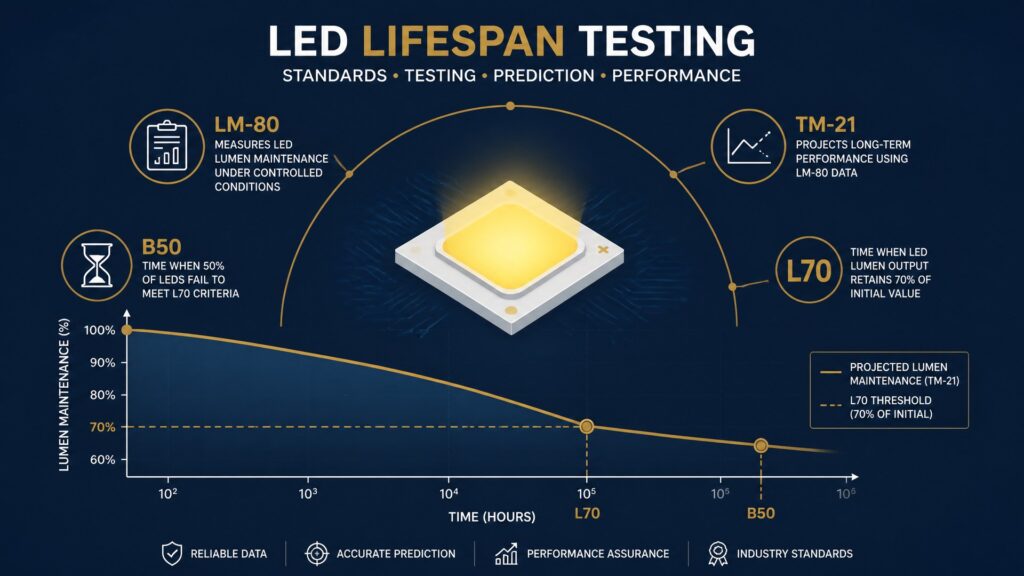
The LED industry has developed a standardized, scientifically grounded framework to test and project LED lifespan. Two standards from the Illuminating Engineering Society (IES) form the backbone of this framework: IES LM-80, which defines how to measure lumen maintenance over time, and IES TM-21, which provides the mathematical method to project long-term lumen maintenance from LM-80 data. Together, they produce the metrics most commonly cited in spec sheets — L70, B50, and combinations like L70B50.
This article explains what each standard measures, how the metrics work, and — most critically for procurement engineers and specifiers — how to read the reports and identify claims that cannot be substantiated.
IES LM-80: The Measurement Standard
IES LM-80 is the approved method for measuring lumen maintenance of LED packages, arrays, and modules over extended periods. The current version, IES LM-80-20, is published by the Illuminating Engineering Society and is publicly available at ies.org. It is the foundational data source for all downstream lifespan projections.
What LM-80 Tests
LM-80 measures two key parameters over time:
- Lumen maintenance — the percentage of initial luminous flux remaining at each measurement interval.
- Color maintenance (color shift) — the change in chromaticity coordinates (Δu’, Δv’) over the test period.
It is critical to understand what LM-80 does not do: LM-80 does not produce a lifespan number. It generates raw measurement data. A lifespan figure (e.g., “L70 = 50,000 hours”) can only be derived by applying the TM-21 projection method to LM-80 data.
Test Conditions
LM-80 testing is conducted under precisely controlled conditions:
- Duration: Minimum 6,000 hours of continuous operation, with 10,000 hours recommended for more robust projection. Data is collected at intervals of at least every 1,000 hours.
- Case temperatures: A minimum of three temperatures — typically 55°C, 85°C, and a manufacturer-specified third point — to characterize performance across thermal conditions.
- Sample size: A minimum of 20 units per test condition for the standard 6× projection multiplier (fewer than 20 units reduces the multiplier to 5.5×).
- Electrical conditions: Constant current drive with voltage/current stability within ±3%.
- Accreditation: Testing should be conducted at a NVLAP-accredited laboratory (such as UL Solutions or Intertek/ETL) to ensure data integrity.
What a Credible LM-80 Report Contains
When evaluating a supplier’s LM-80 report, verify these four elements:
- Test duration — must be at least 6,000 hours. Reports with fewer hours are non-compliant and cannot support TM-21 projection.
- Temperature coverage — must include data at both 55°C and 85°C at minimum. Reports lacking high-temperature data cannot adequately characterize thermal degradation behavior.
- Sample count — at least 20 units per condition. Fewer samples reduce the projection multiplier from 6× to 5.5×.
- Laboratory accreditation — NVLAP or equivalent national accreditation. Self-reported data without independent laboratory verification has limited credibility.
IES TM-21: The Projection Method
IES TM-21 (TM-21-11) is the approved method for projecting long-term lumen maintenance from LM-80 test data. It uses an exponential decay model to fit the measured data points and extrapolate the time at which lumen output reaches a specified threshold.
The 6× Rule
The single most important rule in TM-21 is the projection cap: the projected lifespan cannot exceed six times the actual LM-80 test duration (when ≥20 samples are used). This means:
- 6,000 hours of LM-80 data → maximum projected life of 36,000 hours
- 10,000 hours of LM-80 data → maximum projected life of 60,000 hours
- If fewer than 20 samples: multiplier is 5.5× (e.g., 6,000h → max 33,000h)
This rule is where many exaggerated claims originate. A supplier citing “100,000 hours” based on a 6,000-hour LM-80 report is violating the TM-21 6× cap by nearly threefold. This is the first red flag to check.
L70, L80, L90: Lumen Maintenance Thresholds
The “L” value indicates the percentage of initial luminous flux that the LED maintains at the projected time:
- L70 — light output has declined to 70% of initial. This is the most widely used threshold for defining “useful life” in general lighting.
- L80 — 80% of initial output. Often specified for environments where light level consistency matters, such as precision industrial inspection or horticultural applications.
- L90 — 90% of initial output. Typically required in high-precision environments such as cleanrooms, medical lighting, and laboratory-grade illumination.
B10 and B50: Population Failure Metrics
While the “L” value tells you when output drops to a threshold, the “B” value tells you what fraction of the LED population has reached that point by that time:
- B50 — 50% of the LED population has fallen below the specified L threshold by the projected time. This is the median lifetime and is the most commonly cited metric.
- B10 — only 10% of the population has fallen below the threshold. This is a more conservative metric used in applications where early failures carry high cost, such as tunnel lighting or medical device illumination.
Reading Combined Metrics: L70B50
The combined notation L70B50 = 50,000 hours means: by 50,000 hours of operation, 50% of the LED population will have declined to 70% or less of its initial luminous flux. This is the standard way LED lifespan should be specified in technical documentation.
When a supplier states only “L70 = 50,000 hours” without a B-value, the statistical confidence level is undefined. Always request the full LxBx notation.
How Certification Programs Use These Standards
DLC Qualified Products List (QPL)
The DesignLights Consortium (DLC) maintains the QPL, a qualified product list widely referenced by North American utility rebate programs and commercial building specifications. DLC requires:
- LM-80 test data for the LED light source used in the product.
- TM-21 projection demonstrating L70 ≥ 25,000 hours for standard category products (higher thresholds apply for premium categories).
The DLC QPL is publicly searchable at designlights.org, allowing specifiers to verify whether a product is actually listed — not merely “DLC compliant” in a spec sheet.
Energy Star
The U.S. Environmental Protection Agency’s Energy Star program for LED lighting requires:
- LM-80 data demonstrating at least 6,000 hours of testing, with lumen maintenance meeting Energy Star category-specific thresholds (which vary by product category and claimed life tier).
- TM-21 projection supporting the claimed L70 value.
- The claimed life must not exceed the 6× cap.
Energy Star certified products are verifiable at energystar.gov/productfinder.
Red Flags: How to Spot Exaggerated Lifespan Claims
When evaluating LED supplier lifespan claims, apply this verification checklist:
| Claim or Condition | Verification Method | Why It Matters |
|---|---|---|
| “100,000-hour lifespan” | Check the LM-80 test duration. 100,000h ÷ 6 = 16,667h minimum required test data. | If the LM-80 report shows only 6,000–10,000 hours of testing, a 100,000-hour claim violates the TM-21 6× rule. |
| “50,000 hours” without B-value | Request the full LxBx notation (e.g., L70B50). | Without a B-value, the statistical confidence is undefined. “L70 = 50,000h” could mean B50 (median) or B10 (conservative) — the difference is significant. |
| No case temperature specified | Verify the LM-80 report lists test temperatures (55°C, 85°C, etc.). | Lifespan is temperature-dependent. A claim without a specified test temperature is meaningless — the same LED may show very different L70 values at 55°C vs. 85°C. |
| No accredited laboratory | Confirm NVLAP or equivalent accreditation on the report. | Self-reported data without independent verification provides no assurance of accuracy. |
| “DLC certified” without QPL listing | Search the product at designlights.org/qpl. | Being “compliant with DLC requirements” is not the same as being listed on the QPL. Only listed products qualify for utility rebates. |
Queendom LED: Our Compliance Framework
At Queendom LED, we have manufactured LED components and lighting products since 2002, serving customers across more than 60 countries. Our quality management system is certified to ISO 9001, and our products are verified by SGS. Our D&B registration number (403989914) is publicly verifiable.
Our product lines span two divisions aligned with our positioning matrix:
- LED packages and chips — including SWIR (Short-Wave Infrared), UV-C, and ceramic automotive LED components. Automotive-grade products target AEC-Q102 qualification.
- Lighting products — agricultural, industrial, and specialty lighting. Industrial lighting products target DLC QPL listing, cleanroom lighting targets FDA/GMP-compliant designs, and hazardous-location lighting targets ATEX certification.
For all products where lifespan is a specified parameter, we provide LM-80 test data from accredited laboratories and TM-21 projections in full LxBx notation. We encourage our B2B customers to verify every certification claim through the respective public databases — DLC QPL at designlights.org, Energy Star at energystar.gov/productfinder, and our ISO 9001 registration through the issuing certification body.
If you are evaluating LED products for a project and need LM-80/TM-21 reports or certification documentation, contact our technical team at queen@queendomlamp.com.
B2B Buyer’s Verification Checklist
Before accepting any LED lifespan claim, request and verify the following:
- LM-80 report from an NVLAP-accredited laboratory — verify test duration ≥ 6,000h, three temperatures, ≥ 20 samples.
- TM-21 projection in full LxBx notation (e.g., L70B50) — verify the claimed life does not exceed 6× the test duration.
- Case temperature at which the lifespan is specified — verify it matches or is close to your application’s operating temperature.
- DLC QPL listing — search the exact product model at designlights.org to confirm active listing.
- Energy Star certification — verify at energystar.gov/productfinder if Energy Star is claimed.
- Supplier credentials — verify ISO 9001 registration, SGS reports, and D&B registration through independent databases.
- Color maintenance data — confirm the LM-80 report includes Δu’v’ color shift data, not just lumen maintenance.
Lifespan is not a marketing number. It is a calculated, testable, and verifiable engineering parameter. Treat it as such — and expect your supplier to do the same.
Queendom LED is a manufacturer of LED components and lighting products based in Shenzhen, China. Founded in 2002, the company serves B2B customers in over 60 countries across agricultural, industrial, medical, and specialty lighting markets. For technical inquiries: queen@queendomlamp.com | +86-13612789419
Related Products
Further reading: LM-80, TM-21 & DLC V6.0 Verification Guide · LED Lifetime Standards for B2B Buying
