
 English
 Afrikaans
 Albanian
 Amharic
 Arabic
 Armenian
 Azerbaijani
 Basque
 Belarusian
 Bengali
 Bosnian
 Bulgarian
 Catalan
 Cebuano
 Chichewa
 Corsican
 Croatian
 Czech
Czech Danish
 Dutch
Dutch Esperanto
 Estonian
 Filipino
 Finnish
 French
 Frisian
 Galician
 Georgian
 German
 Greek
Greek Gujarati
 Haitian Creole
 Hausa
Hausa Hawaiian
 Hebrew
 Hindi
Hindi Hmong
Hmong Hungarian
 Icelandic
 Igbo
Igbo Indonesian
 Irish
Irish Italian
 Japanese
 Javanese
 Kannada
 Kazakh
 Khmer
Khmer Korean
 Kurdish (Kurmanji)
 Kyrgyz
 Lao
Lao Latin
Latin Latvian
 Lithuanian
 Luxembourgish
 Macedonian
 Malagasy
 Malay
Malay Malayalam
 Maltese
 Maori
Maori Marathi
 Mongolian
 Myanmar (Burmese)
 Nepali
 Norwegian
 Pashto
 Persian
 Polish
 Portuguese
 Punjabi
 Romanian
 Russian
 Samoan
 Scottish Gaelic
 Serbian
 Sesotho
 Shona
Shona Sindhi
 Sinhala
 Slovak
 Slovenian
 Somali
 Spanish
 Sudanese
 Swahili
 Swedish
 Tajik
Tajik Tamil
Tamil Telugu
 Thai
Thai Turkish
 Ukrainian
 Urdu
Urdu Uzbek
Uzbek Vietnamese
 Welsh
Welsh Xhosa
Xhosa Yiddish
 Yoruba
 Zulu
Zulu



White lighting used to be a fixed choice: pick a colour temperature, buy the fixture, move on. Smart tunable white lighting changes the contract. A tunable white LED panel can shift its colour temperature smoothly – from warm 2700 K to cool 6500 K – and, in better systems, control intensity independently. That single capability opens human centric lighting (HCL), circadian-aligned schedules, energy-saving daylight compensation, and responsive workspaces.
For architects, lighting designers, building owners, and facility managers, the specification questions are no longer “warm or cool?” but “how tunable, how controlled, and how future-proof?” This guide explains what tunable white actually is, which control ecosystems matter (DALI-2, 0–10 V, Zigbee, Matter), and how to specify smart tunable white LED panels for real projects.
What tunable white means in practice
A tunable white luminaire contains at least two LED channels – typically warm-white and cool-white – whose outputs are mixed optically to produce a variable colour temperature at constant or varying intensity. The quality of a tunable white system depends on engineering details:
- Channel separation: the warm and cool channels must blend uniformly; poor optics create colour shadows and visible zones.
- CCT range: typical ranges span 2700 K–6500 K; some systems offer a narrower 3000 K–5000 K band tuned for office use.
- Colour quality across the range: CRI and R9 should stay high through the whole sweep; cheap systems degrade colour rendering at the extremes.
- Binning strategy: maintaining chromaticity consistency requires tight binning of both channels over production and lifetime.
- Dimming smoothness: flicker-free, low-end dimming (to 1–5%) matters for HCL programmes that run at dawn and dusk levels.
Specify the full range, the CRI across the range, the dimming resolution, and the flicker standard (IEEE 1789 compliance is a useful benchmark) – not just “tunable white” on a data sheet.
Human Centric Lighting: the driver behind the upgrade
Human centric lighting (HCL) aligns lighting with the human circadian rhythm: cooler, brighter, more blue-enriched light during the day to support alertness; warmer, dimmer light in the evening to support relaxation and sleep. Research in offices, schools, and healthcare facilities supports measurable outcomes in alertness, wellbeing, and sleep quality – which is why HCL is moving from laboratory to specification.
Tunable white is the enabling hardware. But HCL is a programme, not a product: it consists of a lighting schedule (CCT and intensity over the day), control logic (based on real-world conditions and occupancy), and measurement/verification. When you buy tunable white panels, you are buying the hardware layer that the HCL programme runs on – so the control system must be able to execute time-based CCT schedules, not just manual remote-control adjustment.
The control ecosystem: DALI-2 and beyond
DALI-2: the professional baseline
DALI-2 (Digital Addressable Lighting Interface, version 2) is the standard for professional lighting control: 64 addressable devices per BUS, bidirectional communication, real device type definitions (including LED modules and colour control), and interoperability testing by the DALI Alliance. For tunable white, DALI-2 Device Type 8 (colour control) defines the means to set CCT and intensity with defined colour coordinates. specifying DALI-2 DT8 means the fixture speaks a standard, auditable language for colour control – it will work with DALI-2 controllers, sensors, and gateways from multiple manufacturers.
0–10 V and switches: simple and limited
0–10 V dimming provides intensity control through a separate pair of wires, but true CCT tuning needs a second control signal (historically 2-wire 0–10 V for dual channels, or proprietary protocols). It works for basic presets, but it does not give you software-defined scheduling or per-fixture colour control at scale.
Zigbee, Bluetooth, Z-Wave: wireless retrofit options
Wireless control suits retrofit projects where pulling DALI control wiring is impractical. Quality varies; look for certified interoperability (Zigbee 3.0, Matter) rather than app-specific ecosystems.
Matter: the interoperability wildcard
Matter (with Thread and Wi-Fi) standardises IoT device communication across smart-home and building ecosystems. Matter-enabled tunable white panels can be managed by multiple controllers and ecosystems without vendor lock-in. In commercial projects Matter is emerging; for residential, education, and hospitality HCL applications it is already practical.
Where smart tunable white panels fit best
- Education: classrooms that shift from cool alertness in the morning to calm warm light after lunch; studies support attention and wellbeing outcomes.
- Healthcare and care homes: circadian support for patients and staff – day/night schedules reduce disorientation and support recovery.
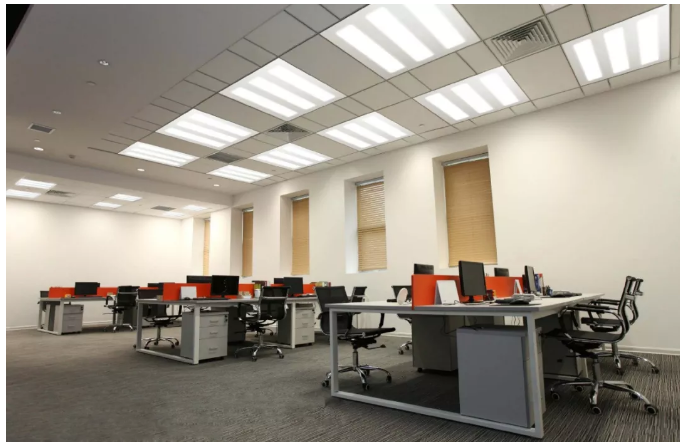
- Office and coworking: daylight compensation plus task-adaptive CCT; meeting rooms that switch scenes with booking systems.
- Hospitality: guest-room scenes from bright welcome to warm evening; corridors with presence-triggered gentle night lighting.
- Wellness and wellness-certified buildings: WELL and similar certifications award credits for circadian-supporting lighting design – tunable white hardware is a core component.
Specifying smart tunable white LED panels: the checklist
- Photometric performance: lumens, efficiency (lm/W), CCT range, CRI (≥90 with R9), and photometric files (IES/LDT) for both extremes.
- Uniformity of mix: verify with sample evaluation – the panel must appear uniform at every CCT, with no visible warm/cool zones.
- Control protocol: DALI-2 DT8 preferred for commercial; state support for OS, gateway, or cloud integration if required.
- Dimming range and flicker: target 1–100% smooth dimming, IEEE 1789-compliant flicker.
- Driver accessibility: maintainable drivers with published service life and spares strategy.
- Lifetime and warranty: lumen maintenance (L70) and chromaticity maintenance over life – colour shifts matter more in tunable systems.
- Compliance and documentation: CE/UL/ENEC, DALI-2 certification evidence, photometric and control datasheets, and dimming curve documentation.
Designing the HCL programme around the hardware
Buying tunable white panels without a schedule is like buying an instrument and never playing it. Design the programme together with the hardware:
- Define the time schedule – e.g. 3000 K/100% at 08:00, ramping to 5000 K by 10:00, back to 3000 K by 16:00, 2700 K/40% by 19:00. Reference the WELL or Circadian Stimulus guidance relevant to your project.
- Lay out control zones – perimeter daylight zones, deep zones, and task areas need independent schedules.
- Plan manual override – occupants and staff need scene control without breaking the programme.
- Instrument and verify – measure CCT and illuminance on site after commissioning and at intervals; verification is what makes it a programme instead of a claim.
Common mistakes in tunable white projects
- Specifying “tunable white” without a colour quality spec. The CRI and chromaticity must be defined across the range, not at a single point.
- Choosing a fixture with no standard control protocol. App-only controls become an orphaned asset when the smartphone is replaced.
- Ignoring the driver ecosystem. A DALI-2 fixture is only useful if the project has a DALI-2 control system or gateway; verify the full chain.
- Overlooking low-end dimming quality. HCL schedules need credible sunset levels; a fixture with 20% minimum dimming fails the programme.
- Treating colour maintenance as a non-issue. Tunable systems drift; specify chromaticity maintenance data and binning.
How QUEENDOM delivers smart tunable white lighting
QUEENDOM manufactures smart tunable white LED panels – including ultra-slim and standard panel formats – with dual-channel engines, CRI ≥ 90 across the 2700–6500 K range, DALI-2 DT8 control, optional Matter/Zigbee support, and IEEE 1789-compliant dimming. We provide photometric and control documentation, sample evaluation support, and project-specific CCT schedule guidance for education, healthcare, office, and wellness-certified projects. If you are designing an HCL environment, tell us the room type, control system plans, and schedule intent – we will match the hardware and supply the data your lighting designer needs.
Smart tunable white is the difference between lighting that illuminates and lighting that participates in building performance. Specify colour quality, standard controls, and maintenance data; design the schedule; verify in the field – and your project will deliver the wellbeing and energy benefits that tunable white exists to provide.
HCL programme data requirements
To run a defensible human centric lighting programme you need hardware that can deliver a defined schedule and data that proves it. Specify and verify:
- CS (circadian stimulus) capability: the fixture should reach a CS value of 0.3 or higher during the high-alertness phase where the lighting scheme requires it – calculate from the emitted spectrum, not from CCT alone, because melanopic content varies between fixtures with the same CCT.
- Melanopic ratio: request the melanopic-photopic ratio from the supplier; typical tunable white engines range from about 0.5 at 2700 K to 0.9 or more at 6500 K, and WELL-style documentation increasingly asks for these values.
- Schedule verification: after commissioning, log CCT and illuminance at representative points over 24 hours and compare against the programme’s target curve; keep the log as the programme’s evidence.
- Flicker compliance: confirm IEEE 1789 low-risk classification at every dimming level used in the schedule – dimming creates flicker risk for some drivers.
A lighting programme whose claims can be measured and logged is a building-performance feature; one that cannot be verified is a marketing story. Choose hardware and control partners that support measurement.
A practical commissioning sequence for a tunable white project
- Design freeze: agree on zones, schedules, manual overrides, and verification points with the client and lighting designer before ordering.
- Sample evaluation: mount one fixture in the project environment, evaluate CCT range, flicker, and mixing uniformity at several points before volume ordering.
- Installation and addressing: install panels, commission DALI-2 addresses and groups; verify every fixture responds to scene commands.
- Calibration and logging: set the schedule in the controller and run a 24–48 hour log to confirm actual CCT/illuminance tracks the targets.
- Handover: deliver the schedule documentation, user override guide, and the verification log to the facility owner; train the maintenance team on driver replacement and spare parts.
Following this sequence converts “smart tunable white lighting” from a feature list into a measured building capability – the difference between a room that illuminates and a space that supports its occupants’ day.
Positioning the product class: Smart Tunable White versus static panels
In project documentation, be explicit that the installed system is a Smart Tunable White LED panel family with DALI-2 control, not a static white panel with a dimmer. The distinction matters to specifiers, facility owners, and WELL/LEED reviewers: tunable white delivers a continuous CCT range with independent illuminance control, which is the technical basis for circadian lighting (HCL) claims and for the Addressable RGB LED Chips options that some projects want for accent scenes. Use the matrix terminology in drawings, schedules, and submittals, so the delivered system and the documented system are the same system – this is the difference between a lighting upgrade and an architectural feature.
Related Products
Further reading: Smart Lighting Systems: DALI-2 & Matter
