

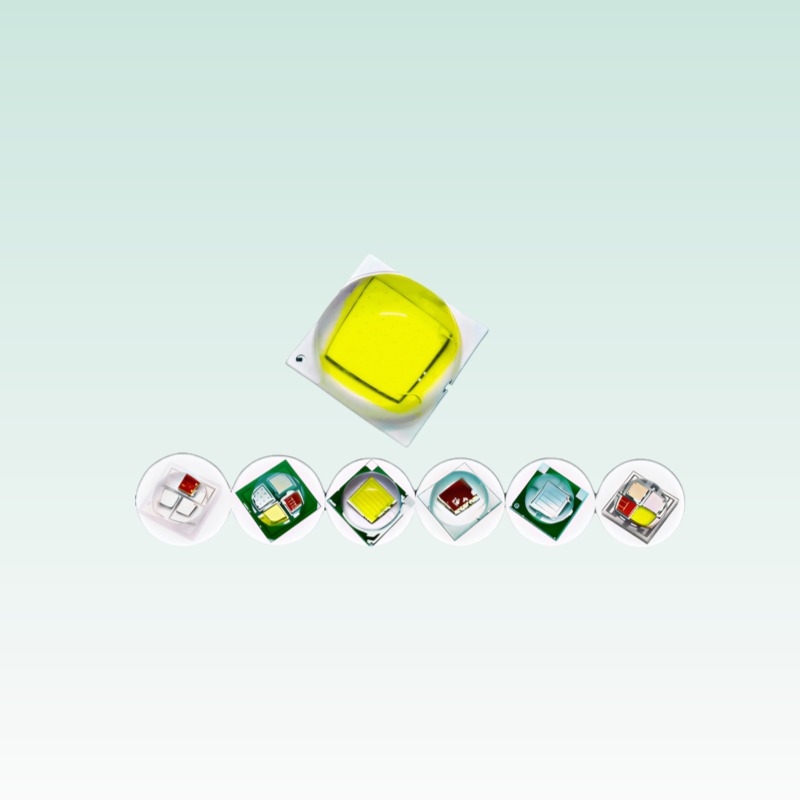

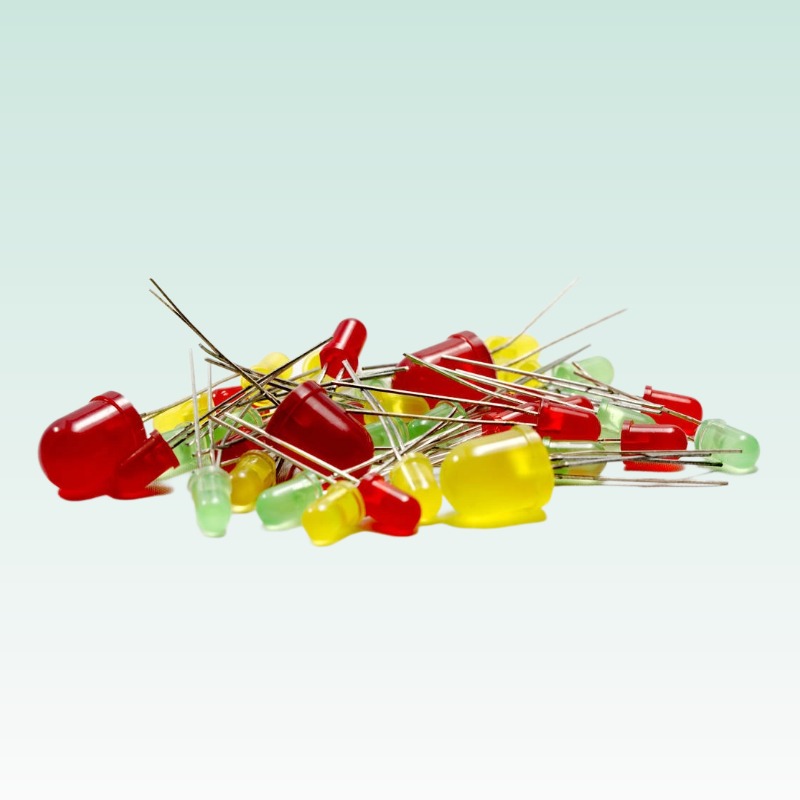
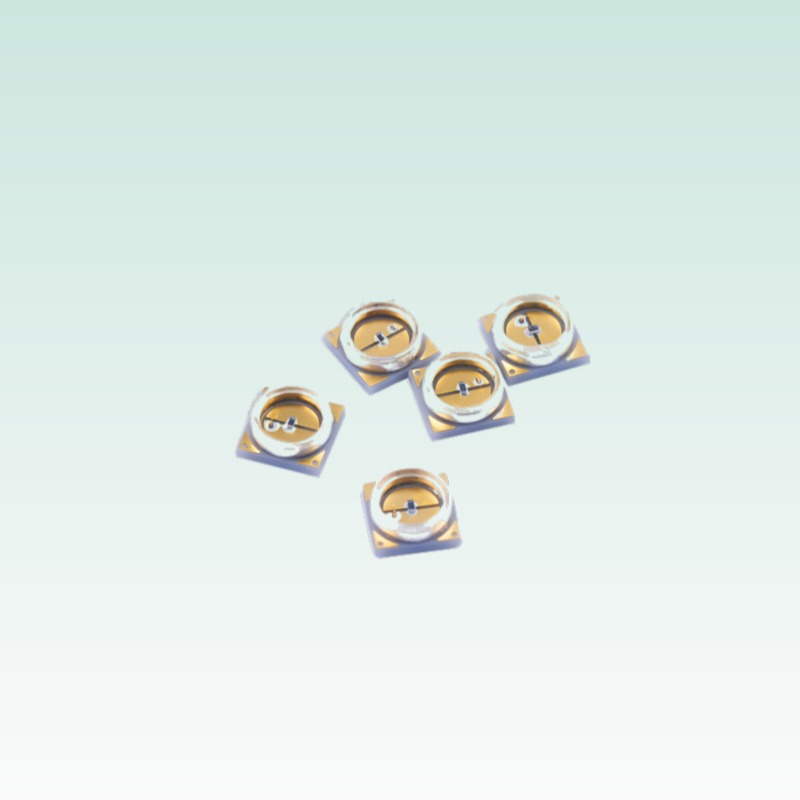
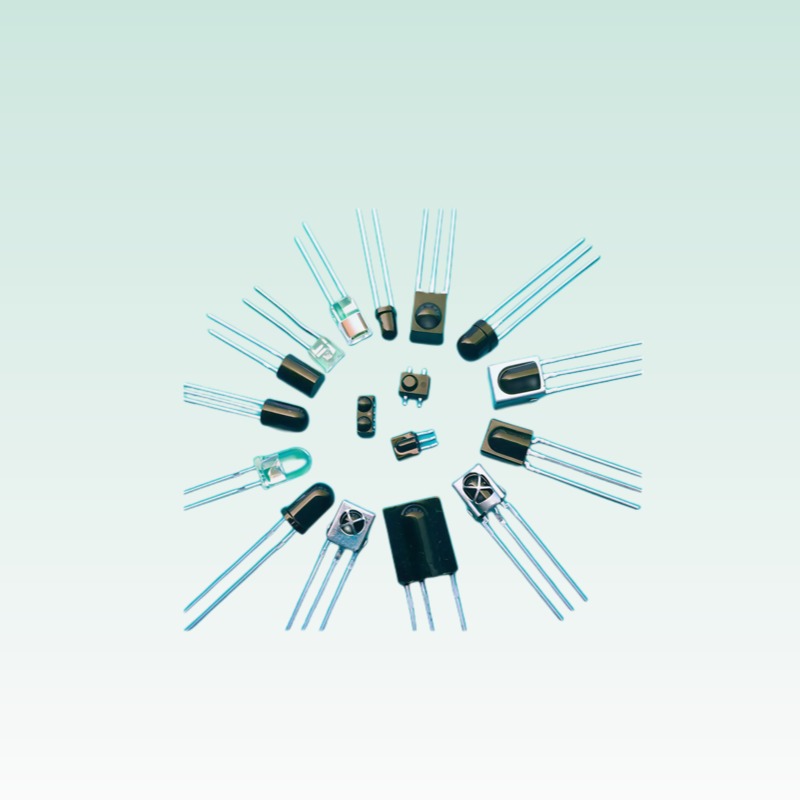









Every LED emits its light at one place: the p-n junction, the boundary between a positively doped and a negatively doped semiconductor layer. Everything a datasheet shows — forward voltage, wavelength, temperature behavior, binning — follows from what happens in that slice of crystal a few micrometers thick. This article walks through the physics in plain terms and connects each idea to the numbers engineers actually specify.
Doping, Depletion Region and the Built-In Potential
Doping adds controlled impurities to a semiconductor. Donor atoms on the n side supply free electrons; acceptor atoms on the p side create holes, vacancies that act as positive charge carriers. Where the two layers meet, electrons diffuse into the p side and holes into the n side, leaving a zone with no free carriers — the depletion region. Fixed ionized charges left behind build an internal electric field and a built-in potential that halts further diffusion.
Forward voltage shrinks this barrier. Once applied voltage approaches the built-in potential — roughly 2 V for red AlGaInP chips, over 3 V for blue and UV GaN-based chips — carriers flood across the junction and recombine. Each recombination can release a photon with energy close to the semiconductor bandgap.
Bandgap Sets the Color
Photon wavelength follows directly from bandgap: energy (eV) = 1240 ÷ wavelength (nm). Wider bandgap means shorter wavelength and higher photon energy, so material families divide the spectrum among themselves:
| Material system | Typical emission | Tuning variable |
|---|---|---|
| InGaN | Blue, cyan, green, UVA | Indium fraction in the active layer |
| AlGaInP | Red, amber, yellow | Aluminum fraction |
| AlGaN | Deep UV, including 254 nm sterilization wavelengths | Aluminum fraction |
A 254 nm photon carries about 4.9 eV, which is why deep-UV chips demand the widest bandgaps and the most difficult epitaxial growth. The same tuning logic covers the visible spectrum from 450 nm blue to 630 nm red, and by adjusting composition manufacturers can place the emission wavelength at almost any point in between.
The Steep I-V Curve: Why Constant Current
The diode I-V curve is exponential: a small rise in forward voltage produces a large rise in forward current, and a 50 mV shift can move current by double-digit percentages. Forward voltage also falls as the junction heats, so a constant-voltage supply invites thermal runaway — more current, more heat, destruction. LED drivers therefore regulate current, not voltage.
The same physics explains why forward voltage varies between production lots. Small changes in doping and layer thickness slide the I-V curve along the voltage axis, which is why datasheets list Vf as a minimum–typical–maximum range at a stated test current instead of a single value.
Temperature, Wavelength Drift and Binning
As junction temperature rises, the bandgap narrows slightly. Peak wavelength drifts — typically hundredths of a nanometer per °C for blue InGaN and more for AlGaInP red — while light output falls and aging accelerates. Thermal design therefore controls color consistency, not only reliability.
This is why binning exists. Manufacturers sort finished chips into bins by luminous flux, color and forward voltage, so a delivered lot forms a consistent population. Precision applications should state the operating temperature range and require that delivered lots stay within the promised bins.
Forward bias narrows the depletion region once the applied voltage exceeds the built-in potential, roughly 3.2 V for InGaN blue chips, and injected carriers recombine radiatively. Reverse bias widens it instead, which is why leakage current and breakdown voltage on a datasheet both trace back to this single junction.
Key Takeaways
- The depletion region and built-in potential explain the forward voltage an LED needs before current flows and recombination begins.
- Bandgap sets photon wavelength: InGaN for blue to UVA, AlGaInP for red and amber, AlGaN for deep UV at 254 nm.
- The exponential, temperature-sensitive I-V curve makes constant-current drive and Vf ranges on datasheets non-negotiable facts.
- Junction temperature shifts wavelength and output, so the thermal path and binning discipline belong in every specification.
