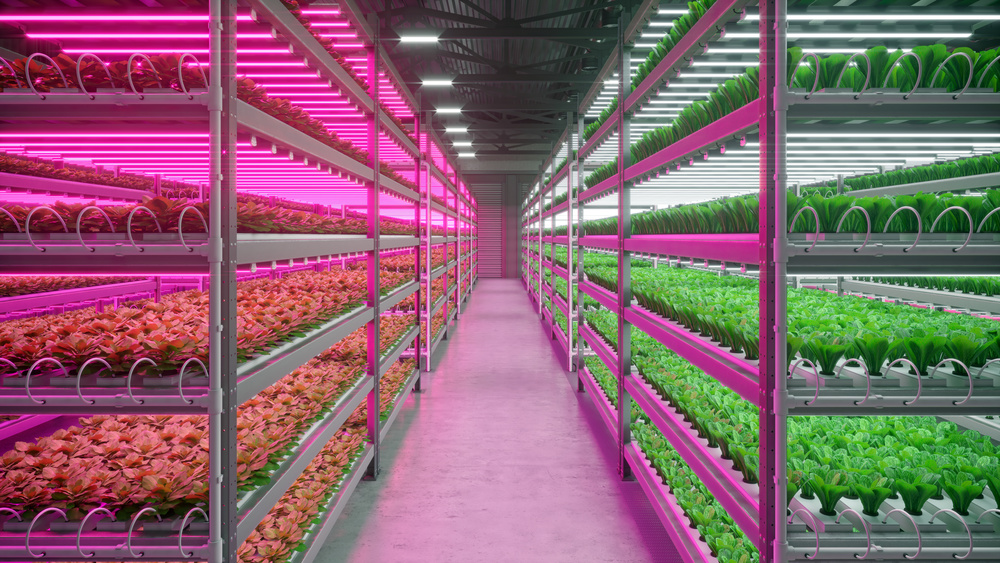



The 2026 update of California’s Title 24 Building Energy Efficiency Standards sets enforceable power density limits for indoor agricultural lighting installations across the state. Commercial greenhouses and vertical farms must now install grow light systems that stay under maximum watts-per-square-foot thresholds while still delivering a minimum average photosynthetic photon flux density (PPFD) at the canopy. Treat this as a compliance deadline attached to the permit process, not a voluntary efficiency target.
The dual requirement: less power, same photons
Title 24 2026 applies two tests to every indoor agricultural lighting installation. The first is installed power density, measured in watts per square foot of growing area. The second is minimum average PPFD at the canopy, so a facility cannot pass simply by dimming everything down. Industry reference values circulating ahead of the code cycle place the caps in the low single-digit watts per square foot for greenhouses, with higher allowances for multi-layer vertical farm racks (to be verified). The exact numbers matter less than the structure: both sides of the dual test must be documented before permits are issued.
| Requirement | Metric | Applies to | Practical effect |
|---|---|---|---|
| Maximum power density | W/sq ft of growing area | Greenhouses and vertical farms | Caps total installed lighting load at design stage |
| Minimum average PPFD | umol/m2/s at canopy | All indoor agricultural areas | Blocks compliance-by-dimming strategies |
| Control credits | Dimming, scheduling, daylight harvesting | Smart-controlled installations | Rewards DALI-2 or Matter connected fixtures |
Why HPS and legacy LED configurations lose
The dual test disqualifies legacy high-pressure sodium from new construction and major retrofits. A 1000 W HPS fixture draws several times more power per square foot than a modern LED bar delivering equal canopy PPFD, and no control credit closes that gap. Inefficient LED configurations fail the same way: fixtures sold on wattage alone, without photometric documentation, cannot demonstrate either side of the requirement to a plan checker.
Compliance credits favor smart controls
The standard awards compliance credits to high-efficiency LED systems that integrate smart controls and daylight harvesting. This regulatory signal strongly favors DLC QPL-qualified fixtures equipped with DALI-2 or Matter connectivity. The credits reward system-level intelligence — the ability to schedule, dim, and respond to ambient conditions across the growing environment — and they recognize that energy compliance in horticulture is a control problem as much as an equipment problem. A fixture with a strong efficacy number but no control interface leaves compliance value on the table.
Design-stage compliance changes procurement
Facility designers must now demonstrate compliance at the design stage, modeling installed power density and predicted PPFD distribution for the specific greenhouse geometry before permits are issued. This favors suppliers that provide photometric simulation data, precise spectral performance documentation, and control-system integration support, rather than fixtures sold on wattage alone. Vertical farm projects face the tightest constraint because they run lighting for extended photoperiods at high density, and they benefit most from daylight-aware dimming and multi-level spectral staging.
Operators should treat Title 24 as a design-phase requirement rather than an afterthought:
- Confirm candidate grow light systems carry DLC QPL listing.
- Verify DALI-2 or Matter control compatibility in writing, not by datasheet implication.
- Request uniformity and power-density modeling for the actual greenhouse geometry.
As other states adopt similar frameworks, California compliance experience is becoming a competitive reference for suppliers and integrators serving the broader North American market. Early adopters of certified smart lighting hold measurable cost advantages in both energy and compliance terms.
FAQ
When does Title 24 2026 take effect for grow lights?
The 2026 code cycle applies to projects permitted under the new standards (to be verified). Confirm the effective date with the local building department before locking the lighting design.
Do the power density caps apply to retrofits?
Yes. New construction and major retrofits must meet the dual power density and PPFD requirement (to be verified).
Which fixtures qualify for compliance credits?
High-efficiency LED systems with smart controls and daylight harvesting — typically DLC QPL-listed fixtures with DALI-2 or Matter connectivity.
Fact-check status: source list pending
