









An LED loses colour two ways. The die can dim, which flux maintenance data catches, or the encapsulation can yellow, which flux data often hides until the tint has already moved. Yellowing is a chemical change in the lens or the potting compound, driven by short wavelength photons and heat, and the choice between epoxy and silicone decides how fast it runs. The two materials age on different clocks, and one of them is not suited to sustained blue or ultraviolet flux at all.
Two Chemistries, Two Failure Clocks
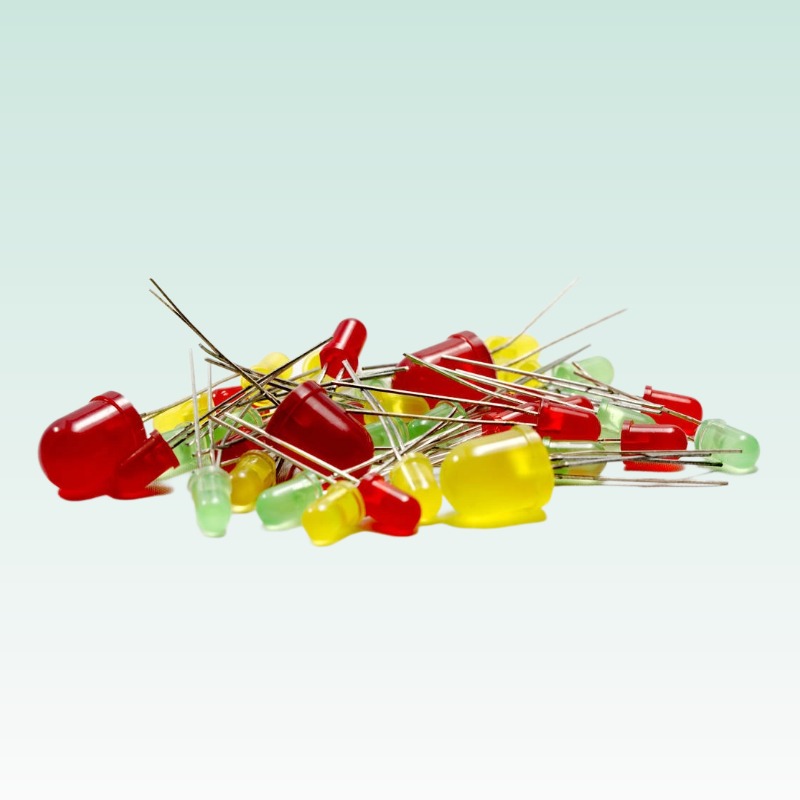
Epoxy is a rigid thermoset. It is cheap, it holds a sharp lens shape, and its glass transition temperature often sits near 120 C to 140 C, which is inside the operating range of a power LED. Silicone is a flexible elastomer with a much higher usable temperature and far better resistance to short wavelength radiation. The trade is mechanical and economic: silicone is softer, it collects dust more readily, and it costs more per part. For a low flux indicator running at a few milliamps, the epoxy clock is long enough. For a 1W part at 350mA, it is not.
| Property | Epoxy | Silicone |
|---|---|---|
| Thermal stability | Softens near 120 to 140 C | Stable well past 150 C |
| Short wavelength resistance | Poor below about 420 nm | Good across blue and near UV |
| Lens shape retention | Rigid, holds tight optics | Flexible, needs a harder overcoat for tight beams |
| Cost | Lower | Higher |
| Typical use | Indicators, low flux sealed parts | Power, outdoor, UV and horticulture |
How Yellowing Starts
Photodegradation begins when a photon carries enough energy to break a chemical bond in the polymer. Blue emitters at 450nm and near ultraviolet parts at 395nm to 405nm supply that energy directly. The absorbed photon starts a radical chain: bonds break, new cross links form, and the polymer develops conjugated structures that absorb in the blue. The material turns amber, and the amber absorbs exactly the wavelengths the phosphor or the die needs to emit. The result is a double loss, because the yellowed lens both blocks the outgoing blue and shifts the transmitted spectrum warmer.
Heat accelerates the process. A junction running hot supplies thermal energy that lowers the barrier for the radical reaction, so the same part in a badly heatsinked fixture can yellow years earlier than the datasheet curve suggests. That interaction is why an accelerated test at one temperature rarely predicts life at another without an Arrhenius style correction.
Where It Shows Up in the Data
Standard lumen maintenance testing reports flux at intervals and derives an L70 figure. Yellowing can pass that test, because the die keeps emitting and a moderate absorption loss stays inside the pass band while the colour has visibly moved. The measurement that catches it is chromaticity maintenance: the shift of the chromaticity coordinate over time, reported as delta u prime v prime. A part that holds 97 percent of its flux but has moved 0.007 in delta u prime v prime is a different product from the one that was sampled. Buyers specifying colour critical work should ask for chromaticity maintenance at the same intervals as flux maintenance.
Design Rules That Follow
Match the chemistry to the flux. Epoxy is acceptable for sealed indicator parts with low drive current and no sustained blue exposure. Silicone or a silicone overcoat belongs on power parts, outdoor luminaires, horticultural fixtures and anything radiating below 420nm. Where the application is severe, moving the phosphor away from the die and onto a remote layer keeps the highest photon flux out of the polymer entirely, and a glass or ceramic window removes the organic material from the optical path. For parts already in the field, a fixture that runs the junction 20 C cooler extends the time to visible yellowing by a wide margin, which makes the thermal path part of the colour specification rather than a separate mechanical concern.
Key Takeaways
- Yellowing is a chemical change in the encapsulant, separate from die level flux decay.
- Epoxy degrades under blue and near ultraviolet flux; silicone resists it and tolerates higher temperature.
- Heating accelerates the reaction, so the thermal design sets the yellowing clock as much as the spectrum does.
- Lumen maintenance can pass while colour drifts, so ask for chromaticity maintenance data.
- Remote phosphor, glass windows and a cooler junction are the three levers that push yellowing past the intended service life.
Related reading
