
 English
 Afrikaans
 Albanian
 Amharic
 Arabic
 Armenian
 Azerbaijani
 Basque
 Belarusian
 Bengali
 Bosnian
 Bulgarian
 Catalan
 Cebuano
 Chichewa
 Corsican
 Croatian
 Czech
Czech Danish
 Dutch
Dutch Esperanto
 Estonian
 Filipino
 Finnish
 French
 Frisian
 Galician
 Georgian
 German
 Greek
Greek Gujarati
 Haitian Creole
 Hausa
Hausa Hawaiian
 Hebrew
 Hindi
Hindi Hmong
Hmong Hungarian
 Icelandic
 Igbo
Igbo Indonesian
 Irish
Irish Italian
 Japanese
 Javanese
 Kannada
 Kazakh
 Khmer
Khmer Korean
 Kurdish (Kurmanji)
 Kyrgyz
 Lao
Lao Latin
Latin Latvian
 Lithuanian
 Luxembourgish
 Macedonian
 Malagasy
 Malay
Malay Malayalam
 Maltese
 Maori
Maori Marathi
 Mongolian
 Myanmar (Burmese)
 Nepali
 Norwegian
 Pashto
 Persian
 Polish
 Portuguese
 Punjabi
 Romanian
 Russian
 Samoan
 Scottish Gaelic
 Serbian
 Sesotho
 Shona
Shona Sindhi
 Sinhala
 Slovak
 Slovenian
 Somali
 Spanish
 Sudanese
 Swahili
 Swedish
 Tajik
Tajik Tamil
Tamil Telugu
 Thai
Thai Turkish
 Ukrainian
 Urdu
Urdu Uzbek
Uzbek Vietnamese
 Welsh
Welsh Xhosa
Xhosa Yiddish
 Yoruba
 Zulu
Zulu

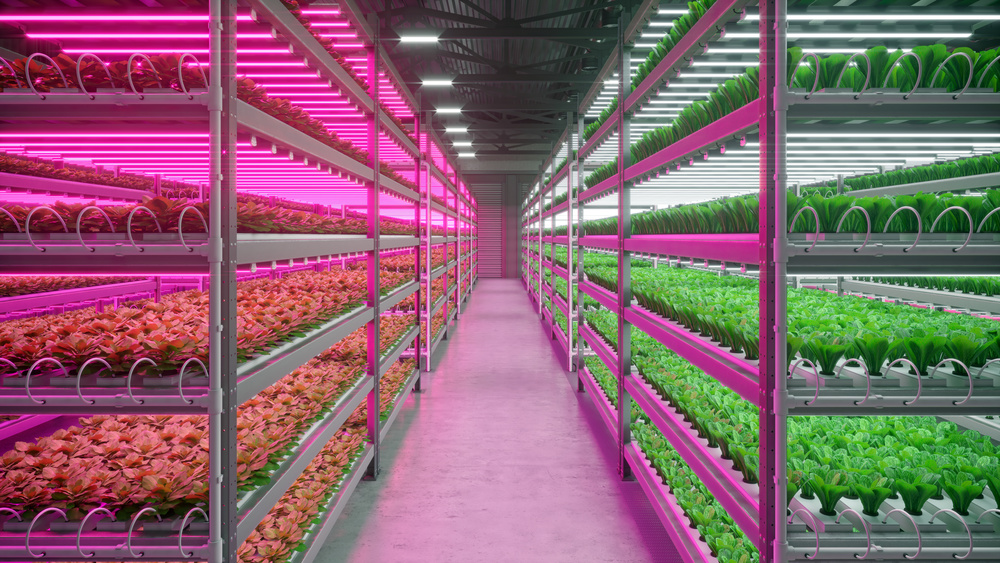



Mounting height is the fastest lever for changing PPFD and uniformity in a vertical farm, so it should be decided from the photometric file, not from habit. A UFO-style high bay grow light with an 80-100 degree beam mounted 1.5-2.5 m above a bench typically delivers a useful 400-800 umol/m2/s window, depending on fixture PPF, beam angle and spacing.
The Height Trade-Off
Raising the fixture spreads the beam, lowers peak intensity and improves uniformity, but a beam that is too wide wastes photons on walls and aisles. Lowering the fixture concentrates photons and raises peak PPFD, but it narrows the lit area and creates hot spots that stress plants and waste energy. Height and spacing must therefore be simulated together, never set by habit.
| Mounting position | Effect on canopy | Main risk |
|---|---|---|
| Lower end of range | Higher peak PPFD, tight coverage | Hot spots, narrow lit area |
| 1.5-2.5 m above bench | 400-800 umol/m2/s window, even coverage | Needs correct spacing to stay even |
| Upper end of range | Wider coverage, lower peak | Photons lost to aisles and walls |
Start From DLI, Then Simulate
Define the crop DLI target first, then compute the hourly requirement: average PPFD = DLI / (photoperiod hours x 0.0036). A leafy-green shelf targeting 15 mol/m2/d over 16 hours needs about 260 umol/m2/s across the bench. The photoperiod choice changes the intensity requirement: the same 15 mol target on a 12 h day needs about 347 umol/m2/s, which raises fixture count and heat, while stretching to 18 h drops it to roughly 232.
Feed the luminaire intensity distribution into lighting software and simulate height and spacing together, comparing configurations on delivered mol/m2/d across the bench rather than on peak numbers alone. Lower intensity over longer hours usually improves uniformity and reduces hot spots, which is why 16-18 h schedules dominate leafy-green shelf design.
Height Meets Airflow and Structure
High bays hang over multi-tier racks, so suspension must clear irrigation lines, trellis supports and trusses. Fixtures close to the canopy reduce shading but obstruct airflow unless suspended with clear vertical clearance; stagnant air around the driver raises junction temperature and shortens L70 life. Mounted too high, lights let radiant heat drift into the plant zone and push more light into the aisle than the crop uses. Use safety hooks rated for the fixture weight plus a margin, and secure the pendant so sway cannot sweep the beam across neighboring tiers. Supplier photometric files should state both the simulated mounting height and the resulting uniformity grid, not just center PPFD.
Buy With Photometric Files, Maintain With Logs
Request the IES or LDT photometric file before buying, and ask the supplier to generate PPFD maps at your actual mounting heights. State the L70 rating at the grow room’s operating ambient, since vertical farms run warm and humid. On maintenance, torque the suspension hardware periodically, keep reflectors and lenses clean, and log measured PPFD across the bench once per cycle so drift is caught before it affects yield.
FAQ
Does raising the fixture save energy?
No. Spreading the beam lowers peak PPFD, but the crop still needs the same DLI, and a beam that is too wide wastes photons on aisles. Optimize height for uniformity, then size the wattage.
What beam angle suits bench lighting?
UFO-style high bays with 80-100 degree beams are common above benches; confirm the choice with the photometric file rather than the catalogue number.
How often should mounting hardware be checked?
Torque the suspension points on a set schedule and re-log PPFD each crop cycle; drift in output or alignment shows up in the map before it shows in yield.
