
 English
 Afrikaans
 Albanian
 Amharic
 Arabic
 Armenian
 Azerbaijani
 Basque
 Belarusian
 Bengali
 Bosnian
 Bulgarian
 Catalan
 Cebuano
 Chichewa
 Corsican
 Croatian
 Czech
Czech Danish
 Dutch
Dutch Esperanto
 Estonian
 Filipino
 Finnish
 French
 Frisian
 Galician
 Georgian
 German
 Greek
Greek Gujarati
 Haitian Creole
 Hausa
Hausa Hawaiian
 Hebrew
 Hindi
Hindi Hmong
Hmong Hungarian
 Icelandic
 Igbo
Igbo Indonesian
 Irish
Irish Italian
 Japanese
 Javanese
 Kannada
 Kazakh
 Khmer
Khmer Korean
 Kurdish (Kurmanji)
 Kyrgyz
 Lao
Lao Latin
Latin Latvian
 Lithuanian
 Luxembourgish
 Macedonian
 Malagasy
 Malay
Malay Malayalam
 Maltese
 Maori
Maori Marathi
 Mongolian
 Myanmar (Burmese)
 Nepali
 Norwegian
 Pashto
 Persian
 Polish
 Portuguese
 Punjabi
 Romanian
 Russian
 Samoan
 Scottish Gaelic
 Serbian
 Sesotho
 Shona
Shona Sindhi
 Sinhala
 Slovak
 Slovenian
 Somali
 Spanish
 Sudanese
 Swahili
 Swedish
 Tajik
Tajik Tamil
Tamil Telugu
 Thai
Thai Turkish
 Ukrainian
 Urdu
Urdu Uzbek
Uzbek Vietnamese
 Welsh
Welsh Xhosa
Xhosa Yiddish
 Yoruba
 Zulu
Zulu

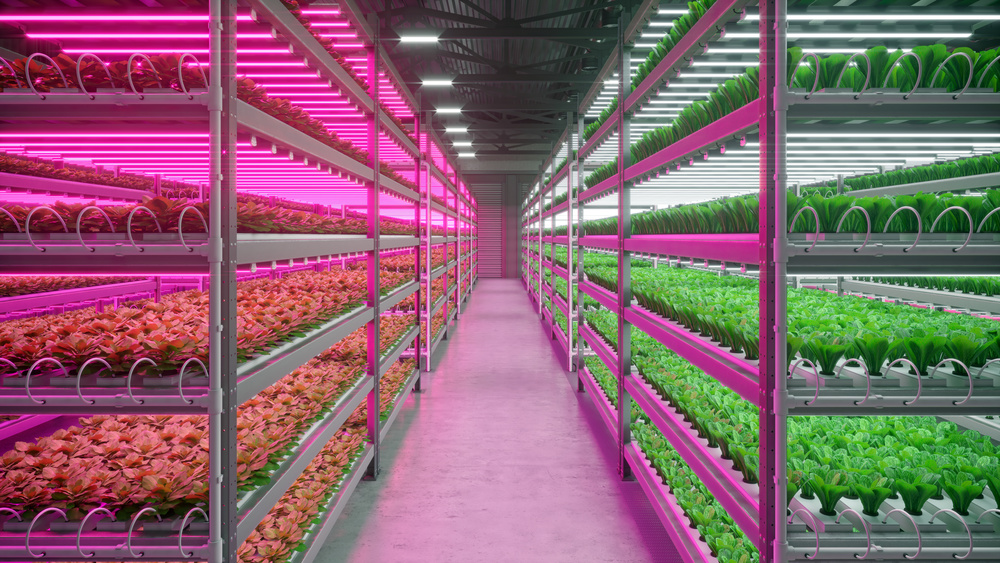



Far-red light, roughly 700-750 nm, is the most misunderstood part of the horticultural spectrum. Used deliberately, it promotes flowering; mixed in carelessly, it stretches plants. The difference lies in timing and dose, and both sit in the lighting recipe rather than the fixture price tag. Most growers already fix the red:blue (R:B) ratio for photosynthesis and leaf shape; far-red is a separate regulatory layer on top.
How Plants Read Far-Red
Two mechanisms explain what far-red does. First, the Emerson enhancement effect: far-red photons alone drive little photosynthesis, but combined with red photons they raise the efficiency of the whole photosystem chain. This is why the extended PAR definition (ePAR, 400-750 nm) now counts far-red photons in photon budgets. Second, phytochrome: a pigment that flips between two forms — Pr, which absorbs red around 660 nm, and Pfr, which absorbs far-red around 730 nm. Red light pushes phytochrome into Pfr; far-red pushes it back to Pr. The balance between the two forms is the signal the plant reads. Full sun carries a high red-to-far-red ratio; shade under a canopy carries a low one.
The EOD Pulse for Flowering
The flowering effect is best delivered as an end-of-day (EOD) far-red pulse: a short burst as the main lights switch off. The pulse drops the Pfr level toward Pr, and the plant reads that red-to-far-red shift at dusk as the signature of a long day. In long-day crops — lettuce, spinach and many ornamentals — this promotes flowering and lets growers shorten the main photoperiod while keeping the flowering signal. Continuous far-red does the opposite job badly: it lowers the red-to-far-red ratio all day and triggers shade-avoidance responses such as stem stretch, larger thinner leaves and delayed pigmentation. That is why far-red should not simply be mixed permanently into the main spectrum.
| Strategy | Far-red delivery | Typical outcome |
|---|---|---|
| EOD pulse | Short burst at end of photoperiod | Earlier flowering in long-day crops |
| Growth-stage share | 5-15% of photon output, switched by stage | Elongation control, canopy development |
| Continuous mix | Blended into the main spectrum all day | Shade avoidance: stretch, thin leaves |
Treat Far-Red as a Growth Regulator
Decide the objective first — flowering promotion, elongation control or canopy development — then set the channel proportion, timing and duration. Responses vary by cultivar, so run small trials and measure hypocotyl length, node spacing and flowering timing on the actual variety under a few far-red settings before scaling the recipe across the rack.
Specification Details That Get Missed
Ask for the spectral distribution showing the far-red peak wavelength and its proportion, and confirm the channel is independently addressable through 0-10 V or DALI rather than hard-wired into the main spectrum. A tunable dimming curve matters in research and propagation facilities, because the same rack may run a vegetative recipe in the morning and an EOD pulse in the evening. Include photoperiod logging in the control system so EOD timing repeats across the season. Finally, check efficacy claims: far-red photons are counted only partially in some efficacy definitions, so confirm whether the published umol/J includes the far-red channel.
FAQ
Does far-red count as photosynthetic light?
Partly. Through the Emerson effect it raises the efficiency of red photons, and the ePAR definition (400-750 nm) includes it, but recipes should still treat it as a regulatory input, not bulk photons.
What share of output should the far-red channel take?
5-15% of total photon output is a common range, switched by growth stage and confirmed with cultivar trials.
How do I make EOD timing repeatable?
Use an independently addressable channel with a control system that logs photoperiod events, so the pulse fires at the same minute every day of the season.
