
 English
 Afrikaans
 Albanian
 Amharic
 Arabic
 Armenian
 Azerbaijani
 Basque
 Belarusian
 Bengali
 Bosnian
 Bulgarian
 Catalan
 Cebuano
 Chichewa
 Corsican
 Croatian
 Czech
Czech Danish
 Dutch
Dutch Esperanto
 Estonian
 Filipino
 Finnish
 French
 Frisian
 Galician
 Georgian
 German
 Greek
Greek Gujarati
 Haitian Creole
 Hausa
Hausa Hawaiian
 Hebrew
 Hindi
Hindi Hmong
Hmong Hungarian
 Icelandic
 Igbo
Igbo Indonesian
 Irish
Irish Italian
 Japanese
 Javanese
 Kannada
 Kazakh
 Khmer
Khmer Korean
 Kurdish (Kurmanji)
 Kyrgyz
 Lao
Lao Latin
Latin Latvian
 Lithuanian
 Luxembourgish
 Macedonian
 Malagasy
 Malay
Malay Malayalam
 Maltese
 Maori
Maori Marathi
 Mongolian
 Myanmar (Burmese)
 Nepali
 Norwegian
 Pashto
 Persian
 Polish
 Portuguese
 Punjabi
 Romanian
 Russian
 Samoan
 Scottish Gaelic
 Serbian
 Sesotho
 Shona
Shona Sindhi
 Sinhala
 Slovak
 Slovenian
 Somali
 Spanish
 Sudanese
 Swahili
 Swedish
 Tajik
Tajik Tamil
Tamil Telugu
 Thai
Thai Turkish
 Ukrainian
 Urdu
Urdu Uzbek
Uzbek Vietnamese
 Welsh
Welsh Xhosa
Xhosa Yiddish
 Yoruba
 Zulu
Zulu
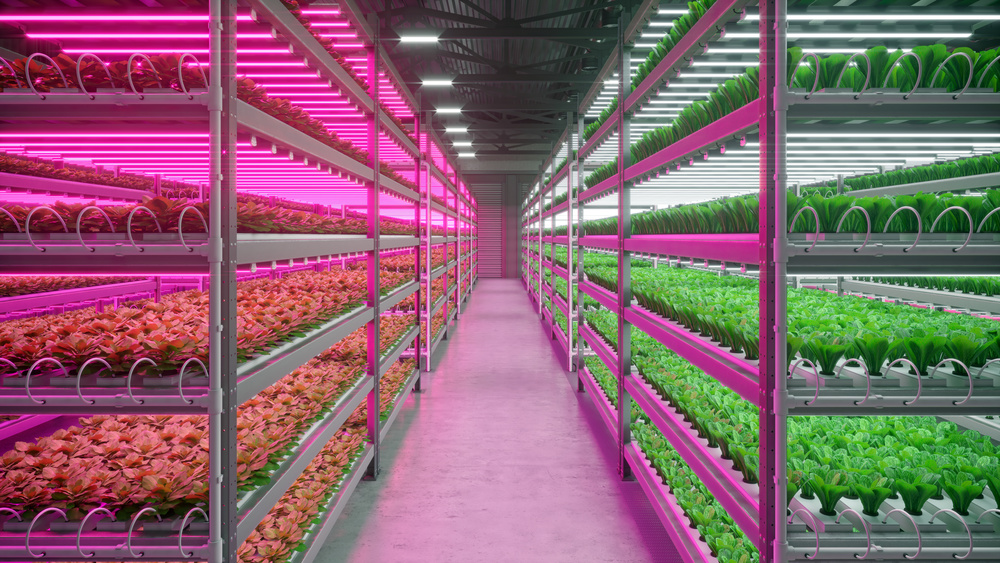



PPFD and DLI are the two numbers that turn a lighting budget into a crop result. PPFD (photosynthetic photon flux density) counts the usable photons in the 400-700 nm band that reach the canopy each second, measured in umol/m2/s. DLI (daily light integral) sums those photons over a full photoperiod: DLI = average PPFD x photoperiod hours x 0.0036, with DLI in mol/m2/d. Work through four steps and the fixture count becomes arithmetic instead of guesswork.
Step 1: Start From the Crop Target, Not the Catalogue
Fixture datasheets list PPF; crops respond to DLI. Set the target per crop and stage first, then derive everything else from it. Winter sunlight in northern latitudes often delivers only 3-8 mol/m2/d at canopy level, so supplemental lighting carries most of the load. Typical design targets:
| Crop and stage | DLI target (mol/m2/d) | Photoperiod (h) | Average PPFD (umol/m2/s) |
|---|---|---|---|
| Leafy greens, winter supplement | 12-20 | 16 | 208-347 |
| Propagation and young plants | 15-17 | 16 | 260-295 |
| Basil and culinary herbs | 15-25 | 16 | 260-434 |
| Tomato and pepper, high light | 25-35 | 18 | 386-540 |
Every value in the PPFD column follows from one formula: DLI divided by (hours x 0.0036). If your local sunlight already contributes 6 mol/m2/d, subtract it from the target before sizing the electric system.
Step 2: Convert DLI Into Average PPFD
Take a propagation facility targeting 17 mol/m2/d on a 16 h photoperiod. Average PPFD = 17 / (16 x 0.0036) = 295 umol/m2/s across the tray. The constant 0.0036 bundles two conversions: one hour holds 3,600 s, and one mole holds 1,000,000 umol.
The photoperiod choice changes the intensity requirement. The same 17 mol target on a 12 h day needs 394 umol/m2/s, which raises fixture count and heat; stretching to 18 h drops it to 262 umol/m2/s. This is why 16-18 h schedules dominate propagation and leafy-green design: lower intensity over longer hours improves uniformity and spreads the photon load.
Step 3: Convert Average PPFD Into Fixture Count
Multiply the target PPFD by the lit area to get the photon flux the canopy must receive. For a 250 m2 propagation bench at 295 umol/m2/s, the canopy needs 73,750 umol/s. Add a service factor of 10-20% to cover dirt on optics, driver tolerance, thermal drift and spacing non-uniformity; at 15%, the required output rises to 86,765 umol/s.
Now divide by the fixture PPF. A 600 W LED grow light rated at 2.8 umol/J delivers 1,680 umol/s, so the count is 86,765 / 1,680 = 51.6, rounded up to 52 fixtures. Total connected load: 31.2 kW, or roughly 499 kWh per 16 h day.
One warning: do not convert PPF to PPFD with a bare formula. Distribution shape, mounting height and beam overlap decide where photons land, and only the photometric file shows that.
Step 4: Verify the Design and the Installation
Model the layout with the fixture’s IES or LDT file in lighting software, then read the simulated PPFD map, not just the average: deep dips between fixtures produce uneven crops even when the average looks right. For North American projects, take the efficacy figure from the DLC QPL listing so the energy model matches the rebate file. After installation, spot-check with a full-spectrum quantum sensor on a grid of at least 9 points per bay; a measured average within +/-10% of the simulation is standard acceptance practice.
FAQ
How much DLI does lettuce need in winter?
Plan 12-17 mol/m2/d including sunlight. Measure the sunlight contribution first with a quantum sensor, then supplement the difference.
Can I run fewer fixtures for longer hours?
Yes. Lower intensity over a longer photoperiod often improves uniformity, but confirm the crop tolerates the extended schedule at each growth stage.
How often should the calculation be revisited?
Recheck each season. Fixture output drifts down with age, optics collect dust, and crop targets change with the planting program.
