

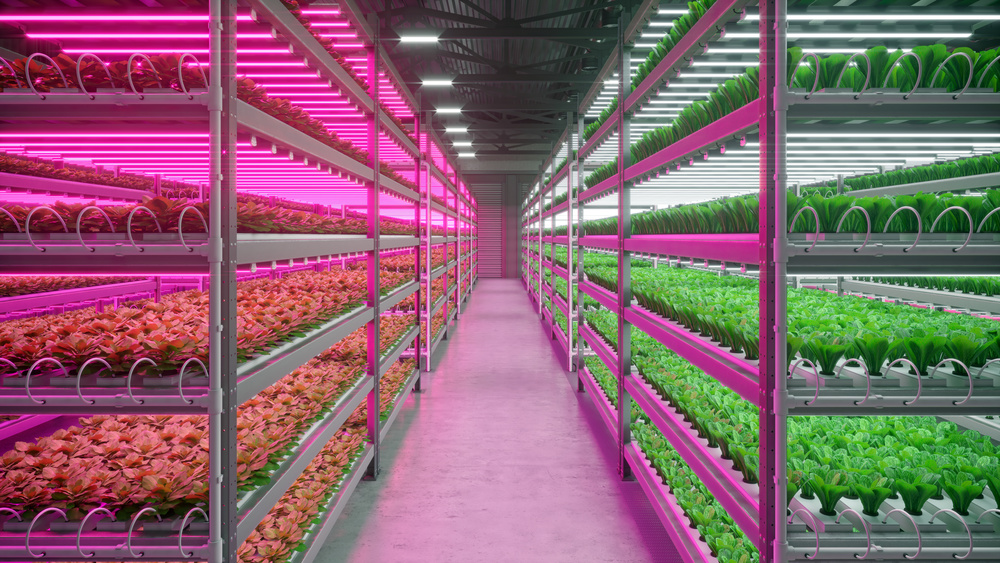


DALI is usually filed under office lighting, yet it fits greenhouse automation better than any analog scheme. It is a digital, two-way bus: every grow light group carries an address, so a controller can switch sectors, ramp PPFD and log runtime per zone. A 0-10 V system needs extra wiring and separate sensors to imitate any of that.
Why a Two-Way Bus Beats 0-10 V
The electrical layer is simple: a two-wire, polarity-free bus, up to 64 addresses per segment, power and bus cable kept in separate trunking. The capability gap is wider than the wiring:
| Capability | DALI | 0-10 V analog |
|---|---|---|
| Control signal | Digital, two-way | One-way analog |
| Addressing | Up to 64 addresses per segment | One channel per dimming zone |
| Fixture feedback | Lamp failure and load status reports | None |
| Schedules | Stored centrally, replayed daily | External timers and sensors |
| Retrofit path | Gateway drives legacy 0-10 V fixtures | Baseline system |
That feedback loop matters when tens of thousands of hours accumulate across a season. Automatically knowing that a driver failed in zone 7 at 3 a.m. is worth real money compared with finding a dark block by eye during morning rounds. Where fitted, DALI also supports emergency function monitoring, which simplifies compliance logging.
The Photoperiod Program Lives in One Place
In a greenhouse, the daily plan is the product. With DALI, the whole schedule — lights-on ramp, daylight intensity levels, sunset fade, any night-interruption pulse — is stored centrally and replayed every day. Manual switching introduces human error; a stored program matches research protocols that demand repeatable conditions, trial after trial.
Keep the controller clock synchronized to a local sunrise table so photoperiods track the season automatically instead of being edited by hand every few weeks. For cultivar trials, that repeatability is the difference between comparable data and noise.
Segment by Crop Block
The design step that decides success is segmentation. Addresses should follow behavioral zones: propagation, vegetative and flowering areas become distinct DALI groups, each running its own DLI schedule and dimming curve. Research benches and cultivar trials get individual addresses; production bays share group addresses. A propagation room that needs a 16 h schedule with a soft dawn ramp can run it without disturbing a flowering bay on a different curve.
Segmentation also contains faults. One misconfigured group cannot drag down the whole house, and a documented bus structure — wiring diagrams kept with the project file — is what makes later expansion cheap. Greenhouse sites change; the documentation is the map.
Installation and Maintenance Checklist
- Choose fixtures with certified DALI drivers and confirm the controller supports your zone count and logging format.
- In hybrid systems, place a gateway between the DALI bus and legacy 0-10 V fixtures so a retrofit can migrate zone by zone instead of a stop-and-swap rebuild.
- Torque-check bus connections after the first season; greenhouse humidity is hard on terminal blocks.
- Re-verify the address map against the drawings after every crop-layout change.
- Keep the controller firmware and clock synchronized, since a drifted clock silently shifts every photoperiod on the bus.
Group addressing keeps the schedule maintainable. Assigning all fixtures in one zone to a single DALI group lets the grower shift sunrise by fifteen minutes across the whole room with one command, instead of reprogramming dozens of individual addresses after each crop rotation.
FAQ
Can DALI and 0-10 V fixtures run on the same schedule?
Yes. A gateway translates between the two, so one photoperiod program drives both fixture types while the 0-10 V zones wait for replacement.
How many fixtures fit on one DALI segment?
Up to 64 addresses per segment. Production bays share group addresses, so capacity is rarely the limit; total cable length within the controller specification is.
Does DALI replace the climate computer?
No. It integrates with it: the DALI controller handles photoperiod and dimming, and the climate computer keeps environmental control.
