
 English
 Afrikaans
 Albanian
 Amharic
 Arabic
 Armenian
 Azerbaijani
 Basque
 Belarusian
 Bengali
 Bosnian
 Bulgarian
 Catalan
 Cebuano
 Chichewa
 Corsican
 Croatian
 Czech
Czech Danish
 Dutch
Dutch Esperanto
 Estonian
 Filipino
 Finnish
 French
 Frisian
 Galician
 Georgian
 German
 Greek
Greek Gujarati
 Haitian Creole
 Hausa
Hausa Hawaiian
 Hebrew
 Hindi
Hindi Hmong
Hmong Hungarian
 Icelandic
 Igbo
Igbo Indonesian
 Irish
Irish Italian
 Japanese
 Javanese
 Kannada
 Kazakh
 Khmer
Khmer Korean
 Kurdish (Kurmanji)
 Kyrgyz
 Lao
Lao Latin
Latin Latvian
 Lithuanian
 Luxembourgish
 Macedonian
 Malagasy
 Malay
Malay Malayalam
 Maltese
 Maori
Maori Marathi
 Mongolian
 Myanmar (Burmese)
 Nepali
 Norwegian
 Pashto
 Persian
 Polish
 Portuguese
 Punjabi
 Romanian
 Russian
 Samoan
 Scottish Gaelic
 Serbian
 Sesotho
 Shona
Shona Sindhi
 Sinhala
 Slovak
 Slovenian
 Somali
 Spanish
 Sudanese
 Swahili
 Swedish
 Tajik
Tajik Tamil
Tamil Telugu
 Thai
Thai Turkish
 Ukrainian
 Urdu
Urdu Uzbek
Uzbek Vietnamese
 Welsh
Welsh Xhosa
Xhosa Yiddish
 Yoruba
 Zulu
Zulu



Automotive exterior lighting has moved beyond simple illumination. Adaptive driving beam (ADB) headlamps, laser-radar (LiDAR) illumination, daytime running lights, and interior ambient systems all demand LED components that survive temperature cycles, vibration, and decades of operational life. That is why ceramic LED chips and the AEC-Q102 qualification are converging as the de facto benchmark for automotive-grade LED components.
For procurement engineers and R&D teams sourcing LED light sources for automotive applications, the questions are practical: What exactly is a ceramic LED chip? What does AEC-Q102 actually test? How do you verify a supplier’s claim of “automotive grade”? This guide answers those questions in procurement language.
What is a ceramic LED chip package?
A ceramic LED chip uses a ceramic substrate – typically alumina (Al₂O₃) or aluminium nitride (AlN) – instead of the more common lead-frame or EMC (epoxy moulding compound) packages used in general lighting.
Why ceramic matters in automotive:
- Thermal performance. AlN ceramic offers thermal conductivity typically in the range of 170–230 W/m·K, versus roughly 1–3 W/m·K for standard EMC packages. In the confined, high-temperature environment behind a headlamp lens, every degree of junction temperature saved extends lifetime and stabilises colour.
- High-temperature tolerance. Ceramic substrates withstand elevated operating temperatures without the yellowing, delamination, or reflectivity loss that epoxy packages suffer over time.
- Mechanical and dimensional stability. Ceramic packages hold tight tolerances through soldering and thermal cycling – essential for the precise optical alignment of lens arrays and ADB matrix modules.
- Reflectivity maintenance. Ceramic cavity reflectors maintain high reflectivity, which keeps optical efficiency stable over the component’s lifetime.
- Corrosion and contamination resistance. In harsh under-hood and exterior environments, ceramic resists moisture ingress and corrosion better than organic packages.
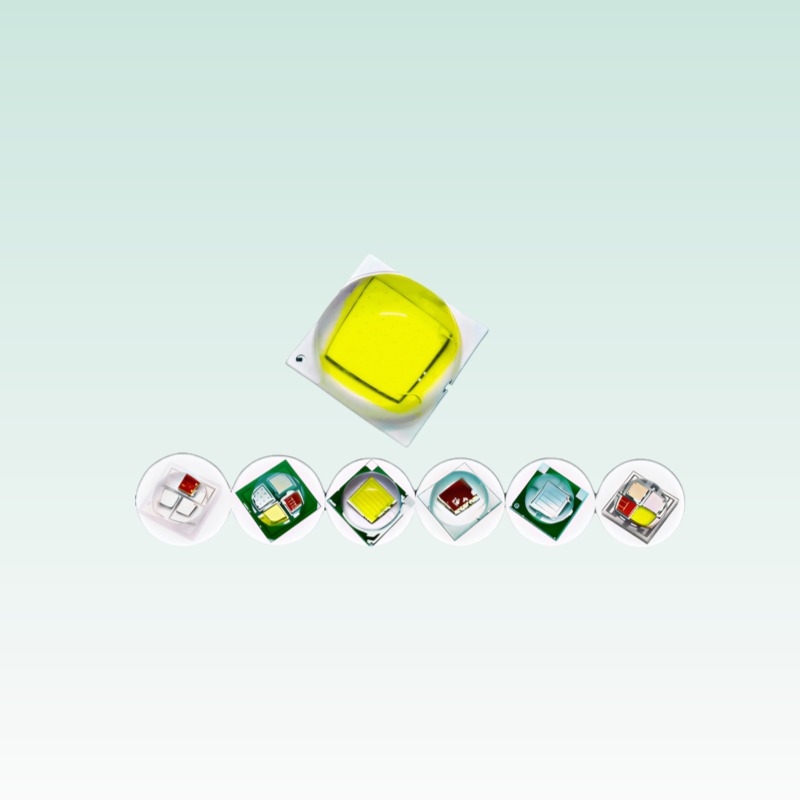
Common ceramic footprint sizes in automotive lighting include 3535, 5050, and 7070 packages – the first four digits describe the package length and width in tenths of a millimetre. The die itself can be a standard chip or a flip-chip configuration for improved thermal path and lower package height.
What is AEC-Q102?
AEC-Q102 is the Automotive Electronics Council’s qualification standard for discrete optoelectronic components – specifically LEDs, laser components, photodiodes, and related devices. It was released to give automotive suppliers a standardised, documented stress test that proves an LED component can survive real automotive environments.
AEC-Q102 replaces the earlier approach of quoting “automotive grade” without evidence. It is built around several stress test groups:
- Environmental tests – temperature cycling, high-temperature storage, damp heat, thermal shock, and temperature-humidity bias, which simulate the car’s environment under the bonnet, behind the lens, and in the cabin.
- Electrical and optical tests – operating life at various drive conditions (continuous and pulsed), ESD sensitivity (HBM and CDM models), and failure-mode verification to ensure the component fails predictably rather than dangerously.
- Mechanical tests – vibration, mechanical shock, and solderability, which validate that the ceramic package and its joints survive assembly and road conditions.
- Solder heat resistance – reflow and wave-soldering profiling to prove the package tolerates assembly heat without internal damage.
Flat stress levels determine how harsh an environment the part is qualified for. A buyer’s job is to confirm that the qualification test conditions match the actual application – a chip qualified only for cabin ambient use is not automatically qualified for an engine-bay or behind-lens environment.
Why AEC-Q102 matters for LED chip buyers
There are three concrete reasons to insist on AEC-Q102 evidence:
- Predictable reliability. The standard’s lifecycle tests – typically 1000-hour or longer endurance at defined conditions – give statistically meaningful data on flux maintenance and failure rates.
- Auditable evidence. The qualification report documents test conditions, sample sizes, and pass/fail criteria. It is the evidence your quality team needs to approve a supplier.
- Liability management. In automotive, component failures cascade into recalls. A documented AEC-Q102 qualification shifts the reliability conversation from speculation to data.
Applications of ceramic AEC-Q102 LED chips
Adaptive driving beam (ADB) headlamps
ADB systems switch individual LED segments on and off to shape the beam around oncoming traffic. Precision, thermal stability, and contrast between segments demand ceramic packages with tight tolerances – often in 3535 or smaller footprints for low-profile matrix boards.
LiDAR illumination
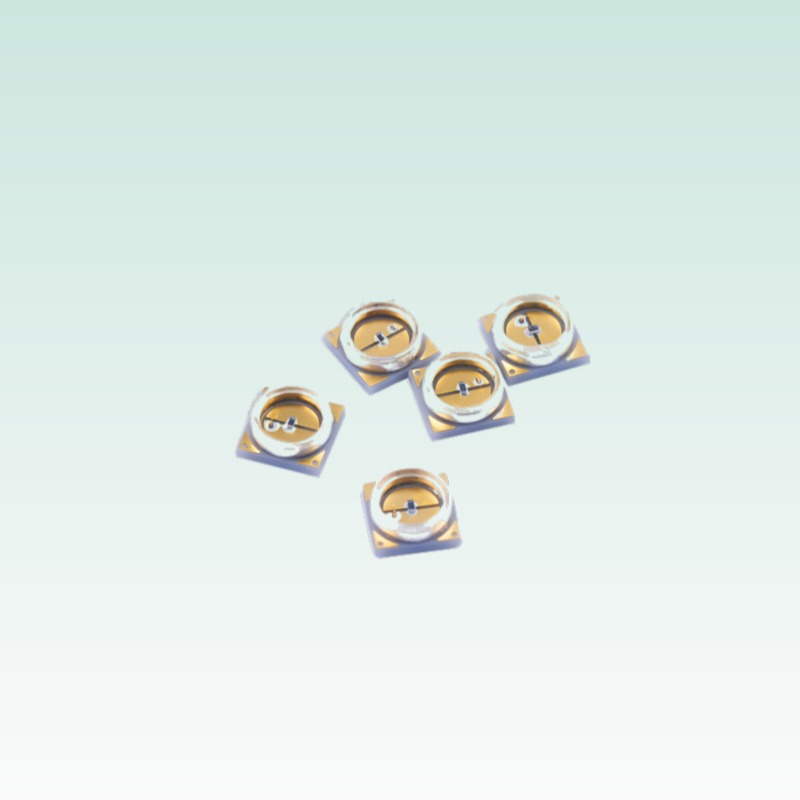
Automotive LiDAR systems use infrared light sources, and SWIR illumination around the 905–1550 nm region is increasingly common. These light sources must survive windshield-mount heat and deliver consistent optical power over the vehicle’s lifetime – ceramic SWIR LED chips are a natural fit.
Headlamp and daytime running light (DRL) modules
High-brightness ceramic chips drive DRLs and low/high-beam modules where thermal management is critical inside sealed headlamp housings.
Interior ambient and HMI lighting
Ambient lighting that must hold chromaticity across millions of vehicles over years of operation benefits from ceramic package stability and tight binning.
Industrial and e-mobility derivatives
The same reliability arguments apply to e-bikes, e-scooters, agricultural machinery, and heavy vehicles – any application with vibration, temperature extremes, and extended operational hours.
How to verify a supplier’s AEC-Q102 claim
“Automotive grade” is a marketing phrase. “AEC-Q102 qualified” is a claim that must be evidenced. Ask for:
- The AEC-Q102 qualification report – confirm the stress levels, temperatures, and durations match your application profile.
- Test lab and standards version – which revision of AEC-Q102, and which accredited laboratory produced the data.
- Coverage scope – does the qualification cover the specific package size, die variant, and wavelength you intend to buy? Qualification is package- and die-specific, not generic.
- PPAP and lot traceability – automotive buyers typically require production part approval process documentation and full lot traceability from wafer to delivered reel.
- Failure-mode and reliability data – ask for the failure analysis summary and the reliability model used for lifetime prediction.
If a supplier cannot produce the report within a short turnaround, treat “AEC-Q102” in their marketing material as unverified. A qualified supplier will be proud to share the documentation – it is their engineering proof, not a secret.
Design considerations when specifying ceramic LED chips
- Total thermal resistance (Rth) – junction-to-solder point values in K/W; compare suppliers on identical definitions.
- Maximum junction temperature (Tj,max) – some ceramic parts run at 150 °C or higher; confirm your thermal simulation uses the right derating.
- Binning strategy – automotive projects typically demand tight flux and chromaticity bins; ask which bins are stocked for production volume.
- Solder pad design and reflow profile – ceramic packages have specific recommended soldering conditions; mismatch costs yield.
- ESD classification – verify HBM and CDM ratings to size your assembly line protection.
- Wavelength and optical output stability – for SWIR and sensor applications, confirm spectral stability over temperature and lifetime.
WHAT ABOUT QUALITY SYSTEMS BEYOND AEC-Q102?
AEC-Q102 is a component stress qualification. It sits on top of (not instead of) a supplier’s quality management system. For production automotive supply, look for IATF 16949 certification – the automotive QMS standard – plus a documented change-management process (PCN), 8D corrective action capability, and 100% lot traceability. The combination of IATF 16949 + AEC-Q102 + PPAP is the professional baseline for automotive LED chip supply.
How QUEENDOM supports automotive buyers
QUEENDOM manufactures ceramic LED chips in 3535, 5050, and 7070 footprints across visible and SWIR wavelengths, with ceramic substrates selected for low thermal resistance. For automotive and harsh-industrial customers, we can provide AEC-Q102 qualification evidence, lot traceability, and engineering samples for evaluation before volume commitment. Tell us your package size, target wavelength, and drive conditions – we will send the thermal data and qualification documentation you need to make an informed sourcing decision.
Ceramic LED chips and AEC-Q102 are not marketing slogans; they are engineering standards that separate automotive-grade supply from general-purpose commodity LEDs. Insist on the evidence, build the qualification into your approved-vendor matrix, and your headlamp, LiDAR, or industrial lighting programme will be built on components that survive the road – not just the datasheet.
AEC-Q102 test groups at a glance
Understanding what the standard actually tests helps you interpret the report a supplier provides. The main groups in the current AEC-Q102 flow and their typical conditions:
- Environmental stress: temperature cycling (e.g. 1000 cycles at -40 °C to +125 °C), high-temperature storage, damp heat/steady-state humidity, thermal shock, and temperature-humidity bias – conditions chosen to simulate the automotive environment.
- Electrical and optical endurance: continuous operating life and pulsed operating life at specified currents, generally 1000+ hours, with periodic optical measurement to confirm flux and colour stability.
- ESD characterisation: Human Body Model and Charged Device Model tests to classify the component’s sensitivity and confirm the design does not fail dangerously.
- Mechanical integrity: vibration, mechanical shock, and solderability – the joints and the ceramic body must survive assembly and road conditions.
- Failure-mode verification: the standard requires the failure analysis of failed samples, so the failure mode is known and predictable rather than mysterious.
The qualification report states sample sizes, test conditions, and pass/fail criteria. When a supplier summarises “AEC-Q102 qualified”, ask them to share the specific stress levels and durations – a report qualified at benign conditions does not automatically cover a harsh engine-bay profile.
Qualification evidence versus production consistency
AEC-Q102 is a laboratory qualification; production consistency is governed by process controls and statistical methods. For volume procurement, also request:
- PPAP (Production Part Approval Process) documentation – standard in automotive supply and expected for headlamp, LiDAR, and body-control modules.
- Lot traceability: the ability to trace a delivered reel back to epitaxial wafer, die lot, assembly batch, and test record.
- Statistical process control (SPC) data on key optical parameters – wavelength, flux, Vf – across recent production lots, showing the actual bin distribution you will receive.
- Change notification: a documented PCN mechanism with a defined notification window before any material, process, or design change.
- 8D and corrective action capability: evidence of structured problem-solving from previous customers, especially on optoelectronic failures.
The combination of an AEC-Q102 report, IATF 16949 certification, and production SPC data is the evidence package you can defend in an automotive customer audit. Anything less is a starting point for qualification, not a substitute for it.
Related Products
Further reading: AEC-Q102 Certification Guide · 3535 Ceramic LED Chip Datasheet Guide · Automotive LEDs Solutions
