

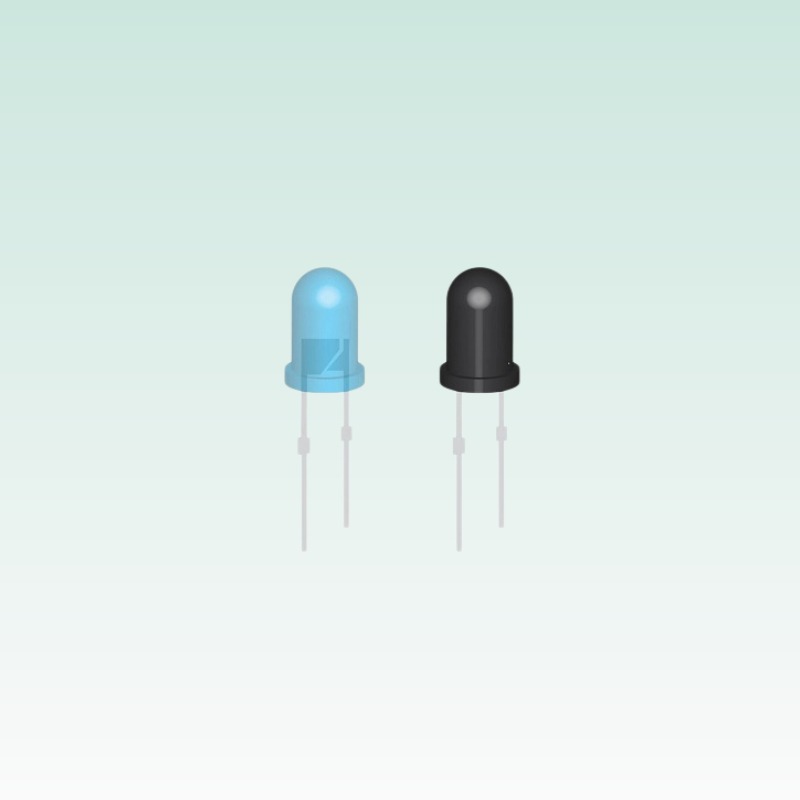





A 254nm emitter and a blue emitter fail in a similar shape but for a different reason. UVC light creates defects in the AlGaN active region and in the encapsulant that sits over it, so output falls while the forward voltage holds. A bar that meets its sterilisation dose on day one can miss it in month thirty if the design sized the margin from the fresh number.
The fix is not a more powerful bar. It is binning discipline, a cool junction, and a spec written against end-of-life irradiance.
What Degradation Comes From
Two mechanisms act together. Non-radiative defect generation inside the quantum wells removes carriers that should leave as photons, and the UV-transparent encapsulant yellowing under the same exposure absorbs part of what remains. Both are slow at a low junction temperature and both accelerate above roughly 80C.
| Cause | Effect on output | What slows it |
|---|---|---|
| Defect generation in the wells | Gradual slope over 10,000h | Low junction temperature |
| Encapsulant yellowing | Early fast then flatter | Short light path, clean optics |
| phosphor-free spectral shift | Dose change at the target | Stable drive current |
| Drive current creep | Apparent rise then fall | Fixed current source, not resistor |
Heat is the lever a designer controls. A UVC bar mounted on a metal spine with forced air behind it will keep more of its day-one output over three years than the same bar in a sealed housing, because the defect generation rate tracks the junction.
What Binning Guarantees
Binning for UVC is stated in irradiance at a measurement distance, usually expressed in microwatts per square centimetre at a given current and a set hour. A bar built from a high bin starts brighter; a bar built from a low bin can still be the better product if it holds its slope.
Ask two numbers from the supplier: the bin at zero hours and the flux maintenance at 5,000 or 10,000 hours. A 70% maintenance at 10,000 hours on a high bin outlasts a 90% maintenance on a low bin when the design target is a three year dose. Grouping by initial irradiance alone is how a line ends up re-certifying every six months.
Sizing for End of Life
Size the bar against the dose the target needs after the expected operating hours, not at installation. If a water line needs 40 mJ/cm2 per pass and runs 6 hours a day for 3 years, the bar must produce that dose at roughly 60% of its commissioned output so the plant can schedule a swap before the dose falls.
Measure irradiance in situ with a calibrated UV-C meter at the actual working distance. Bench numbers taken at 50mm mean nothing on a 300mm pipe where reflectivity of the housing and the transmission of any cover glass take the delivered dose down. Log the reading at commissioning and again at 6 months; the delta tells you the real slope for that bar.
Driver Current and Duty Cycle
Running a UVC emitter below its rated current buys life. A bar driven at 60% of the nominal current gives up some instant irradiance and buys a longer usable slope, which is the right trade for a sterilisation tunnel that runs every day. Driving at the absolute rating to hit a day-one number is how schedules slip.
Pulse the bar only as often as the process needs. A continuous 24-hour UVC application on a surface that is already clean wastes energy and accelerates the encapsulant. Interlock it with the door and with the flow so the emitters only run when product or air is actually passing.
Key Takeaways
- Degradation is defect generation plus encapsulant yellowing; both respond to junction temperature.
- Spec the bin and the flux maintenance figure together, never the bin alone.
- Size the bar for the dose at end of life, and measure in situ at the real distance.
- Run below rated current where the process allows, and interlock to cut duty cycle.
- junction temperature limits for UV LEDs in medical devices
- more UV and package reliability notes in LED Diode Q&A
