
 English
 Afrikaans
 Albanian
 Amharic
 Arabic
 Armenian
 Azerbaijani
 Basque
 Belarusian
 Bengali
 Bosnian
 Bulgarian
 Catalan
 Cebuano
 Chichewa
 Corsican
 Croatian
 Czech
Czech Danish
 Dutch
Dutch Esperanto
 Estonian
 Filipino
 Finnish
 French
 Frisian
 Galician
 Georgian
 German
 Greek
Greek Gujarati
 Haitian Creole
 Hausa
Hausa Hawaiian
 Hebrew
 Hindi
Hindi Hmong
Hmong Hungarian
 Icelandic
 Igbo
Igbo Indonesian
 Irish
Irish Italian
 Japanese
 Javanese
 Kannada
 Kazakh
 Khmer
Khmer Korean
 Kurdish (Kurmanji)
 Kyrgyz
 Lao
Lao Latin
Latin Latvian
 Lithuanian
 Luxembourgish
 Macedonian
 Malagasy
 Malay
Malay Malayalam
 Maltese
 Maori
Maori Marathi
 Mongolian
 Myanmar (Burmese)
 Nepali
 Norwegian
 Pashto
 Persian
 Polish
 Portuguese
 Punjabi
 Romanian
 Russian
 Samoan
 Scottish Gaelic
 Serbian
 Sesotho
 Shona
Shona Sindhi
 Sinhala
 Slovak
 Slovenian
 Somali
 Spanish
 Sudanese
 Swahili
 Swedish
 Tajik
Tajik Tamil
Tamil Telugu
 Thai
Thai Turkish
 Ukrainian
 Urdu
Urdu Uzbek
Uzbek Vietnamese
 Welsh
Welsh Xhosa
Xhosa Yiddish
 Yoruba
 Zulu
Zulu






Introduction
Short-Wave Infrared (SWIR) illumination, operating in the 970-1700nm wavelength range, has emerged as the critical enabling technology for next-generation industrial vision systems. Unlike visible-light cameras that can only detect surface color and texture, SWIR imaging penetrates organic materials and reveals subsurface features invisible to conventional inspection systems.
For B2B procurement teams evaluating machine vision upgrades and system integrators designing next-generation sorting lines, understanding SWIR LED technology’s capabilities, implementation requirements, and ROI potential is essential. This technical guide examines the two highest-impact applications — food quality control and polymer recycling — with practical specification guidance for industrial deployment.
The Physics of SWIR Detection
SWIR photons interact with materials differently than visible light. Water molecules exhibit strong absorption bands at 1450nm and 1950nm, making SWIR exceptionally sensitive to moisture content. Organic compounds including lipids, proteins, and cellulose have characteristic absorption signatures between 1000nm and 1700nm that enable material-specific identification.
Crucially, silicon becomes semi-transparent above 1100nm, allowing SWIR cameras with InGaAs sensors to image through silicon wafers and certain packaging materials. This physical property underlies both semiconductor defect detection and automated optical inspection applications that drive demand for high-radiance SWIR LED sources.
Application 1: Food Sorting and Quality Control
Detecting Internal Defects
Conventional RGB camera systems detect surface blemishes but miss internal bruising, rot, and foreign object contamination. SWIR illumination at 1450nm penetrates fruit skin to reveal subsurface bruising hours before it becomes visible, enabling preemptive sorting that prevents defective products from reaching consumers.
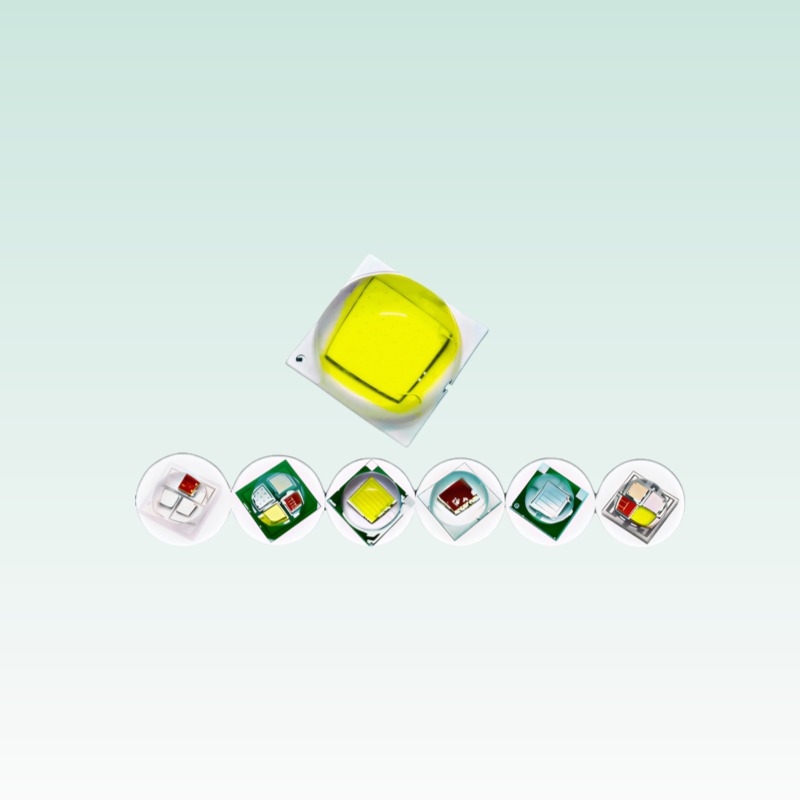
For stone fruits (peaches, plums, cherries), SWIR imaging achieves >99.5% bruise detection accuracy at conveyor speeds exceeding 3 m/s. The key specification is optical power density: QUEENDOM SWIR LED chips deliver 500-2000mW/sr radiance in compact 3535 or 5050 ceramic packages, achieving the signal-to-noise ratios required for real-time high-speed inspection without expensive laser sources.
Moisture and Dry Matter Analysis
The 1450nm water absorption band enables simultaneous moisture content mapping during sorting. Potato processors use SWIR systems to separate high-moisture tubers (prone to enzymatic browning) from optimal frying stock. Nut and seed processors detect insect damage through moisture signature anomalies without destructive sampling.
Implementation requires wavelength-stabilized SWIR sources with <5nm spectral variation to maintain calibration across production batches. QUEENDOM's SWIR chips offer ±3nm wavelength tolerance and include temperature compensation circuitry that maintains spectral stability across -20°C to +60°C operating environments typical in food processing facilities. Application 2: Plastic and Polymer Recycling NIR Spectroscopy for Polymer Identification Different polymer types — PET, HDPE, PVC, PP, PS — exhibit distinct absorption spectra in the 1000-1700nm range. PET shows strong C-H overtone bands at 1410nm and 1660nm. HDPE has characteristic peaks at 1200nm and 1390nm. These spectral fingerprints enable automated NIR spectroscopy systems to sort mixed plastic waste streams at >95% purity, a critical capability for meeting Extended Producer Responsibility (EPR) regulations in the EU and emerging state-level mandates in the US.
Black Plastic Recovery
Carbon-black-filled plastics absorb visible light completely, making them invisible to RGB sorting systems. However, carbon black is partially transparent in SWIR wavelengths above 1200nm. SWIR illumination enables recovery of black HDPE, PP, and PS containers that previously were landfilled or incinerated, improving overall recycling yields by 15-25% for mixed waste streams.
This application demands high optical power because black plastics have low reflectance even in SWIR. QUEENDOM’s SWIR LED arrays deliver 5-15W total optical power in compact linear configurations, achieving the irradiance levels (typically 50-100mW/cm² at 500mm working distance) required for reliable spectroscopic identification of dark-colored polymers.
System Integration Considerations
Camera and Illumination Matching
InGaAs cameras have peak sensitivity at 1550nm, making 1450nm and 1550nm SWIR LEDs the optimal illumination choices for maximum signal-to-noise ratio. Camera selection must match the LED’s emission spectrum: broadband sources (100nm FWHM) pair better with spectrometer-based systems, while narrowband sources (50nm FWHM) optimize monochrome imaging systems.
Thermal Management
High-power SWIR LEDs at 1-3W per chip require active thermal management. Junction temperature affects both output power (approximately -0.3%/°C derating) and wavelength stability (approximately +0.3nm/°C shift). Ceramic-substrate packages with thermal resistance <3.5 K/W are essential for maintaining calibration in continuous industrial operation. QUEENDOM's AlN ceramic substrates (thermal conductivity >170 W/mK) enable passive cooling with standard aluminum heat sinks in most food processing environments.
Optical Design
SWIR lenses require specialized glass or germanium optics that transmit above 1000nm. Standard borosilicate glass absorbs strongly above 1400nm. System integrators must specify SWIR-compatible lens materials (S-LAH79, CaF₂, or germanium) and anti-reflection coatings optimized for the target wavelength band.
ROI and Business Case
For food processors, SWIR sorting systems typically deliver payback within 12-18 months through reduced customer complaints, decreased product returns, and premium pricing for defect-free product batches. A mid-size apple packing facility (50,000 tons/year) reports $400,000 annual savings from eliminating bruised fruit shipments that previously triggered retailer penalty clauses.
For recycling operations, SWIR-enabled black plastic recovery adds $200-400 per ton revenue from previously discarded material. A 100,000 ton/year MRF (Materials Recovery Facility) achieves $2-4M incremental annual revenue with 18-month system payback, excluding avoided landfill tipping fees and carbon credit monetization.
QUEENDOM SWIR Solutions
QUEENDOM offers a complete range of SWIR LED chips engineered for industrial vision and spectroscopy applications:
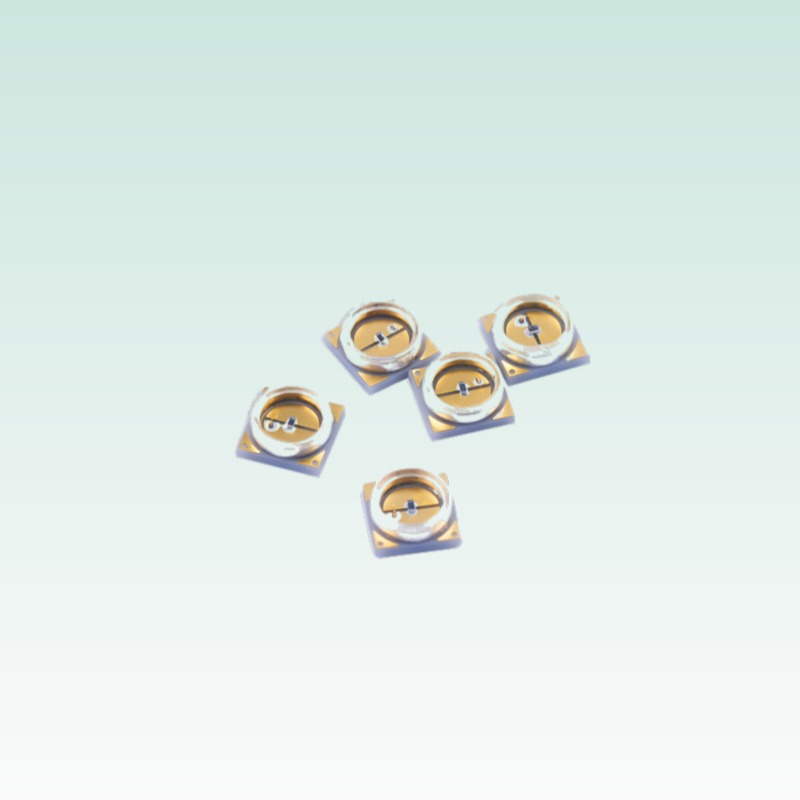
• SWIR LED Chips (970-1700nm): 1-3W optical power in 3535 and 5050 ceramic packages, ±3nm wavelength tolerance
• Custom Wavelength Engineering: Peak emission tuned to your specific application requirements
• Application Engineering Support: Optical design consultation, thermal simulation, and driver circuit optimization
• OEM/ODM Programs: Custom chip arrays, integrated optics, and complete illumination modules
Related Products
• SWIR LED Chips (970-1700nm) — Our core SWIR product line for industrial vision and spectroscopy
• 7070 High-Power Ceramic LED Chips — High-power solutions for large-area illumination applications
• 3535 Ceramic LED Chips (AEC-Q102) — Automotive-grade ceramic LEDs for extreme environments
Conclusion
SWIR LED technology represents a paradigm shift in industrial quality control and material sorting, enabling detection capabilities impossible with visible-light systems. For procurement teams and system integrators, the key specification parameters are wavelength precision, optical power density, thermal resistance, and spectral stability — all areas where QUEENDOM’s ceramic-package SWIR chips deliver industry-leading performance.
Contact our application engineering team to discuss your specific SWIR illumination requirements and receive customized optical design recommendations for your inspection or sorting application.
Contact
Email: sales@queendomlamp.com
Website: www.queendomlamp.com
Related Article: AEC-Q102 Certification: What Automotive LED Suppliers Must Know
Related Products
Further reading: SWIR LED Chips (970-1700nm) · SWIR Machine Vision Deep Dive
