

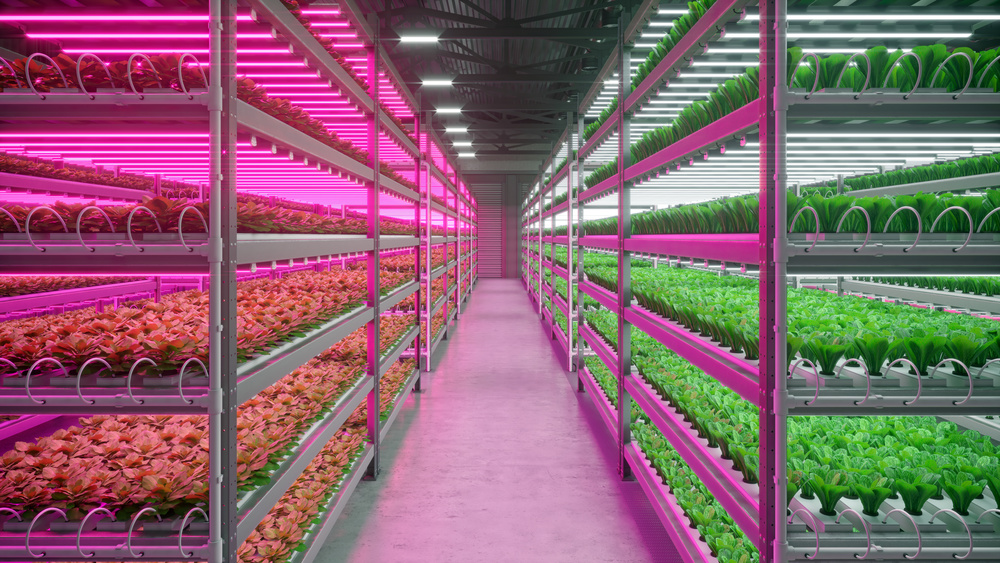



1. Warum die LED-Technologie die landwirtschaftliche Beleuchtung verändert hat
For most of the twentieth century, growers chose between lamp types whose spectra were fixed properties of the physics inside the bulb: incandescent filaments heavy in red and infrared, fluorescent tubes rich in blue, high-pressure sodium dominated by yellow-orange. Light was a boundary condition of the crop environment, not a controllable input. Solid-state lighting changed that boundary into a control knob. A LED fixture is, at its core, a programmable light source: wavelengths can be mixed by design, output can be dimmed across a wide range without spectral shift, und die whole assembly converts electricity to plant-usable photons at efficiencies the older technologies never approached.
Three consequences matter commercially. First, photon efficacy: modern horticultural LEDs deliver roughly two to three times the photosynthetically useful output per watt of legacy lamps, which directly reduces the largest operating cost of controlled-environment agriculture. Second, thermal management: LEDs emit little radiant heat toward the canopy, so lamps can be positioned close to plants and cooling loads drop in sealed rooms. Third, spectrum becomes a crop-management tool — a grower can hold one fixture platform and retune the spectrum for germination, vegetative growth, flowering, or finishing without changing hardware. This white paper explains the photobiology that makes those tuning decisions effective, the metrics used to specify and compare fixtures, and a design method you can apply to a shelf, a room, or a greenhouse bay.
2. Pflanzenphotobiologie: Wie Pflanzen Licht tatsächlich nutzen
Photosynthesis is driven by photons between roughly 400 and 700 nanometres, a band the industry calls photosynthetically active radiation, or PAR. Within that band, absorption is not uniform. Chlorophyll a absorbs strongly near 430 and 662 nm, chlorophyll b near 453 and 642 nm, and accessory carotenoids fill in around 450–500 nm. Early fixture design chased those pigment peaks, but field experience shows plants grown under broad-spectrum sources generally outperform plants under narrow dual-band red-blue light: the action spectrum of whole-plant photosynthesis is flatter than the absorption spectra suggest, and green light penetrates deeper into dense canopies where it remains photosynthetically useful.
2.1 Photorezeptoren jenseits der Photosynthese
Plants also carry sensor pigments that read the spectral composition of their environment and steer development. Phytochrome exists in two interconvertible forms: Pr absorbs red light near 660 nm and Pfr absorbs far-red near 730 nm. The ratio of red to far-red light in a habitat tells a plant whether it is shaded by neighbors, and it regulates stem elongation, leaf expansion, und die transition to flowering in sensitive species. Cryptochromes and phototropins sense blue light and control phototropism, stomatal opening, und die compact, sturdy morphology growers prize. A spectrum plan that ignores these sensors produces plants that photosynthesize adequately but grow leggy, flower late, or finish inconsistently.
2.2 Photoperiode und der Emerson-Effekt
Photoperiodism — the response of flowering to day length — is also phytochrome-mediated, which is why brief night-interruption lighting with red sources can hold short-day plants vegetative or trigger flowering on schedule. Separately, the classical Emerson enhancement effect showed that photosynthetic yield under long-wavelength red light improves when far-red photons accompany it, because the two photosystems of the photosynthetic apparatus are driven in balance. Practical fixture design exploits this by pairing deep-red 660 nm emission with a measured far-red 730 nm component, gaining canopy penetration and photosynthetic efficiency simultaneously.
3. Die wichtigen Kennzahlen: PPF, PPFD, DLI und Wirksamkeit
Die Beleuchtung im Gartenbau wird in Photonen und nicht in Lumen angegeben, da die Lumengewichtung das menschliche Sehvermögen und nicht die Reaktion der Pflanzen beschreibt. Vier Größen bestimmen den Großteil des technischen Gesprächs.
| Metric | Definition | Units | Wo es verwendet wird |
|---|---|---|---|
| PPF | Insgesamt pro Sekunde emittierte PAR-Photonen | µmol/s | Gerätedatenblätter, Geräteauswahl |
| PPFD | PAR-Photonenflussdichte auf dem Blätterdach | µmol/m²/s | Designziele, Messung auf Pflanzenebene |
| DLI | Tageslichtintegral, Photonen pro Tag | mol/m²/day | Anbauplanung, zusätzliche Gewächshausdimensionierung |
| Photonenwirksamkeit | PPF pro Watt Eingangsleistung | µmol/J | Energievergleich, Betriebskostenmodelle |
Conversion between them is straightforward. Daily light integral equals average PPFD multiplied by photoperiod: sixteen hours at 250 µmol/m²/s delivers DLI = 250 × 16 × 3600 / 1,000,000 = 14.4 mol/m²/day. In greenhouses, the designer sums natural DLI from climate data and adds only the supplemental deficit. In sole-source indoor farms, the fixture system supplies the entire DLI. Two spectral ratios also appear in specifications: red-to-blue ratio, which shapes morphology, and red-to-far-red ratio, which steers shade-avoidance and flowering behavior.
4. Spektrumstrategie nach Wachstumsphase
4.1 Keimung und Vermehrung
Seedlings and clones have limited root systems and low stress tolerance. A moderate PPFD of 100–200 µmol/m²/s under a spectrum with a meaningful blue fraction (15–25 percent) keeps transplants compact and stocky. Überbelichtung junger Pflanzen wastes energy and stresses tissue without accelerating development.
4.2 Vegetatives Wachstum
During bulk biomass accumulation, many crops perform well under full-spectrum white light supplemented with deep red, at PPFD targets of 200–400 µmol/m²/s for leafy greens and herbs. The blue component maintains leaf thickness and pigmentation; the red component drives the photosynthetic heavy lifting at the highest efficacy available in the fixture.
4.3 Blüte und Fruchtbildung
Generative crops such as tomato, pepper, and strawberry shift priority from leaf to fruit. Red-dominant spectra with adequate blue support photosynthesis during high-demand fruit fill, while photoperiod and far-red management time the reproductive transition. High-wire greenhouse vegetables commonly receive both top lighting and interlighting bars placed inside the canopy, where previously wasted photons now illuminate lower leaves directly.
4.4 Vollspektrum-Weiß versus gezieltes Schmalband
Broad white-plus-red spectra make crop inspection easy, support worker comfort, and hedge against physiology that pure red-blue fixtures optimize narrowly. Targeted red-blue mixtures maximize photon efficacy for energy-dominated operations such as vertical farming of commodity greens. The pragmatic choice for most operations is a full-spectrum platform with switchable or dimmable red channels, preserving inspection quality and crop flexibility at a small efficacy premium.
5. Integrale Tageslichtziele für gängige Nutzpflanzen
In der folgenden Tabelle sind weit verbreitete DLI-Bereiche für die alleinige Produktion in Innenräumen aufgeführt. In der Praxis von Gewächshäusern werden diese Gesamtwerte üblicherweise als kombinierter Zielwert aus natürlichen Pflanzenstoffen und Nahrungsergänzungsmitteln behandelt.
| Crop | DLI Range (mol/m²/day) | Notes |
|---|---|---|
| Microgreens | 8–12 | Kurze Zyklen, moderate PPFD bewahren die Qualität |
| Salat und Babyblatt | 12–17 | Höherer DLI verkürzt den Zyklus; Achten Sie auf Tipburn über ~20 |
| Küchenkräuter (Basilikum, Minze) | 12–20 | Artensensibel; Basilikum verträgt starkes Licht |
| Strawberry | 17–25 | Blüte und Fruchtqualität hängen stark vom Spektrum ab |
| Tomate, Gurke, Paprika | 20–30+ | Hochseil-Gewächshauskulturen, Zwischenbeleuchtung üblich |
6. Auswahl einer Vorrichtungsplattform
Fixture geometry follows the growing system. Tiered vertical racks and propagation shelves use linear tubes and bars that distribute light evenly along the shelf and fit tight vertical clearance. The T8-format grow tubes serve this class directly, operating on standard fixtures and delivering full-spectrum or red-blue recipes. High-bay installations over open growing rooms and tall greenhouses call for concentrated sources — UFO-style hohe Leistung units — that project PPFD across greater distances. Humid, irrigation-heavy environments require IP65-class waterproof luminaires with sealed drivers and corrosion-resistant hardware. Bulb-format retrofits let a grower convert legacy fluorescent or sodium installations to LED spectrum control without rewiring the facility.
Control capability belongs in the specification from day one. Dimming inputs (0–10 V or similar), multi-channel spectrum switching, and scheduling interfaces determine whether the facility can implement stage-specific recipes or will be locked to a single fixed output. Fixture-level data sheets for each platform in the Queendom horticultural range — including grow tubes, panel formats, and UFO high bays — are available through the downloads section below und die plant lighting manual.
7. Eine Entwurfsmethode in sieben Schritten
Ein diszipliniertes Beleuchtungslayout kann auf einer Seite berechnet werden. Führen Sie die Schritte der Reihe nach aus:
Schritt 1 – Korrigieren Sie den Zuschnitt und sein DLI-Ziel. Nutzen Sie die Tabelle in Abschnitt 5 plus lokale Erfahrungen.
Schritt 2 – Wählen Sie die Fotoperiode. Übliche Zeiträume für den Innenbereich sind 14–18 Stunden; Bestätigen Sie die Photoperiodenempfindlichkeit der Pflanze.
Schritt 3 – Berechnen Sie den erforderlichen durchschnittlichen PPFD. PPFD = DLI × 1,000,000 / (photoperiod in seconds). For DLI 14.4 at 16 hours: 250 µmol/m²/s.
Schritt 4 – Größe des Gesamt-PPF für das Anbaugebiet. PPF ≈ PPFD × area, then divide by a utilization factor (typically 0.7–0.85) to account for wall losses and non-uniformity.
Schritt 5 – Geräte auswählen und zählen. Fixture count = total required PPF ÷ rated PPF per fixture, rounded up.
Schritt 6 – Überprüfen Sie die Gleichmäßigkeit. Ordnen Sie PPFD auf einem Raster in Überdachungshöhe zu; Das Verhältnis von Minimum zu Durchschnitt sollte etwa 0,7 für einstufige Kulturen und 0,8 für empfindliche Kulturen überschreiten. Passen Sie den Abstand und die Höhe an oder fügen Sie ein Reflexionsmanagement hinzu.
Schritt 7 – Überprüfen Sie die elektrische und thermische Hülle. Bestätigen Sie vor der Bestellung die Kapazität des Schaltkreises, die Auslastung des Gerätetreibers und die Raumwärmeabfuhr.
As a worked miniature: a 10 m² lettuce room targeting 250 µmol/m²/s needs roughly 2,500 µmol/s at the canopy; with a utilization factor of 0.8 the installed PPF is about 3,100 µmol/s, met by twelve bars rated at 260 µmol/s each, arranged with overlap to satisfy the uniformity check.
8. Energie- und Betriebsökonomie
Photonenwirksamkeit translates directly into cost. A legacy high-pressure sodium installation delivering 1.0–1.7 µmol/J compared with a current LED platform at 2.5–3.5 µmol/J means the same crop DLI is reached with 30–50 percent less lighting energy. In sealed indoor rooms, every lighting watt saved also removes roughly 0.3 W of cooling load, compounding the saving. Maintenance economics shift in parallel: sodium lamps require planned replacement every one to two years as output decays, while LED luminaires are typically budgeted to an L90 lumen-maintenance point five to eight years out, und die absence of lamp changes removes a recurring labor and disposal cost — including the hazardous-waste handling that mercury-bearing lamps require.
Die Amortisationszeiträume für Umbauten hängen von den örtlichen Stromtarifen und Nutzungsstunden ab; Hochbetriebliche Anlagen mit teurem Strom amortisieren sich in der Regel innerhalb von drei Jahren vollständig. Viele Energieversorger bieten Effizienzrabatte für LED-Nachrüstungen im Gartenbau an, die vor der endgültigen Auswahl der Leuchten geprüft werden sollten.
9. Illustrative Bereitstellungsprofile
Profil A – Vertikale Blattgemüsefarm. A five-tier rack system converted from fluorescent tubes to full-spectrum LED grow tubes. Sixteen-hour photoperiod at 220–250 µmol/m²/s per tier delivers DLI near 14; energy consumption for lighting falls by roughly a third, germination uniformity improves because spectrum and PPFD are consistent across tiers, and close-mounting is possible because radiant heat at canopy level is negligible.
Profil B – Gewächshaus-Zusatzbeleuchtung für Hochseiltomaten. Sodium toplighting is supplemented — and in stages replaced — by LED toplight plus horizontal interlighting bars inside the canopy. The added 70–90 µmol/m²/s lifts winter DLI into the target band, lower-canopy leaves receive direct photons instead of shade, and crop steering benefits from independently timed spectrum channels. Both profiles reflect the pattern our applications team sees across horticultural projects rather than a single named installation.
10. Erste Schritte
Begin with the crop und die numbers, not the catalog: choose the DLI target, compute PPFD, and only then compare fixture platforms on PPF, efficacy, and control capability. The documents below supply the detailed product parameters and spectrum tables for the Queendom horticultural range, and our applications engineers review grow-room layouts at no charge for project opportunities.
11. Messung, Inbetriebnahme und laufende Überprüfung
A lighting layout is only as good as its verification. Every installation should be commissioned with a quantum sensor (PAR meter) rather than trusted from the drawing, because real reflectance, rack finishes, and neighboring equipment shift PPFD away from the model. Take measurements at canopy height on a grid — a 0.5 × 0.5 m grid is adequate for most rooms — with the sensor leveled and fixtures at operating temperature. Record the map; it becomes the baseline for maintenance decisions und die reference when crop performance questions arise later.
Sensor quality matters at this stage. Full-spectrum quantum sensors designed for LED sources read mixed white-plus-red spectra correctly, whereas older sensors calibrated only to sunlight or sodium lamps can bias red-heavy spectra by several percent. When comparing readings against a manufacturer’s published PPFD map, confirm the measurement plane distance und die drive current assumed in the datasheet before drawing conclusions.
After commissioning, schedule an annual re-measurement. Fixture output declines slowly (the L-values discussed in our LED reliability resources), room reflectance degrades with dust, and crop canopy geometry changes as varieties turn over. A five-minute spot check at four fixed reference points, compared with the commissioning map, tells you whether the decline is within budget or worth investigating. Log the readings next to the fixture model and install date so the history survives staff changes.
11,1 Messgeräte und Datengewohnheiten, die es wert sind, aufgebaut zu werden
Three habits keep a grow facility’s lighting data trustworthy. First, one meter, one owner: designate a single instrument and a responsible person, and send the sensor for factory recalibration on the interval the manufacturer states (typically every two years). Second, photograph the measurement grid positions once and reuse the exact locations every time. Third, pair every lighting reading with the electrical reading — a clamp meter on the lighting circuit confirms actual power draw, which lets you recompute in-situ photon efficacy and catch driver faults or unintended dim levels early.
12. Häufige Fallstricke und wie man sie vermeidet
| Pitfall | Symptom in der Ernte | Correction |
|---|---|---|
| Streben nach maximalem PPFD statt Gleichmäßigkeit | Heiße Regale in der Mitte, Randpflanzen bleiben zurück | Überlappende Vorrichtungsabstände; verify min/avg > 0.7 |
| Abstandsabfall in hohen Racks wird ignoriert | Das obere Blätterdach ist leicht beansprucht, die untere Reihe ist ausgehungert | Stufen neu aufleveln; Wählen Sie eine Optik, die zum Etagenabstand passt |
| Überbelichtung junger Pflanzen | Sämlingsverbrennung, verkümmerte Transplantationen | Dim to 100–200 µmol/m²/s for propagation |
| Festes Spektrum über alle Stufen hinweg | Langbeiniges vegetatives Wachstum, ungleichmäßige Blüte | Bühnenspezifische Rezepte; Blau in der Vermehrung hervorbringen |
| Tipburn bei hohem DLI | Nekrose der Salatblattränder, wenn die Köpfe reifen | Cap DLI ~17–20 für empfindliche Sorten; Verbessern Sie den Luftstrom |
| Photoperiodische Überraschungen | Schossen oder verzögerte Blüte | Bestätigen Sie die Photoperiodenklasse des Zuschnitts vor der Planung |
| Nassaufstellungsgeräte in der Nähe von Bewässerungsanlagen | Fahrerkorrosion, störende Ausfälle | Setzen Sie auf bewässerten Etagen Leuchten der Schutzklasse IP65 ein |
Two further mistakes deserve mention because they are expensive to unwind. The first is specifying fixtures without a control interface, then discovering mid-season that stage-specific recipes require one; retrofit dimming onto installed drivers is rarely practical. The second is mixing fixture generations in the same visible room: bin and spectrum differences between old and new units show up as growth bands across the room. When expanding in phases, hold the new installation to the original spectrum part number, or plan the expansion as a complete re-specification.
13. Glossar der Begriffe Gartenbaubeleuchtung
| Term | Klartextbedeutung |
|---|---|
| PAR | Photosynthetisch aktive Strahlung, das 400–700 nm Photonenband, das Pflanzen für die Photosynthese nutzen |
| PPF | Total PAR photons a fixture emits per second (µmol/s) |
| PPFD | Density of PAR photons landing on the canopy (µmol/m²/s) |
| DLI | Daily light integral, the photon dose per day (mol/m²/day) |
| Photonenwirksamkeit | PPF per input watt (µmol/J); higher means cheaper photons |
| R:B-Verhältnis | Rot-zu-Blau-Photonenverhältnis; prägt Kompaktheit und Blattfarbe |
| R:FR-Verhältnis | Rot-zu-Far-Rot-Verhältnis; steuert Schattenvermeidung und Blüte |
| Photoperiod | Tägliche Lichtstunden, die die Pflanze erhält |
| L90 / L80 | Stunden, bis die Leistung auf 90 %/80 % des Ausgangswerts fällt; Angaben zur Wartungslebensdauer |
| Interlighting | Im Inneren des Blätterdachs angebrachte Stäbe beleuchten die unteren Blätter direkt |
| Alleinige Quelle | Indoor-Produktion, bei der die Leuchten 100 % des Erntelichts liefern |
| Toplighting | Deckenbefestigungen, die herkömmliche Gewächshausgeometrie |
14. Spezifizierung und Beschaffung: Was Sie einen Lieferanten fragen sollten
Der letzte Schritt eines disziplinierten Projekts besteht darin, den Entwurf in eine Bestellung umzuwandeln, die ihn schützt. Unabhängig von der Plattform – Anbauröhren, Panels oder UFO-Hochregale – unterscheiden die folgenden Fragen zwischen Anbietern, die hinter ihren photometrischen Ansprüchen stehen können, und Anbietern, die dies nicht können. Fordern Sie jeden Punkt schriftlich an und fügen Sie die Antworten der Projektdatei bei.
| Fragen Sie nach | Warum es wichtig ist |
|---|---|
| PPFD-Karte bei der von Ihnen angegebenen Montagehöhe und dem Antriebsstrom | Überprüft die Homogenitätsansprüche Ihrer Geometrie, keine generischen |
| Bewerteter PPF und Photonenwirksamkeit unter Testbedingungen | Macht Geräte hinsichtlich Photonen pro Watt vergleichbar |
| Spektrumdiagramm mit R:B- und R:FR-Verhältnissen | Bestätigt, dass das Rezept mit Ihrem Ernteplan übereinstimmt |
| L-Wert-Erhaltungsprojektion (L90-Basis) | Begründet das Ersatzbudget in Testdaten |
| Spezifikation der Steuerschnittstelle (Dimmen, Zeitplanung) | Bestimmt, ob Stufenrezepte tatsächlich umsetzbar sind |
| Schutzart für Nassbereiche | Versiegelte Leuchten überstehen Bewässerungszyklen; andere nicht |
| Garantiebedingungen einschließlich Fahrerschutz | Treiber, nicht LEDs, verursachen die meisten frühen Geräteausfälle |
| Bin- und Spektrumstabilitätsrichtlinie | Schützt Phase-2-Erweiterungen vor sichtbarer Nichtübereinstimmung |
Lieferanten, die diese Fragen schnell beantworten, sind in der Regel diejenigen, deren Geräte sich nach dem zweiten Jahr wie angegeben verhalten. Wenn Antworten langsam oder vage sind, behandeln Sie dies als eigenständige Projektinformation. Unser Anwendungsteam stellt standardmäßig PPFD-Karten, Spektrumsdaten und Zuverlässigkeitsdokumentationen für das gesamte Queendom-Gartenbausortiment bereit und überprüft die Anlagenlayouts mit Käufern während der Spezifikation kostenlos.
• Pflanzenbeleuchtungshandbuch (PDF)
• Queendom Pflanzenbeleuchtungskatalog (PDF)
• UFO-Pflanzenbeleuchtungsserie (PDF)
• Vollspektrum-Korrespondenztabelle (PDF)
Verwandte Ressourcen:
• Spezifikationen für die Beleuchtung im Gartenbau
• Leitfaden zur Beleuchtungsplanung
Lassen Sie sich benachrichtigen, wenn neue Whitepapers zur Landwirtschaftsbeleuchtung veröffentlicht werden