





Ultraviolet-B phototherapy is a dosimetric therapy. The clinical outcome depends on delivering a defined radiant exposure, measured in millijoules per square centimetre, to a defined skin area within a defined time, and the difference between a therapeutic dose and a burning dose is often less than a factor of three. This white paper is written for medical device engineers and clinical engineering teams building UVB LED phototherapy equipment, and for component buyers who must judge whether an emitter is suitable for that role. It covers the dose-response relationship, spectral irradiance measurement, minimal erythema dose (MED) reference values, and the design discipline required to keep a UVB device safe. QUEENDOM’s J-14 3535 UVB (275/310 nm) and J-13 3 mm UVB emitters are used as the worked examples. The paper also draws a hard boundary between UVB phototherapy and UVA or 405 nm systems, which operate in a different biological regime and must not be substituted for one another.
1. Why UVB dosimetry is unforgiving
UVB occupies the 280–315 nm band. It is the portion of the solar spectrum that produces sunburn, stimulates cutaneous vitamin D synthesis, and — under controlled dosage — induces the immunomodulation that makes phototherapy effective in psoriasis, vitiligo, atopic dermatitis and several other conditions. Narrowband UVB, historically produced by fluorescent lamps with a peak near 311 nm, has become the clinical standard for many indications because it delivers therapeutic effect with less erythema than broadband UVB.
Two properties make UVB dosimetry harder than most lighting engineering tasks.
The erythema action spectrum is steep. The relative effectiveness of UVB for producing erythema peaks near 297 nm and falls sharply towards 315 nm. A small error in peak wavelength is a large error in biological effect.
The dose-response curve saturates. Therapeutic response increases with dose and then plateaus, while erythema continues to increase. The therapeutic window is the region between the minimum effective dose and the threshold erythema dose, and it is narrow.
| Band | Wavelength range | Primary biological effect | Role in phototherapy |
|---|---|---|---|
| UVA | 315–400 nm | Pigmentation, dermal penetration | PUVA, UVA1 for scleroderma |
| UVB | 280–315 nm | Epidermal DNA damage, immunomodulation | Narrowband UVB phototherapy |
| Narrowband UVB | 310–313 nm | Optimised therapeutic/erythema ratio | Standard clinical phototherapy |
| UVB, short | 275–300 nm | High erythema effectiveness | Emerging LED platform, requires careful dosing |
| UVC | 200–280 nm | Germicidal, superficial absorption | Disinfection, not phototherapy |
2. The dose-response relationship
Phototherapy dose is expressed as radiant exposure:
“ H = E × t “
where H is dose in mJ/cm², E is irradiance in mW/cm² and t is exposure time in seconds. Because the response is not linear, the clinical protocol steps the dose along a protocol-specific ladder, typically starting at 50–70 % of the patient’s MED and increasing by 5–20 % per session depending on the response and the number of treatments per week.
2.1 Dose versus exposure time
Because dose is the product of irradiance and time, a device’s practical session length is set by the irradiance it can deliver at the treatment plane. The table below shows delivered dose against exposure time for three irradiance levels that correspond to typical LED panel and lamp-based systems.
| Irradiance at skin | 30 s | 60 s | 120 s | 300 s |
|---|---|---|---|---|
| 1 mW/cm² | 30 mJ/cm² | 60 mJ/cm² | 120 mJ/cm² | 300 mJ/cm² |
| 3 mW/cm² | 90 mJ/cm² | 180 mJ/cm² | 360 mJ/cm² | 900 mJ/cm² |
| 10 mW/cm² | 300 mJ/cm² | 600 mJ/cm² | 1,200 mJ/cm² | 3,000 mJ/cm² |
| 30 mW/cm² | 900 mJ/cm² | 1,800 mJ/cm² | 3,600 mJ/cm² | 9,000 mJ/cm² |
Clinical protocols for whole-body narrowband UVB commonly operate between 5 and 15 mW/cm² at the patient plane, producing session lengths of one to ten minutes. Higher irradiance shortens sessions but increases the consequence of a timer or shutter fault, which is why IEC 60601-2-83 places such emphasis on independent dose-limiting safeguards.
3. Spectral irradiance and why wavelength accuracy matters
The therapeutic and erythematous effectiveness of UVB depends on wavelength, and the two action spectra are not identical. The practical consequence is that the emitter’s peak wavelength and full-width half-maximum must be specified and verified, not assumed.
The figure carries the central engineering warning of this paper. A 275 nm emitter lies close to the peak of the erythema action spectrum and is therefore intrinsically more erythemogenic per unit dose than a 310 nm emitter. It is useful where superficial, high-potency action is wanted, but its therapeutic window is narrower and its dosing must be more conservative. A 310 nm emitter sits further from the erythema peak and closer to the therapeutic optimum that made narrowband UVB successful with fluorescent lamps.
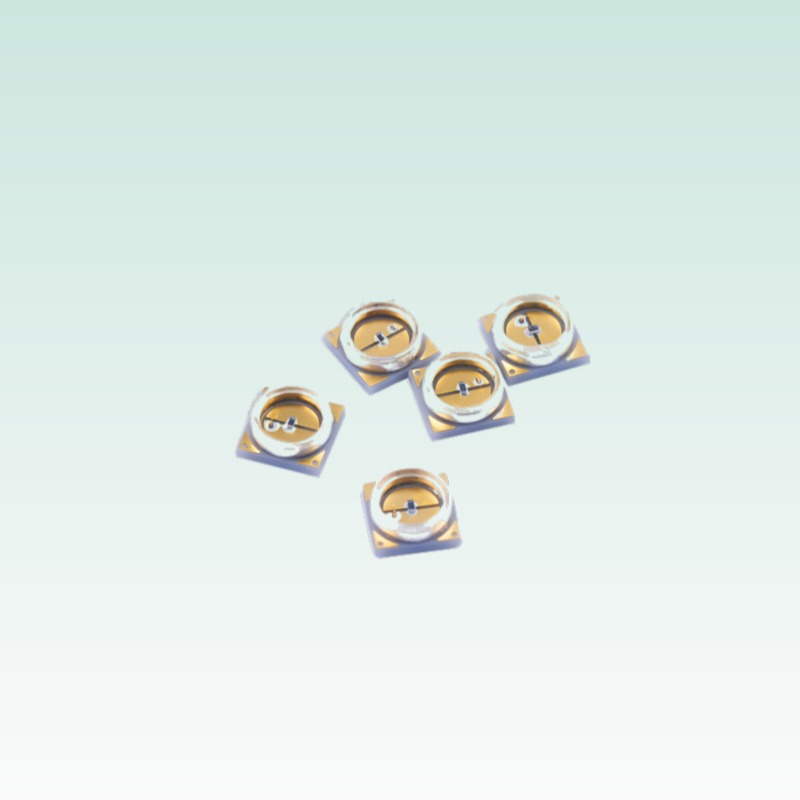
| Property | J-14 3535 UVB | J-13 3 mm UVB |
|---|---|---|
| Peak wavelength options | 275 nm / 310 nm | 275 nm / 310 nm |
| FWHM | ≤ 12 nm (275 nm) / ≤ 14 nm (310 nm) | ≤ 12 nm / ≤ 15 nm |
| Radiant flux | 8–18 mW @ 350 mA (270–320 nm total) | 2–5 mW @ 20 mA |
| Forward voltage | 5.5–7.0 V @ 350 mA | 5.0–6.5 V @ 20 mA |
| Viewing angle | 120° | 20°–30° (lensed) |
| Package | 3.5 × 3.5 mm ceramic, quartz window | 3 mm through-hole, metal can |
| Resistencia Térmica | ~15 K/W | ~180 K/W |
| Targeted function | Panel array, high-irradiance devices | Point treatment, targeted applicator |
| Erythema-band overlap | High at 275 nm | High at 275 nm |
4. Minimal erythema dose and the dosing ladder
MED is defined as the lowest radiant exposure that produces a just-perceptible erythema, assessed 24 hours after exposure. It is patient-specific and depends on Fitzpatrick skin type, prior UV exposure, medication and the anatomical site. Published reference values are used to set the starting dose; they are not a substitute for individual determination.
| Fitzpatrick skin type | Descripción | Typical MED at 311 nm (mJ/cm²) | Typical whole-body starting dose (mJ/cm²) |
|---|---|---|---|
| I | Very fair, always burns | 200–300 | 130–200 |
| II | Fair, burns easily | 300–500 | 200–350 |
| III | Medium, sometimes burns | 500–700 | 350–500 |
| IV | Olive, rarely burns | 700–900 | 500–650 |
| V | Brown, very rarely burns | 900–1,200 | 650–850 |
| VI | Deeply pigmented, never burns | > 1,200 | 850–1,000+ |
These values are given for engineering context only. Clinical protocols, starting doses and dose increments are the responsibility of the treating clinician and must follow the applicable national guidance and the device’s cleared indications.
| Design consideration | Requirement | Rationale |
|---|---|---|
| Dose accuracy | ±10 % of set point | Clinical protocols assume delivered dose |
| Independent timer | Separate from control firmware | Prevents overexposure on control failure |
| Irradiance calibration | Before first use and at defined intervals | LED output drifts with age and temperature |
| Shutter or enable | Fail-safe to off | Dose must stop when the session ends |
| Uniformity over treatment area | ≤ 1.3:1 max-to-min | Avoids hot spots above MED |
| Eye protection | Mandatory goggles | UVB is a significant ocular hazard |
4.1 Dose uniformity and the hot-spot problem
In a multi-emitter panel, dose non-uniformity is the most common source of unexpected erythema. If the maximum-to-minimum irradiance ratio is 1.5:1 and the protocol sets the mean dose at 60 % of MED, the hottest point receives 90 % of MED, and a slightly photosensitive patient will burn. Panels should be designed and validated for a uniformity ratio no worse than 1.3:1 across the treatment area.
5. Product mapping
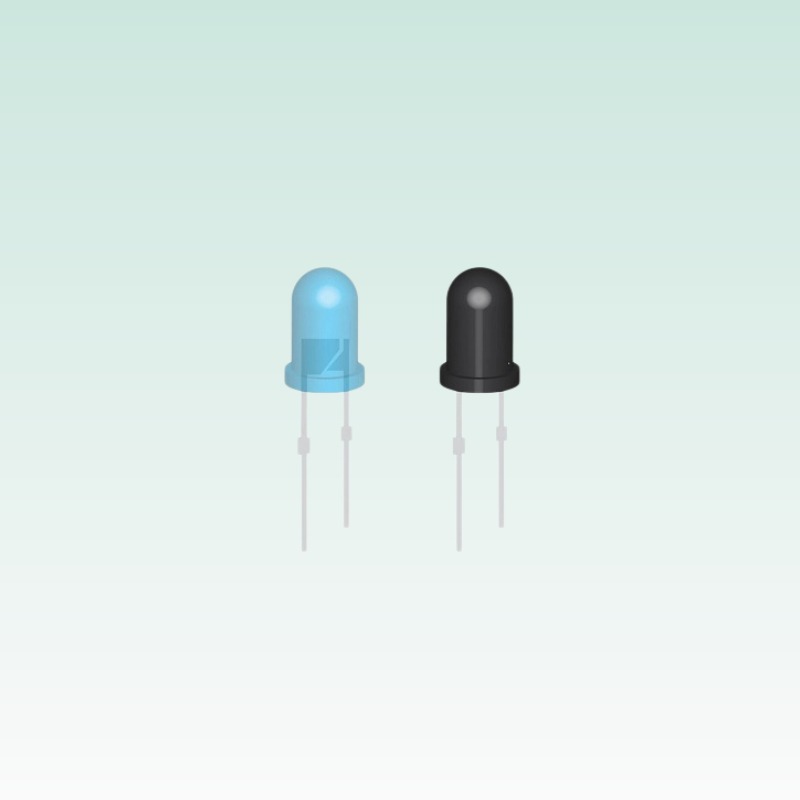
The two UVB families cover different device architectures. The J-14 3535 ceramic package with a quartz window is designed for panel arrays in whole-body or large-area devices, where its lower thermal resistance and higher per-emitter flux support the irradiance levels clinical protocols require. The J-13 3 mm device, with its lensed narrow beam and through-hole mounting, suits targeted applicators and hand-held point-treatment devices.
| Device architecture | Recommended part | Cantidad | Why |
|---|---|---|---|
| Whole-body treatment panel | J-14 3535 UVB (310 nm) | 200–600 | Flux density with manageable thermal load |
| Targeted plaque therapy | J-13 3 mm UVB (310 nm) | 5–30 | Narrow beam, small spot |
| Hand-held point applicator | J-13 3 mm UVB (275/310 nm) | 1–10 | Lensed output, low current |
| High-potency superficial device | J-14 3535 UVB (275 nm) | 50–200 | Short-wavelength action, careful dosimetry |
| Research / spectroscopic source | J-14 3535 UVB | 10–50 | Narrow FWHM, quartz window |
5.1 Distinguishing UVB from UVA and 405 nm systems
A recurring failure in procurement documents is the conflation of UVB phototherapy devices with UVA or 405 nm systems. They are different therapies with different indications, different action spectra and different safety profiles, and the emitters are not interchangeable.
| Attribute | UVB (J-14 / J-13) | UVA 365/385 nm (J-12) | UVA 405 nm (J-10 / J-11) |
|---|---|---|---|
| Wavelength band | 275 / 310 nm | 365 / 375 / 385 nm | 405 nm |
| Penetration depth in skin | Epidermis, 20–100 µm | Dermis, 100–300 µm | Dermis, 300–700 µm |
| Primary therapy use | Psoriasis, vitiligo, atopic dermatitis | PUVA, UVA1 protocols | Photodynamic activation, sensing |
| Erythema potency per unit dose | High | Low | Very low |
| Ocular hazard | High — goggles mandatory | Moderate | Lower |
| Typical device power for therapy | Low (mW/cm² at patient) | Moderate | Moderate to high |
| Interchangeable with UVB? | — | No | No |
6. Common mistakes and how to avoid them
| Mistake | Consequence | Correction |
|---|---|---|
| Treating 405 nm as a substitute for UVB | No therapeutic effect at required dose | Specify UVB emitters for UVB therapy |
| Assuming published MED applies to every patient | Erythema or underdosing | Determine MED individually or use conservative starting doses |
| Quoting emitter flux instead of patient-plane irradiance | Delivered dose unknown | Calibrate irradiance at the treatment plane |
| Uniformity ratio above 1.3:1 | Hot spots exceeding MED | Increase emitter density or add a diffuser |
| Relying on firmware timing alone | Overexposure if firmware faults | Fit an independent hardware dose limit |
| No periodic recalibration | Dose drifts as emitters age | Recalibrate at defined intervals against a reference meter |
| Standard silicone encapsulation on a UVB part | Rapid optical degradation | Use a quartz-window emitter such as J-14 |
| Ignoring ocular protection | Corneal and lens injury | Mandatory goggles; IEC 62471 classification |
7. Verification and test methods
- Spectral irradiance measurement — measure the device’s spectral irradiance at the treatment plane with a calibrated spectroradiometer, and report peak wavelength, FWHM and total UVB irradiance. This single measurement underpins dose accuracy.
- Irradiance uniformity scan — map the treatment plane on a grid of at least 5 × 5 points and report the maximum-to-minimum ratio. Repeat at the minimum and maximum working distances specified.
- Dose timing verification — measure actual delivered dose for each programmed dose level using a calibrated radiometer with dose integration, and confirm it within ±10 % of set point.
- Emitter aging and calibration interval — run an LM-80-style maintenance test on the emitter family at rated current, then set the device’s recalibration interval from the resulting depreciation rate.
- Photobiological safety assessment — classify the complete device against IEC 62471, including reflected and scattered ultraviolet within the treatment room.
- Fault-mode testing — verify that timer failure, shutter failure and firmware crash all result in termination of exposure rather than continuation.
8. Conclusion and selection guidance
UVB phototherapy devices should be designed around dose, not around emitter count or flux. For whole-body and large-area panels, J-14 3535 UVB at 310 nm delivers the wavelength and irradiance that clinical narrowband protocols assume, in a ceramic package with a quartz window that tolerates continuous UV operation. For targeted and hand-held applicators, J-13 3 mm UVB provides a compact, lensed source. Where a 275 nm variant of either part is chosen, treat the device as a higher-potency system with a narrower therapeutic window, and reduce starting doses accordingly: 275 nm sits substantially closer to the erythema action spectrum peak than 310 nm does. In all cases, verify spectral irradiance at the treatment plane, keep uniformity at or below 1.3:1, provide an independent hardware dose limit, and recalibrate at defined intervals. Never substitute UVA or 405 nm emitters into a UVB therapy device.
9. Referenced standards
- IEC 60601-1 — Medical electrical equipment: general requirements for basic safety and essential performance
- IEC 60601-2-83 — Particular requirements for the basic safety and essential performance of home light therapy equipment
- IEC 62471 — Photobiological safety of lamps and lamp systems
- ISO 15858 — UV-C devices: safety information — permissible human exposure
- IES LM-80 — Approved method: measuring luminous flux maintenance of LED light sources
- IES TM-21 — Projecting long-term lumen maintenance of LED light sources
- CIE S 007 / CIE 174 — Erythema reference action spectrum and standard erythema dose
10. Contact us
QUEENDOM supplies the J-14 3535 UVB (275/310 nm) and J-13 3 mm UVB emitters from stock, with spectral characterization data, binning statements and reference panel layouts for medical device development. Our component engineering group can provide spectral irradiance files and uniformity design guidance on request. Where devices require visible-spectrum sources for photodynamic or sensing functions, our J-12 3535 UVA (365/375/385 nm) and J-10 3 mm UVA (405 nm) parts are available separately. Contact us for samples and application support.
Related products and applications
The UV-B emitters referenced in this dosimetry paper are available in the following families.
- UV-B LED (J-14)
- UV-B LED (J-13)
- Application overview: LED components application solutions
- More technical papers: LED knowledge resources