

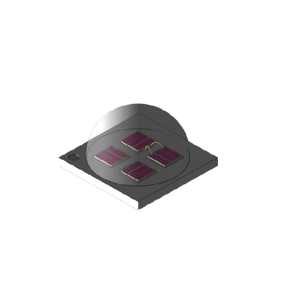
Deep ultraviolet (DUV) LED technology has emerged as a groundbreaking innovation in the field of solid-state lighting and optoelectronics. These LEDs are capable of emitting light at wavelengths shorter than 400 nanometers, making them ideal for various applications ranging from industrial processes to medical diagnostics. This article provides an in-depth introduction to the DUV LED industry, exploring its evolution, technological advancements, applications, and future prospects.
Introduction to Deep Ultraviolet LEDs
Deep ultraviolet LEDs are solid-state devices that emit light in the deep ultraviolet (DUV) region of the electromagnetic spectrum. Unlike traditional light sources, such as incandescent bulbs or fluorescent lamps, DUV LEDs are more energy-efficient, durable, and compact. The primary advantage of DUV LEDs lies in their ability to emit light at shorter wavelengths, which makes them suitable for various applications requiring high-intensity ultraviolet light.
Evolution of DUV LED Technology
The development of DUV LED technology has been a gradual process, with significant advancements made over the past few decades. Initially, researchers focused on developing gallium nitride (GaN) as a suitable material for DUV LED fabrication due to its wide bandgap and excellent optoelectronic properties. The first GaN-based DUV LEDs were developed in the late 1990s, and since then, the technology has undergone continuous improvements.
Several key milestones have been achieved in the evolution of DUV LED technology:
1. Material Development: Researchers have developed various GaN-based materials, including AlGaN and InGaN, to achieve the desired emission wavelengths. The introduction of quantum wells and multi-quantum wells has further enhanced the efficiency and performance of DUV LEDs.
2. Device Fabrication: Advances in semiconductor manufacturing processes have enabled the production of high-quality DUV LED devices. The development of epitaxial growth techniques, such as metalorganic chemical vapor deposition (MOCVD), has been crucial in achieving uniform and high-quality thin films.
3. Packaging and Cooling: Efficient packaging and cooling solutions are essential for the optimal performance of DUV LEDs. Researchers have developed various packaging techniques, such as flip-chip and direct bonding, to minimize light loss and improve heat dissipation.
Applications of Deep Ultraviolet LEDs
The unique properties of DUV LEDs make them suitable for a wide range of applications. Some of the key applications include:
1. Industrial Processing: DUV LEDs are extensively used in various industrial processes, such as curing of inks and adhesives, surface treatment, and lithography. Their high intensity and short wavelength make them ideal for achieving precise and efficient results.
2. Medical Diagnostics: DUV LEDs are used in medical diagnostics, including fluorescence microscopy, DNA sequencing, and endoscopy. Their ability to excite specific fluorescent molecules makes them valuable tools for detecting diseases and monitoring patient health.
3. Water Purification: DUV LEDs are used in water purification systems to eliminate contaminants, such as bacteria and viruses. Their high-intensity ultraviolet light breaks down the molecular bonds of these contaminants, rendering them harmless.
4. Air Purification: Similar to water purification, DUV LEDs are used in air purification systems to eliminate harmful substances, such as allergens and mold spores, from indoor environments.
5. Surface Disinfection: DUV LEDs are used for surface disinfection in healthcare facilities, laboratories, and other environments requiring high levels of cleanliness and hygiene.
Future Prospects of the DUV LED Industry
The DUV LED industry is expected to grow significantly in the coming years, driven by the increasing demand for energy-efficient and high-performance light sources. Several factors are contributing to this growth:
1. Technological Advancements: Continuous research and development efforts are being made to improve the efficiency, stability, and lifespan of DUV LEDs. The development of new materials and device structures is expected to further enhance the performance of these devices.
2. Market Expansion: The expanding applications of DUV LEDs in various industries, such as healthcare, environmental, and industrial sectors, are expected to drive the market growth. The increasing awareness of the benefits of DUV LEDs is also expected to contribute to market expansion.
3. Government Initiatives: Many governments around the world are promoting the adoption of energy-efficient technologies, including DUV LEDs, to reduce carbon emissions and improve energy efficiency. These initiatives are expected to create favorable conditions for the growth of the DUV LED industry.
In conclusion, deep ultraviolet LED technology has made significant advancements in recent years, offering numerous benefits in various applications. With continuous technological improvements and market expansion, the DUV LED industry is poised to grow exponentially in the coming years. As a result, it is essential for stakeholders to stay informed about the latest developments and trends in the industry to capitalize on the immense potential of DUV LEDs.
 English
 Afrikaans
 Albanian
 Amharic
 Arabic
 Armenian
 Azerbaijani
 Basque
 Belarusian
 Bengali
 Bosnian
 Bulgarian
 Catalan
 Cebuano
 Chichewa
 Corsican
 Croatian
 Czech
Czech Danish
 Dutch
Dutch Esperanto
 Estonian
 Filipino
 Finnish
 French
 Frisian
 Galician
 Georgian
 German
 Greek
Greek Gujarati
 Haitian Creole
 Hausa
Hausa Hawaiian
 Hebrew
 Hindi
Hindi Hmong
Hmong Hungarian
 Icelandic
 Igbo
Igbo Indonesian
 Irish
Irish Italian
 Japanese
 Javanese
 Kannada
 Kazakh
 Khmer
Khmer Korean
 Kurdish (Kurmanji)
 Kyrgyz
 Lao
Lao Latin
Latin Latvian
 Lithuanian
 Luxembourgish
 Macedonian
 Malagasy
 Malay
Malay Malayalam
 Maltese
 Maori
Maori Marathi
 Mongolian
 Myanmar (Burmese)
 Nepali
 Norwegian
 Pashto
 Persian
 Polish
 Portuguese
 Punjabi
 Romanian
 Russian
 Samoan
 Scottish Gaelic
 Serbian
 Sesotho
 Shona
Shona Sindhi
 Sinhala
 Slovak
 Slovenian
 Somali
 Spanish
 Sudanese
 Swahili
 Swedish
 Tajik
Tajik Tamil
Tamil Telugu
 Thai
Thai Turkish
 Ukrainian
 Urdu
Urdu Uzbek
Uzbek Vietnamese
 Welsh
Welsh Xhosa
Xhosa Yiddish
 Yoruba
 Zulu
Zulu
Explore More from Queendom Lamp
Stay updated with the latest LED technology, lighting solutions, and industry insights.
Request a Quote About Queendom