


Introduction to Infrared Laser Diode
What is an Infrared Laser Diode?
An infrared laser diode, also known as an infrared laser diode, is a semiconductor device that emits infrared light through the process of optical amplification. It is widely used in various fields such as medical, military, industrial, and communication. As the core component of the infrared laser diode, the semiconductor material plays a crucial role in its performance. In this article, we will introduce the basic principles, types, applications, and development trends of infrared laser diodes.
Basic Principles of Infrared Laser Diode
The infrared laser diode is a semiconductor device that uses the optical amplification principle. When the semiconductor material is excited by an external energy source, the electrons in the material will move to a higher energy level, and then return to the ground state, releasing energy in the form of photons. These photons are then amplified by the semiconductor material, forming a laser beam with a certain wavelength.
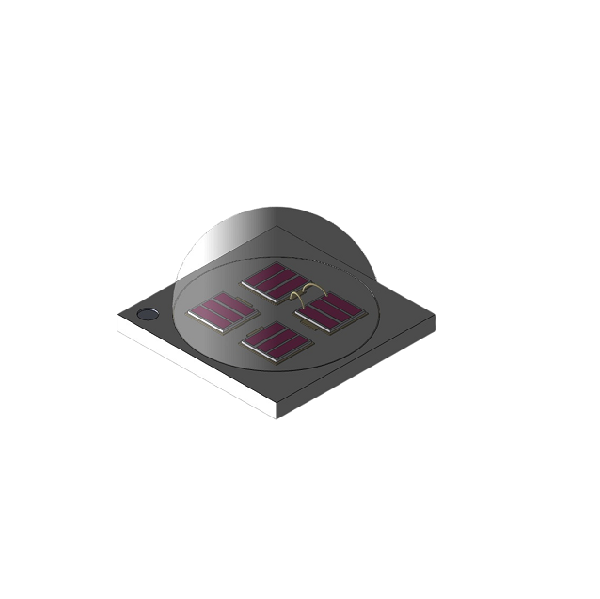
The basic structure of an infrared laser diode includes an active region, a p-n junction, and a package. The active region is the core part of the laser diode, where the optical amplification process occurs. The p-n junction is formed by the contact between the p-type and n-type semiconductor materials, which plays a key role in the generation of carriers. The package is used to protect the internal structure of the laser diode and improve its performance.
Types of Infrared Laser Diodes
According to the wavelength of the emitted light, infrared laser diodes can be divided into three types: near-infrared, mid-infrared, and far-infrared laser diodes.
1. Near-infrared laser diode: The wavelength range of near-infrared laser diodes is generally between 0.7μm and 3μm. They are widely used in optical communication, medical diagnosis, and industrial processing.
2. Mid-infrared laser diode: The wavelength range of mid-infrared laser diodes is generally between 3μm and 30μm. They are mainly used in spectroscopy, remote sensing, and environmental monitoring.
3. Far-infrared laser diode: The wavelength range of far-infrared laser diodes is generally between 30μm and 1000μm. They are mainly used in astronomy, atmospheric research, and military applications.
Applications of Infrared Laser Diodes
Infrared laser diodes have a wide range of applications in various fields:
1. Optical communication: Infrared laser diodes are used as the light source in optical communication systems, providing high-speed, long-distance transmission of information.
2. Medical diagnosis: Infrared laser diodes are used in medical instruments for diagnosis, such as endoscopy, laser surgery, and photoacoustic imaging.
3. Industrial processing: Infrared laser diodes are used in industrial processing applications, such as laser cutting, welding, and marking.
4. Military and aerospace: Infrared laser diodes are used in military and aerospace fields, such as target acquisition, range finding, and laser guidance.
5. Environmental monitoring: Infrared laser diodes are used in environmental monitoring equipment for detecting and analyzing atmospheric pollutants.
Development Trends of Infrared Laser Diodes
With the continuous development of technology, the requirements for infrared laser diodes are increasingly stringent. The following are the main development trends of infrared laser diodes:
1. High power and high brightness: To meet the needs of various applications, the power and brightness of infrared laser diodes are constantly improving.
2. Wide wavelength range: To expand the application fields of infrared laser diodes, the development of wide wavelength range laser diodes is necessary.
3. Low threshold and high efficiency: The optimization of the semiconductor material and structure design can reduce the threshold of infrared laser diodes and improve their efficiency.
4. Miniaturization and integration: The miniaturization and integration of infrared laser diodes can reduce the volume and weight of the equipment, making it more convenient for use.
5. High reliability and stability: The reliability and stability of infrared laser diodes are crucial for ensuring the stable operation of the system.
In conclusion, infrared laser diodes have wide application prospects in various fields. With the continuous development of technology, the performance and application of infrared laser diodes will be further improved, bringing more benefits to human society.
 English
 Afrikaans
 Albanian
 Amharic
 Arabic
 Armenian
 Azerbaijani
 Basque
 Belarusian
 Bengali
 Bosnian
 Bulgarian
 Catalan
 Cebuano
 Chichewa
 Corsican
 Croatian
 Czech
Czech Danish
 Dutch
Dutch Esperanto
 Estonian
 Filipino
 Finnish
 French
 Frisian
 Galician
 Georgian
 German
 Greek
Greek Gujarati
 Haitian Creole
 Hausa
Hausa Hawaiian
 Hebrew
 Hindi
Hindi Hmong
Hmong Hungarian
 Icelandic
 Igbo
Igbo Indonesian
 Irish
Irish Italian
 Japanese
 Javanese
 Kannada
 Kazakh
 Khmer
Khmer Korean
 Kurdish (Kurmanji)
 Kyrgyz
 Lao
Lao Latin
Latin Latvian
 Lithuanian
 Luxembourgish
 Macedonian
 Malagasy
 Malay
Malay Malayalam
 Maltese
 Maori
Maori Marathi
 Mongolian
 Myanmar (Burmese)
 Nepali
 Norwegian
 Pashto
 Persian
 Polish
 Portuguese
 Punjabi
 Romanian
 Russian
 Samoan
 Scottish Gaelic
 Serbian
 Sesotho
 Shona
Shona Sindhi
 Sinhala
 Slovak
 Slovenian
 Somali
 Spanish
 Sudanese
 Swahili
 Swedish
 Tajik
Tajik Tamil
Tamil Telugu
 Thai
Thai Turkish
 Ukrainian
 Urdu
Urdu Uzbek
Uzbek Vietnamese
 Welsh
Welsh Xhosa
Xhosa Yiddish
 Yoruba
 Zulu
Zulu
Explore More from Queendom Lamp
Stay updated with the latest LED technology, lighting solutions, and industry insights.
Request a Quote About Queendom