
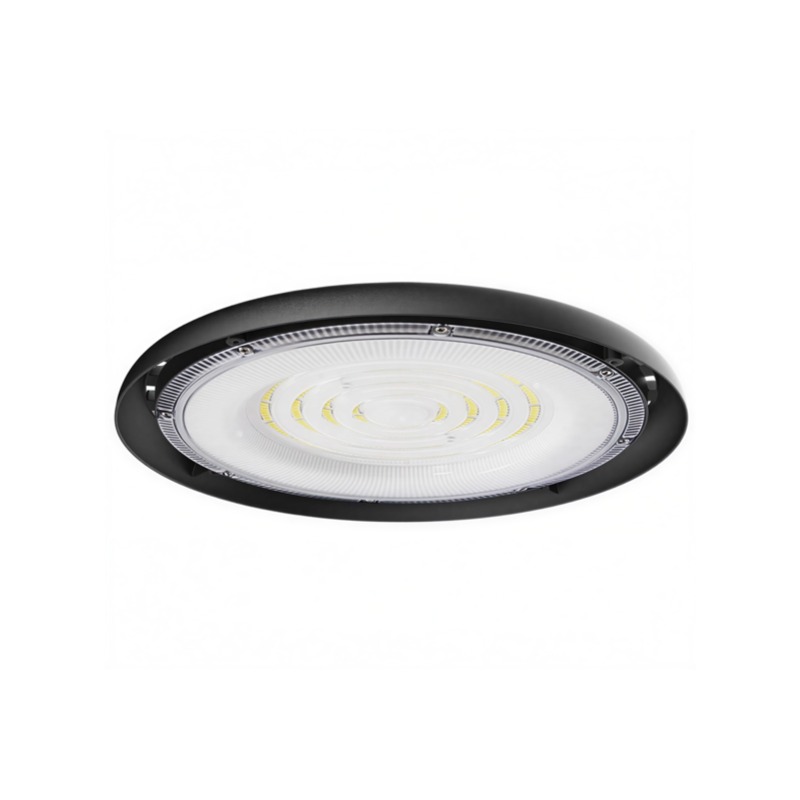
For large-scale industrial warehousing, energy consumption is often one of the highest overhead costs. Retrofitting traditional High-Pressure Sodium (HPS) or Metal Halide (MH) fixtures with modern LED High Bay systems is no longer just an environmental choice—it is a critical financial strategy.
1. Massive Increase in Luminous Efficacy
Modern LED High Bays deliver significantly higher lumens per watt compared to legacy systems. While an older MH lamp might hover around 70-90 lm/W (and degrade rapidly), high-quality warehouse LEDs often exceed 150-190 lm/W. This transition typically results in an immediate reduction of energy consumption by 50% to 70%.
2. Advanced Thermal Design and Longevity
The efficiency of a warehouse lighting system is also tied to its maintenance cycle. Legacy bulbs require frequent replacement and suffer from “lumen depreciation.” LEDs, designed with advanced finned heat sinks, maintain over 90% of their light output for up to 50,000–100,000 hours, virtually eliminating maintenance labor costs.
3. Integration with Smart Controls
The true “efficiency multiplier” in warehouse retrofitting is the use of motion sensors and daylight harvesting. Because LEDs are instant-on and dimmable, they can be programmed to operate at 10% capacity in empty aisles and 100% only when activity is detected. This smart integration can push total energy savings toward 80%.
ROI Analysis
Most industrial retrofits see a full Return on Investment (ROI) within 12 to 24 months based on energy savings alone. When considering reduced HVAC load (as LEDs produce less waste heat) and zero maintenance costs, the long-term operational efficiency is unparalleled.

 English
 Afrikaans
 Albanian
 Amharic
 Arabic
 Armenian
 Azerbaijani
 Basque
 Belarusian
 Bengali
 Bosnian
 Bulgarian
 Catalan
 Cebuano
 Chichewa
 Corsican
 Croatian
 Czech
Czech Danish
 Dutch
Dutch Esperanto
 Estonian
 Filipino
 Finnish
 French
 Frisian
 Galician
 Georgian
 German
 Greek
Greek Gujarati
 Haitian Creole
 Hausa
Hausa Hawaiian
 Hebrew
 Hindi
Hindi Hmong
Hmong Hungarian
 Icelandic
 Igbo
Igbo Indonesian
 Irish
Irish Italian
 Japanese
 Javanese
 Kannada
 Kazakh
 Khmer
Khmer Korean
 Kurdish (Kurmanji)
 Kyrgyz
 Lao
Lao Latin
Latin Latvian
 Lithuanian
 Luxembourgish
 Macedonian
 Malagasy
 Malay
Malay Malayalam
 Maltese
 Maori
Maori Marathi
 Mongolian
 Myanmar (Burmese)
 Nepali
 Norwegian
 Pashto
 Persian
 Polish
 Portuguese
 Punjabi
 Romanian
 Russian
 Samoan
 Scottish Gaelic
 Serbian
 Sesotho
 Shona
Shona Sindhi
 Sinhala
 Slovak
 Slovenian
 Somali
 Spanish
 Sudanese
 Swahili
 Swedish
 Tajik
Tajik Tamil
Tamil Telugu
 Thai
Thai Turkish
 Ukrainian
 Urdu
Urdu Uzbek
Uzbek Vietnamese
 Welsh
Welsh Xhosa
Xhosa Yiddish
 Yoruba
 Zulu
Zulu
Explore More from Queendom Lamp
Stay updated with the latest LED technology, lighting solutions, and industry insights.
Request a Quote About Queendom